
A Movement in a Word: Scanning the Impact of “Required” vs. “Recommended”
by Chasidy Rae Sisk
Debate has raged between shops and insurers regarding the necessity of performing OEM procedures – particularly when the vehicle manufacturer identifies a procedure as “recommended,” instead of “required.” But does a mere shift in semantics really make that much of a difference?
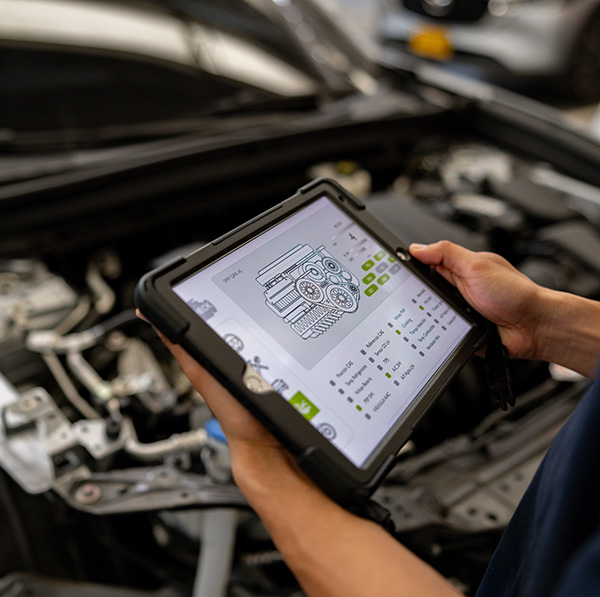 A Scanning Case Study
The trajectory taken by scanning requirements provides strong evidence that makes all the difference. It began when multiple vehicle manufacturers took a stand…and started a movement.
Although OEMs began incorporating advanced technology in their vehicles in the 1990s, few position statements were issued about the need for scanning until 2016 when manufacturers began declaring the necessity of scanning every vehicle before and after the repair. Over the past decade, position statements on scanning have been issued by a majority of popular vehicle manufacturers. Although earlier iterations often recommended pre-repair scans while requiring post-repair scanning, current versions reflect the necessity of both.
Ford requires a pre-repair scan on all model year 2010 and forward vehicles, adding, “The vehicle must have a post-repair diagnostic scan completed after the vehicle has been repaired to verify that new faults have not been introduced in the course of the repair and to verify that the vehicle has been fully repaired.” General Motors agrees that vehicles “must be tested for Diagnostic Trouble Codes (DTCs) during the repair estimation in order to identify the required repairs. Additionally, the vehicle must be retested after all repairs are complete in order to verify that the faults have been repaired and new faults have not been introduced during the course of repairs.” FCA, Kia, Mopar, Subaru, Toyota and Volvo all concur that pre- AND post-repair scanning is required, though some use synonyms such as “imperative” or “necessary.”
This past summer, both Honda and Hyundai strengthened their pre- and post-repair scan recommendations by updating their position statements to reflect that scans are required; however, several manufacturers have not taken slightly different stances. Jaguar/Land Rover and Mercedes-Benz recommend pre-repair scans but require post-repair scans. Nissan/Infiniti follows suit on 2008 and newer vehicles – with the caveat that post-repair scans are merely recommended on their 1996-2007 vehicles. Mazda still “recommends that all vehicles being repaired for collision damage be scanned before and after the repair.”
Did a simple revision of position statements actually impact shops’ activities though? A review of the “Who Pays for What?” Scanning and Calibration surveys, compiled yearly by Collision Advice and Crash Network as part of their quarterly industry series, suggests it could make a significant impact, based on responses from body shops nationwide.
The 2016 survey indicated that shops were pre-scanning vehicles 31 percent of the time and performing a post-repair scan 50 percent of the time (on average). Those numbers increased slightly by 2018 with just over 40 percent of shops performing pre-repair scans all/most of the time and around 55 percent scanning after most/all repairs. Over 90 percent of 2022 survey respondents reported performing both scans on most/all vehicles, and that has jumped to 96 percent of shops pre-scanning while 98 percent perform post-repair scans according to the most recent Scanning and Calibration survey, conducted in 2024.
The “Who Pays for What?” surveys also seem to indicate the strengthened verbiage in OEM position statements also holds sway with insurers. In 2016, just 41 percent of shops reported being paid all/most of the time for pre- and post-repair scans, a number that had remained relatively flat over the past year’s survey – but it didn’t remain flat for long as that number nearly doubled by 2018, reaching 80 percent. Insurers typically reimbursing for pre-repair scans increased to 88 percent in the 2022 survey and to 90 percent by 2024; the number of insurers paying for post-repair scans all/most of the time remained consistent at 91 percent in both sets of results.
It will be interesting to see if the recent “required” declarations made by Honda and Hyundai impact future results. (The 2025 “Who Pays for What?” Scanning and Calibration survey is open now; crashnetwork.com/collisionadvice.)
But What About OEM “Recommendations”?
While the previous case study suggests a correlation between the use of “required” and both shops and insurers adapting, a large amount of documented OEM procedures still include a mere “recommendation,” often creating friction between the insurance carrier and the collision repair facility.
For years, collision industry leaders have preached that recommended procedures are still necessary; regardless of whether the OEM recommends or requires something, failure to do so could compromise the safety of the vehicle in a subsequent accident, creating liability concerns for the shop that performed the repairs. This was demonstrated during the infamous John Eagle lawsuit when a shop’s decision to repair the roof of a 2010 Honda Fit using adhesives instead of welding as recommended by the manufacturer led to a $42 million verdict against them.
In 2023, Rhode Island legislators voted to amend the state’s Unfair Claims Practices Act, which now explicitly calls upon insurers “to acknowledge and compensate an auto body repairer for documented procedures identified as required or recommended by the original equipment manufacturer, or paint manufacturer, upon the initial request from the auto body shop, such as, but not limited to, post collision procedures and components that should not be reused or reinstalled, when included in the repairer’s appraisal, or when requested by the repairer” [emphasis added]. Several other states have introduced similar legislation in recent legislative sessions.
“Consider it a requirement whether they’ve used that word or not,” attorney Erica Eversman (Vehicle Information Services) has said many times, observing that OEMs use the verbiage in question “for legal reasons, [but] you can pretty well equate that with a standard.”
Collision Advice’s Mike Anderson has explained on numerous occasions that the variation is often cultural with Asian brands defaulting to “recommendations” based on social etiquette
A position statement from the Society of Collision Repair Specialists (SCRS) indicates, “It remains SCRS’ position that if an OEM documents a repair procedure as required, recommended or otherwise necessary as a result of damage or repair, that those published procedures would be the standard of repair until such time the documentation changes. Disregarding a documented procedure that is made available to the industry creates undue and avoidable liability on the repair facility performing the repair.”
Vehicle manufacturers agree.
“If we’re saying we ‘recommend’ this, that recommendation is coming from a better understanding of the vehicle structure, the materials used and the process of reconstruction than a mere opinion of ‘I can just do it this way,’” Mark Allen (Audi) has pointed out. “OEM procedures aren’t opinions or some sort of black magic; they are tested processes that we’ve developed based on factual data and evidence. Repair procedures are developed from a point of research that includes understanding the vehicle structure and how it was engineered, not simply because someone thinks it’ll work.”
“Recommended procedures should be done. Ultimately, it is to the benefit of the customer and could save the insurance carriers rental costs by catching potential issues early,” Benito Cid (Mercedes-Benz) expressed.
So, why not just call a spade a spade? If manufacturers expect recommended procedures to be performed, courts equate the two terms in enacted legislation and industry leaders insist the words are the same, it would be ideal if shops and insurers would unilaterally recognize the need to repair all vehicles according to OEM procedures – regardless of whether that procedure is required or recommended.
Since the coming together of these two industries seems unlikely, an alternative may be OEMs following their own example and explicitly requiring their procedures to ensure vehicle owners are consistently receiving safe and proper repairs.
Want more? Check out the November 2025 issue of Hammer & Dolly!