

ABAT’s Jill Tuggle Leads Critical Discussions at CIC
by Alana Quartuccio
The July Collision Industry Conference (CIC) held in Philadelphia was the first of its kind with all committees centering their discussions around the growing trend of total loss.
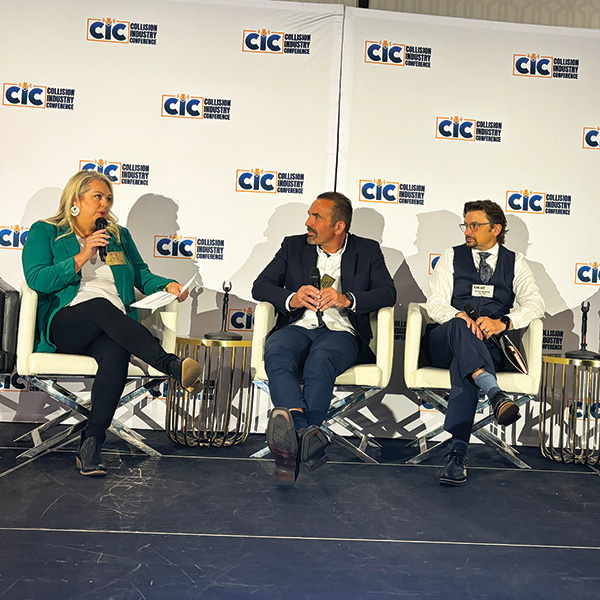 ABAT’s Jill Tuggle led the Governmental Committee in an exploration of total loss and salvage vehicle laws at the state level. There’s no universal definition for total loss or salvage, Tuggle stated, adding “every state makes its own definitions or uses different terms, and each state has different rules for salvage vehicles.” Iowa has a state total loss threshold of 70 percent, although it’s still in the insurer’s hands to determine if a vehicle is a total loss even if under 70 percent. Rhode Island is the only state that gives the customer the right to determine if they want their vehicle repaired below an 80 percent threshold. In Pennsylvania, every total loss vehicle gets a salvage title.
Via a panel including Stephen Madrak (Pennsylvania Department of Transportation Motor Vehicles), local shop owner Max Keller (Conestoga Collision and Auto Body Repair; Berwyn, PA) and David Willett (SPARK Underwriters), discussion focused on consumer safety and the qualifications for determining if a vehicle is eligible for the reconstructive process.
“We have an enhanced safety program in Pennsylvania that ensures that the post-repair vehicle is on-the-road worthy and branded properly so the consumer is aware of the history of the vehicle,” Madrak explained.
Most people aren’t familiar with the laws in their state, and therefore, states could do a better job at educating people on those laws, Tuggle noted. As a shop owner in Pennsylvania, Keller reported seeing about 50/50 total loss versus repairable. As for handling the customer when their car is deemed a total loss, “These days, the insurance companies are beating us to that conversation and totalling the car before we are even notified,” he claimed. “We will try to let the customer know there may be a chance, and we will try to prepare them for that conversation and suggestions on how to work out the value.”
Willett gave some food for thought, suggesting OEs start to play a bigger role in the areas of total losses. “OEs come up with ways to repair the car; should they be coming up with ways on how to total a car? It seems to me that it should be more reliant upon the manufacturers’ engineers and certified repairers to make that [total loss] determination. Some are saying that there are vehicles that could be repaired. It seems like we’re missing an opportunity to use the expertise and knowledge of the OEs. I believe that for the betterment of our industry, that’s something that should be explored.”
Later, during the open mic session, Tuggle set out to make sure the industry’s concerns about I-CAR’s recent actions were heard loud and clear.
“We are super grateful for all that I-CAR does for this industry, but there’s a critical component that continues to be overlooked, and that’s the voice of the independent collision repairer,” voiced Tuggle. “Recently, we were made aware of a situation where I-CAR determined that association leaders are not eligible for a seat on their Board. We wholeheartedly disagree with that sentiment, especially because we really are the voice of independent shops and small MSOs.”
Tuggle expressed her extreme disappointment over having received an “automatic response” to the concerns she expressed in writing. “It didn’t address any of the issues that I had brought up, including the amendment of their bylaws to uphold the opinions of the Board on the director being ineligible.”
Tuggle’s frustrations were echoed by several fellow independent repair professionals who took to the mic to call the canned response disheartening and discouraging.
Amber Alley (Barsotti’s Body and Fender; CA) called the lack of communication disturbing. “After they denied or determined that [Society of Collision Repair Specialists’] (SCRS) Aaron Schulenburg’s nomination wouldn’t move forward and they decided to change the bylaws, there were comments made that they didn’t have any other nominees. That’s not true. I had made it clear that I intended to run for the independent repairer position after I completed my [SCRS chairperson] role.” She added that she was discouraged she wasn’t contacted and that I-CAR did not seek to fill the seat with an independent repairer.
Washington Independent Collision Repairers Association President Justin Lewis echoed the sentiments. “I look around the room and see tons of associations represented here. To Jill’s point, the associations are not just one voice; they are the voice of a collective group of shops.”
SCRS Chairman Michael Bradshaw accused I-CAR of not listening. “The fact that we sent that letter and nobody’s reached out to me should show everybody in the room how tone deaf you guys have become to what the independent repairers need. They need you to be what you’re supposed to be, but you’re too busy catering to big money!”
I-CAR CEO and President Kyle Thompson took the mic to admit, “We could’ve done better, and that lands certainly on me,” regarding the canned response sent. Addressing the issue regarding Schulenburg, he insisted, “Bringing on somebody who represents many different entities changes the balance and runs the risk of altering the way the Board’s votes stack up; that is the reason the associations aren’t allowed. You can disagree with it. I have shared the information, and the Board is well aware [and could] choose to address it through the government process. They have seen the letters and the feedback, so we’ll see what happens down the path.” Thompson also claimed I-CAR didn’t receive additional nominations.
Thompson’s claim seems incongruent with the way a governance board works in general; Board members are tasked with representing the interests of stakeholders in making organizational decisions, and regardless of how many stakeholders an individual Board member represents, each Board member still only gets ONE vote. I-CAR appears to recognize this fact by allowing Board seats to be filled by executives from General Motors, Nissan and Ford who each represent thousands of dealerships nationwide as well as Caliber Collision and CARSTAR/Driven Brand representatives who vote on behalf of thousands of MSO locations across the country. Yet, independent repairers’ voices are restricted to just one shop owner. Logic dictates that filling a Board seat with someone (like Schulenburg) who can speak on behalf of a larger number of independent repairers would establish more balance on the Board by giving independents the same consideration that their OEM and MSO counterparts receive.
Jeff Hendler continued to challenge I-CAR on their stance. “If you don’t recognize the voice of the independent repairer, you’re going nowhere. Aaron is probably the ultimate voice of the independent repairer. I-CAR comes to SCRS meetings at least twice a year asking questions to try to gain knowledge, and yet when the time came to step up and have the one voice that was needed you found some BS, for lack of a better term, to eliminate it. All of your statements today about the Board, the makeup of the Board and all of that goes by the wayside when you’re not listening to the collision repairer. I’ll go back some 40 years and tell you that was the goal then, and it should be the goal now.”
Schulenburg took the mic to acknowledge the comments made by his fellow industry colleagues and to address I-CAR’s actions.
“You’re acknowledging, but you’re not listening,” Schulenburg told Thompson, adding that 35 emails could have been easily addressed with phone calls. He also refuted Thompson’s insistence that filling a single Board seat with one independent repairer is proper representation. He pointed out that the Board has “a fourth seat that’s undefined,” and despite the industry making their discontent and frustrations with I-CAR leadership known, I-CAR chose to just say “we have one independent repairer, we don’t need any more [instead of] being thoughtful and identifying somebody else who could also represent the independent body shop.
“When you shut the industry out, this is where it unfolds,” Schulenburg added. “You have all these people in the industry telling you ‘we believe in I-CAR’s potential,’ but I-CAR is not listening. We need you to do better.”
Want more? Check out the September 2025 issue of Texas Automotive!
>