

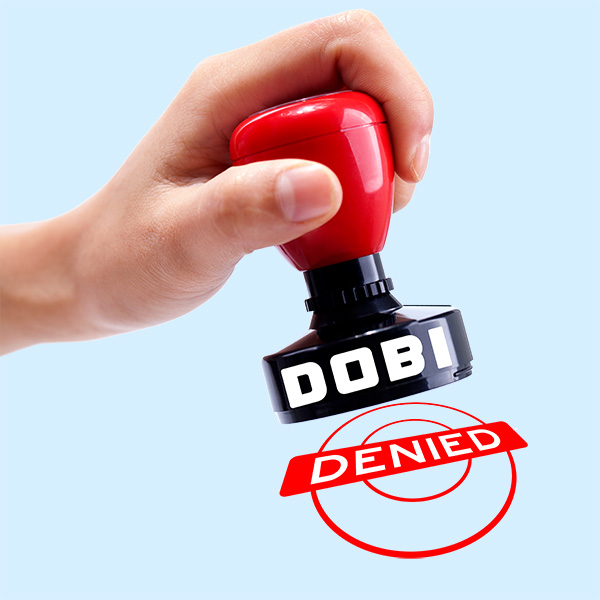
DOBI Rubberstamps Insurers, Rejects Collision Data
by Chasidy Rae Sisk
What should have been a pretty standard total loss claim turned into a yearlong debate about data credibility…a debate that made it crystal clear where the New Jersey Department of Banking and Insurance’s (DOBI) loyalties lie!
 It all began on December 17, 2024 when a customer towed her 2014 Jeep Cherokee to DJ’s Restoration (Trenton). Three days later, Allstate’s adjuster inspected their policyholder’s vehicle, writing an estimate for just under $3,500; however, when the shop disassembled the vehicle and discovered additional damage, their blueprint predicted it would cost $11,608.51 for repairs, putting the vehicle over the threshold and causing it to be deemed a total loss.
Although Allstate refused to communicate with the shop directly, they informed the customer of their refusal to pay for storage past January 10. Through that date, the shop’s invoice for total loss charges came to just over $5,000. With no negotiation attempts from Allstate, DJ’s Restoration reached out to the appraiser on January 14 to discuss the total loss charges, even offering to waive a portion of the storage charges in order to settle the claim, but receiving no response to this message or subsequent escalation attempts to the claim supervisor – in which he provided documentation via National AutoBody Research’s (NABR) BillableGenie, which proved Allstate had previously paid those same charges – shop owner Danny Brandt felt he had no choice but to file a complaint with DOBI as the month ended.
In March, he received a response from DOBI Supervisor of Investigations Robert Palentchar indicating that Allstate maintained “its position that it has made good faith offers to reimburse [the] shop for reasonable fees and storage charges based on a review of publicly available information.” The information in question? Discounted towing and storage rates for the New Jersey State Police provided by the Garden State Towing Association (via gsta.org/state-police-rates). “Those companies are under contract and agreed to accept those rates, but we didn’t sign any such contract and shouldn’t have to accept rates someone else agreed to,” Brandt points out.
Allstate also cited information obtained from eCode 360 (though they did not provide the specific code they were referencing), and according to Palentchar’s email, “Data from multiple New Jersey boroughs reveals the maximum amount that can be charged for storage averages approximately $36.14 per day for storage.” Although he requested documentation to refute Allstate’s claim that they had negotiated from $75 daily storage to $100, Palentchar warned, “Keep in mind there are no insurance regulations governing such fees.”
Brandt pushed back, insisting that Allstate’s negotiation attempts were minimal and that the “last person we spoke with did not offer to pay our posted rate of $100 per day storage, the tow to retrieve this vehicle, the pre-scan, the vehicle damage analysis and the blueprinting fee.” Brandt expressed concern that the policyholder still had not received her settlement three months after her vehicle was deemed a total loss: “It seems Allstate is attempting to abandon this vehicle without reimbursing its policyholder.”
He also contested the “evidence” Allstate shared, noting that DJ’s Restoration is “not a storage facility; we are an auto body repair facility, therefore, I am certain there is no ‘state limit’ […] Everything we have billed for is not only an industry standard, usual and customary, but has been proven to Allstate with documentation that it has all been paid for [on previous claims].” He evidenced this assertion by providing proof from NABR that his shop had been paid these charges by Allstate and other insurance companies in the recent past.
That evidence got him no where as Palentchar responded over a week later – after seeking feedback from the insurer – that “Allstate’s position remains unchanged as it continues to maintain it offered to pay a fair and reasonable amount to settle the claim with its final compromised offer of $3,500” (around $1,000 above their original offer but barely half of the $7,000 owed to the shop after three months of storage)!
“Our posted rate was $100 and has been that for at least a decade, but Allstate wanted to pay $75,” Brandt recalls, calling the insurer’s negotiation attempts “nominal. By March, we had accrued around $7,000 in total loss fees, and even when we offered to negotiate our invoice down to $5,000 with their total loss department, they refused to budge past $3,500.”
Furthermore, Palentchar’s email demonstrated a concerning trend that won’t come as a surprise for many Garden State collision repair facilities. While the DOBI supervisor blindly accepted irrelevant and vague data from Allstate as “evidence” of reasonable rates, he completely disregarded Brandt’s provided proof, blindly accepting the insurer’s assertion that “the data provided from ‘BillableGenie’ is not accurate nor consistent with its records as to actual amounts paid.”
Neither Allstate nor DOBI offered any evidence to justify this claim, but this seems to be standard practice, according to Brandt. “DOBI just rubberstamps wherever the insurer says,” he laments. “Allstate claims they were willing to negotiate and we weren’t, and although we take the opposite stance, DOBI takes their word over ours. Then we provided proof that Allstate has paid our shop these rates for these items, and since they say the data isn’t accurate, DOBI just passes that message along and closes the complaint.”
With the vehicle still sitting in his lot when October rolled around, Brandt reached out to DOBI again, sharing more documentation from BillableGenie, “a reputable auto body tool, showing that the disputed charges are usual and customary. Allstate has not only paid these charges on 28 other claims in New Jersey but also directly to our shop, DJ’s Restoration, on October 3, 2024 and most recently on September 3, 2025.
“NABR verifies all data and payments made, and its accuracy has been upheld in court as reflecting the true cost of repairs unlike closed-door contracts that fail to represent the prevailing competitive price,” Brandt defended his data, explaining that BillableGenie’s total loss data cannot be manipulated since it’s based on final invoices and requires proof of payment to be entered into the system.
BillableGenie is part of the Collision PowerPak provided by NABR, a suite of online software tools designed to arm shops with valuable data to help ensure they’re being fairly compensated for work performed. NABR President Sam Valenzuela graciously gave New Jersey Automotive a demo of BillableGenie, explaining that for total loss documentation, shops are required to submit a detailed final invoice that breaks down all charges, such as administrative, disassembly and gate fees, along with evidence of payment to prove they received the full amount of their invoice.
Valenzuela navigated BillableGenie to review the data that Brandt had provided, revealing multiple instances where Allstate had paid similar fees to what had been denied to DJ’s Restoration and sharing evidence that payment was remitted for those charges. “Although Allstate says these numbers aren’t accurate based on their records, multiple shops were paid for the same total loss charges in New Jersey,” Valenzuela points out, observing DOBI’s hypocrisy in accepting Allstate’s unsubstantiated “public data” which “leaves more questions than answers.”
That’s not to say that Valenzuela believes his software provides all the answers; he acknowledges that it was developed as a tool to aid shops, not to solve all their problems. “A lot of shops have been able to leverage information from BillableGenie to help negotiate for needed items that insurers don’t want to pay for,” Valenzuela shares. “It’s obviously not an easy button – nothing in this industry is! Insurers are making it incredibly difficult for shops to collect on a lot of stuff; even when a shop shows the insurer its own data that proves they’ve paid for those items before, the carriers still fight it.”
Clearly, the real problem in question has nothing to do with NABR’s substantiated figures. “This is yet one more case (out of thousands and thousands nationwide) of insurers refusing to pay for usual and customary charges by shops, and they have a whole series of word tracks that are just another way to say ‘NO,” Valenzuela suggests.
He remains unruffled by DOBI’s decision to take Allstate’s “absurd assertions” at face value. “The burden of proving they didn’t pay for those items should fall on Allstate, but we all know that inventing new ways to say ‘no’ is simply how insurers operate. I don’t know how deeply DOBI investigated Allstate’s statements, but I know they didn’t call us to help them uncover the truth. And based on what I’ve heard from shops all over the country, it seems like DOBI did what a lot of DOIs do – they went through the motions and pushed some paper instead of conducting a real investigation, and then they passed along whatever the insurer said.”
Through these actions, DOBI and other states’ insurance departments “don’t seem to provide much help to shops or consumers,” Valenzuela observes. “They appear to merely accept the statements of insurers – without really digging deeply into the matter beyond making some surface level inquiries – parrot back the response to the shop, then close the case on the grounds that there’s nothing they can really do about it. This serves as a good example of why regulators are not the solution to this industry’s massive problem of shops not getting paid for all their work at adequate rates.”
Brandt agrees and expresses his concern that “DOBI’s deference to unsupported statements sets a troubling precedent. It seems as though any assertion an insurance company makes – no matter how implausible – would apparently be accepted by DOBI without scrutiny. In this case, Allstate has merely stated that BillableGenie is ‘not accurate,’ yet has offered no supporting documentation or proof. That is not due process nor is it fair to New Jersey consumers. We’re not sure what it’s going to take to get DOBI to actually assist the consumer rather than protect the insurance companies.”
Brandt is not the only Garden State shop owner who feels DOBI’s priorities should be reevaluated.
“If Allstate told DOBI it was raining, snowing and 100 degrees with thunderstorms inside their office all at the same time, DOBI would accept it without question,” AASP/NJ Collision Chairman and Immediate Past President Jerry McNee weighs in, expressing “no surprise that Allstate would lie about the vetted accuracy of NABR’s data. DOBI’s decision to uphold Allstate’s statement shows exactly where their loyalty lies – with the insurance companies, not New Jersey consumers.”
In fact, McNee has sounded this alarm many times in the past, yet “despite citing DOBI’s own regulations in multiple complaints, not a single violation has ever been found, and not one insurer has been held accountable. Insurers routinely provide nothing more than self-serving statements – without evidence – while documented, factual proof from consumers and repair shops is disregarded. This completely undermines transparency and consumer protection, so who’s the repair expert?
“Behind the scenes, insurers have long pushed the narrative that they’re losing money and need rate increases. They use fear tactics and invoke the ‘Cost Reduction Act’ to pressure DOBI – claiming that holding them accountable would harm consumers through higher premiums. This is nothing more than half truths and fear,” McNee adds. “DOBI is supposed to protect New Jersey consumers, yet it continues to turn a blind eye – accepting insurers’ statements at face value while disregarding factual data from those directly affected. The result is a hidden burden on consumers, who face unexpected out-of-pocket expenses and unpleasant surprises.
“Is this the insurance promise that policyholders were sold?” he asks. “This isn’t consumer protection – it’s corporate protection.”
The situation at DJ’s Restoration seems to justify this belief as the shop is left holding the bag with an invoice that has increased to over $30,000 due to nearly a year’s worth of storage charges on the abandoned vehicle. New Jersey Automotive’s interview request went unanswered by DOBI’s Robert Palentchar.
“The fact that an insurer can simply make statements to the Department of Banking and Insurance (DOBI) without providing factual proof undermines transparency and consumer protection,” Brandt points out. “By rubber-stamping Allstate’s response without requiring evidence, DOBI has failed to protect the public interest. At a minimum, clarification should be required when one party presents verified data and the other offers nothing but unsupported denial. Otherwise, this process does not serve consumers but instead shields insurers from accountability while passing the cost on to consumers who ultimately pay the price.”
Want more? Check out the November 2025 issue of New Jersey Automotive!