

AASP/NJ Event Offers Wealth of Financial Tactics for Business Owners
by Alana Quartuccio
Collision and mechanical repair shop owners have so much to contend with they may not easily find the time to think about the fundamentals of their business beyond the everyday.
 But the fact of the matter is that business finances can be quite complex. Everything from payroll to exit planning and everything in between should be given regular consideration in order to maintain good financial health.
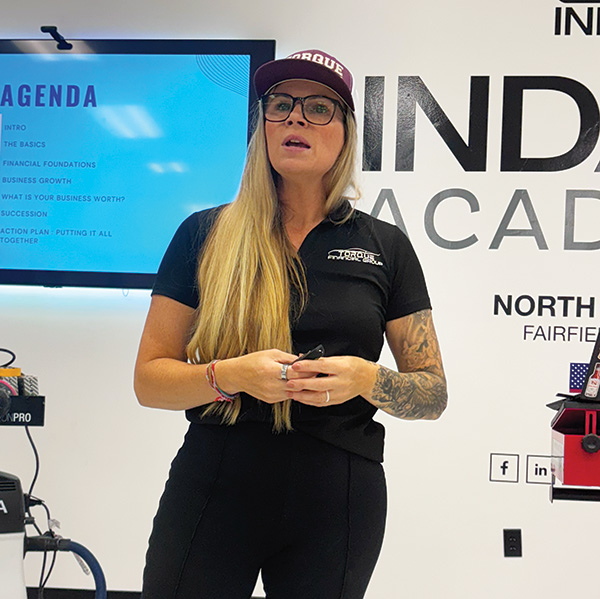
Last month, AASP/NJ welcomed Rachel James of Torque Financial Group to lead a comprehensive discussion geared toward business owners and their principal team members at INDASA USA Training Academy (Fairfield) that left them with a deeper understanding of how to maximize their company finances.
James – a former technician and former major paint manufacturer employee turned financial advisor – stressed just how many components play a role in a healthy financial picture. It’s not something that shines by slapping on a layer of clearcoat.
It may have started with how they got into the industry; many may have grown into the family business or started as technicians and estimators before opening their own shop.
“For most of us who get into the business, we learn the hard way,” she acknowledged. “You sort of build this quilt of things around you in your business. For example, your employees may be asking for a 401(k) plan, so when a random 401(k) plan representative knocks on your door, you decide to go with them. Perhaps the bookkeeper you work with is someone your uncle referred to and is the person you just always used. It can be so difficult to run a business that it can often be hard to really reevaluate all these different people in your business because there’s all these other fires that you’re putting out at any given time.”
James illustrated the process of starting out and the appropriate steps that should be taken along the way toward growth and eventual exit planning.
“The more you observe your finances, you’ll start to get better performance, and that is true of everything in our life, right? The more you monitor and track things, the better you’ll see.”
She encouraged establishing relationships with one’s bank or an accountant to regularly review finances because it really “takes a village” to make finances work well for one’s business.
Once a business is established and is sustaining a profit, “we get to the place where you want to maintain, and that’s usually after the 10-year mark. That’s the right time to start looking at whether you have the right benefits in place or who is your CPA. Who are your board of directors? Who are the people that help you make decisions and who will help you build this out like a real official sparkling business? Next comes exit planning. Whether it’s a family member or to a third party, one should at a minimum start [thinking about it] five years out. That may sound shocking, but five years out, you really should identify the successor, figure out the logistics of that arrangement and start working on the estate team and tax team and people to get there.”
Doing the research and understanding what options may be available to businesses is another key toward healthy finances. James pointed to various tax write-offs related to owning property and purchasing new equipment that are available to shops as per the passage of the federal Big Beautiful Bill many may not be aware of.
James got attendees to think about offering incentives to key employees to keep them on board long-term and about “perfect world” SOPs to consider. “Make sure that you have a personal emergency fund and one for your business and that each has three months of expenses in cash.”
She pointed out how some business owners may find comfort in numbers when, for example, they have a million dollars in their checking account, but “that’s inefficient. You’re not making any money on that. High yield savings accounts are a great opportunity.”
Building investments outside of the business is key to one’s personal financial growth.
“A business is not necessarily a wealth-generating asset, but it is an income-generating asset,” she reminded all. “The value of your business is really determined upon who’s willing to buy it. You could have the most beautiful shop with a floor you could eat off of and all the best equipment, but if you’re geographically in a place where no one wants to buy your shop or you can’t find a buyer, there is no value in the business. So, as a business owner, make sure you’re taking money out of your business and putting it into things for yourself, for your family, so that if you get to the point where you want to leave, and you can’t find the right buyer, you will have other things to lean on.”
Managing finances should be an ongoing process. “Maybe it’s just increasing what you put into an IRA from $100 to $150. Financial planning should not be painful; it should be manageable, and one should have the discipline to do a little more every year.
“Be consistent. It doesn’t matter who you are. Whether you’re a multi-millionaire or someone just starting out, keep layering on top.”
Want more? Check out the October 2025 issue of New Jersey Automotive!