

Hidden Horrors: The Risks of Not Performing Safety Inspections
by Alana Quartuccio
True or false? Performing safety inspections on seat belts, steering columns or SRS components is optional.
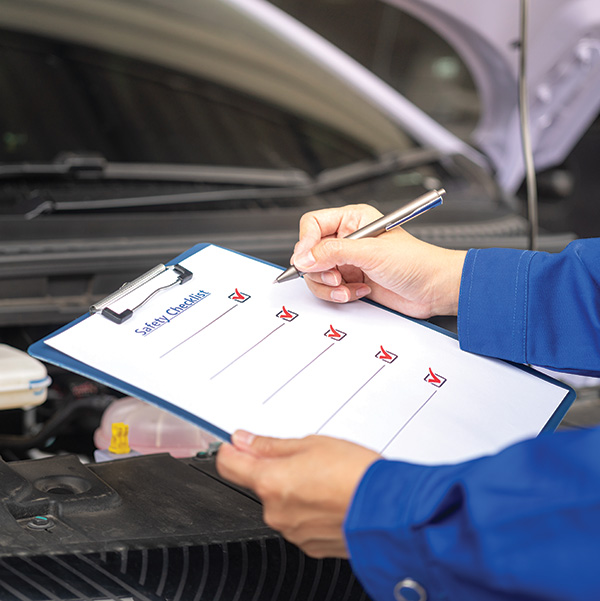 Now, if you really believe that statement to be true, not only would you be wrong, but you could be dangerously wrong. Hopefully, it won’t take a serious accident involving one of your customers – or a loved one – to convince you to research those OEM repair procedures and make sure you don’t miss this vital step.
According to Mike Anderson (Collision Advice), “Most, if not all, OEM manufacturers have safety inspection procedures for items such as seat belts, steering columns or SRS components such as airbag sensors or the actual airbag – all the items that you may have to inspect after a vehicle has been in a collision.”
To some, it may seem like an unnecessary step to have to disassemble parts of the vehicles that were otherwise untouched, but as one shop owner recently discovered, it really is pivotal!
Ken Miller (821 Collision; North Haledon) couldn’t believe his eyes when he learned what his team had uncovered – the seat belt and airbag systems had been rigged to appear as though they were fixed!
“It’s totally disgusting,” laments Miller about the worst repair job he’s ever come across from another shop. He is taking measures to help spread the word about this frightening situation.
Upon performing a mandatory seat belt inspection on a 2024 Honda CRV, Miller’s team “had to visibly inspect the unit which required doing some disassembly to get to the seat belt units. Evidently, from what we could tell, the seat belts deployed and cinched up tight to keep the driver in his seat. The shop that performed the repairs cut the seat belt to release the mechanism and cut the air bag harnesses and wired in resistors to trick the computer to think the air bag system was functioning properly.
“Arguably, it’s criminal to try to defeat a safety system,” Miller continues. “I’m not a lawyer, but I assume it’s criminal to try to cheat a federally-mandated safety system.”
It’s scary to think that there was no reason to suspect the system was tampered with. And the customer had no idea.
“We had no suspicions. After the repair was performed, we went through to verify everything via the safety inspection, and that’s how we uncovered this. The parts [the other shop] manipulated are the parts that cinch you into the seat. Now, that has a repercussion on how the individual would protrude forward toward the air bag and how they would hit that air bag. It’s a really big deal,” Miller notes.
What may be even scarier is that this was all done unbeknownst to the customer. Not surprisingly, Miller’s customer was shocked to learn about what his team uncovered. The car was brought to 821 Collision for a minor dent in the back of the vehicle. “As we learned from the customer, the car had about 1,000 miles on it from the time of the previous accident.
“The only real explanation is money,” Miller considers, as insurer pushback unfortunately leads some shops to cut corners in dangerous ways. “There was a fair amount of work put in to do what they did, but it wasn’t going to work. The retractors that keep the occupant in the seat and cinch up in an accident would not work at all.”
So, with all the dangers involved in not fixing cars correctly, why would a body shop do something like this?
I-CAR’s Bud Center believes there’s a combination of reasons collision repairers are failing to perform post-collision safety inspections. “It’s not something that’s really easily identifiable in the OEM repair procedures. For example, if somebody’s replacing the quarter-panel on a car and they pull up the quarter-panel replacement procedure, there’s nothing in there that says you have to do a post-collision safety inspection. You have to look for that information in the vehicle maker’s general procedures, so there are some who will say they didn’t know that it needed to be done. And then there are others who will say they’re not doing it because they’re having a challenge getting third-party payers to agree to cover the expense.”
Anderson acknowledges the seriousness of this issue, insisting “one hundred percent, safety inspections is the single biggest friction point that I see out there between shops and insurers.”
“In fairness, some of the OEMS don’t provide clarity as to what defines a collision so you know when it should be done or not be done,” he continues. “But some OEMs really do define it. And a lot of people say, ‘I don’t find anything the majority of the time.’ Well, I get that. But instead of talking about what you don’t find, let’s talk about the times that you do find things.”
Anderson cited examples of what issues inspections can reveal like how removing the dash uncovered a damaged or cracked dash carrier or the possibility of measuring a steering column only to discover it’s collapsed.
“Insurers will talk about how much it drives up severity, but what’s the price of a life worth? Because when seat belts don’t work or the steering column collapses, what does it take to save a life? So, at the end of the day, we can talk about how it drives up severity, but on the flip side, it also saves lives when these components work as intended.”
“I’m not an attorney, so don’t take legal advice from me, but if any shops were to run into a problem down the road when someone gets hurt in a subsequent accident and the shop didn’t do the proper safety inspections, they are going to have a legal problem,” Center states. “They have some liability. So, at the end of the day, just because a third-party payer won’t cover it, that does not remove the shop’s liability, and they need to understand that.”
How insurers feel about safety inspections is one thing, but unfortunately, the collision repair industry is also not very educated about it. Anderson believes shops need to really fully gain an understanding of what needs to be done.
“I was doing a seminar out west recently, and a shop owner showed me their estimate stating they got paid for doing a safety inspection. They had one hour on the estimate for the safety inspection. He was proud of himself, and I didn’t mean to burst his bubble, but I told him there was no way he spent only one hour doing a safety inspection. I explained to him that he had to remove the steering column and remove this and that, and he admitted he didn’t realize that.”
Anderson sees many make the mistake of thinking one doesn’t need to do more than jerk a seat belt once, “but some OEMs require you to test drive the vehicle, at three different speeds and braking conditions to test them. Sometimes, it involves a diagnostic tool; sometimes, it’s inspecting the mounting location. It’s not just a one-hour procedure. It can be very invasive and very time-consuming.”
According to Center, the OEMs are wide open to helping educate the industry about post-collision safety inspections. “The conversations we are having with OEMs have been about getting more clarity around the requirements. They’ve actually asked us to help them understand how they can help”
Center pointed to examples that leave a lot of room for interpretation, which is another snag in the process of getting the industry on board with safety inspections.
“In some cases, you’ll see things like ‘following a collision with damage that is beyond cosmetic, you will need to perform the post-collision safety inspection,’ and then they will list out the tasks that need to be done for post inspection, but what is the definition of cosmetic? Or if there is substantial damage that’s considered more than cosmetic, it leaves things open to interpretation. Repairers are going to have to put together their own definition of what that means, and it causes confusion.”
In order to collect information to be shared with OEMs, I-CAR has set up a link (bit.ly/SRSfeedback) via its Repairability Technical Support (RTS) “to allow people to submit information about post-collision safety inspections or safety inspections on SRS systems. They can submit any kind of questions, information or photos they have to report what they are seeing when they perform these types of inspections. We can put all that information together and work with the OEMs to figure out how to make some of this better.”
Endangering vehicle occupants is the largest concern by far, but shops should also be aware of the liability aspect. Had Miller not uncovered what he did when he did, who would have been on the hook if that vehicle were to get into a subsequent serious accident?
“That’s an even bigger issue here,” he states. “The unsuspecting repairer, like ourselves, fixing this car. Now, I knew it was in another accident because the repairs that were done on the front weren’t great. This was a minor repair, so my guys were complaining a bit about having to do a safety inspection, but we replaced the gate, so the answer was yes. If we didn’t uncover that, I was the last person to touch it. I wouldn’t have had photos of the good parts, if they were not undamaged. So, then I would have been on the hook if somebody got hurt or worse, because I was the last person to touch it.”
Center validates the importance of industry education on post-collision safety inspections. “Those doing these inspections are actually finding some things that are concerning. Some manufacturers say that following a collision, you need to check the steering gear and the steering rack. You’re doing very specific testing that requires some unique equipment and processes to do these tests. Shops need to understand what their investment is in equipment, what they need to be looking for and why. The industry needs more education and more clarity on this.”
Miller hopes that the collision industry will get on board more with the importance of post-collision safety inspections.
“I hope no one else sees something like this,” he says. “I’ve talked to a lot of people since this happened, and supposedly, this is a big business in the rebuildable industry. When these cars get totaled and they go to these auctions, there’s a bunch of guys out there doing this [type of job]. I had no idea to be honest. So, my advice to other shop owners is to perform the safety inspections.”
Want more? Check out the August 2025 issue of New Jersey Automotive!