
BMW M1 – A Rare Gem
by Keith Krehel, AASP/NJ Mechanical Chairman
Back in the late 1970s, BMW wanted to compete in Group 5 racing, specifically against their archrival Porsche, as well as to help promote their brand.
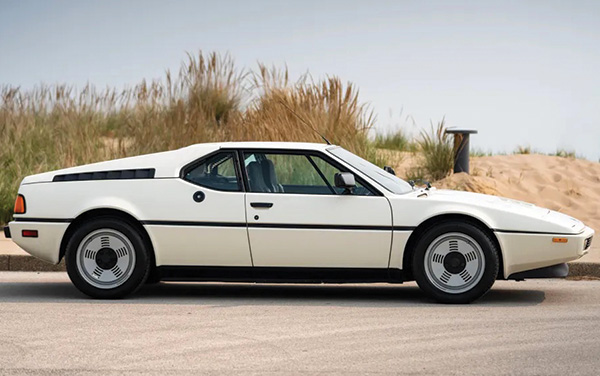 To enter Group 5, they were required to build 400 roadworthy vehicles to meet the homologation standards set forth. The resulting car was to be sold under the name BMW M1 – M for Motorsports and the 1 for the first produced vehicle by the division. Jochan Neerpasch, the head of the motorsports division of BMW, wanted to prevail, not just compete, using a car specifically built for racing versus heavily modifying a sedan already available to the public. He demanded the car be midengined in order to outperform the present competition.
Realizing BMW Motorsports did not have the capacity to build this quantity of vehicles in the allotted time, Lamborghini was contacted to assist in the design and construction of the M1. Unfortunately, Lamborghini’s financial situation deteriorated along with emerging legal issues which prevented Lamborghini from contributing. As such, BMW reassumed control over the project. Although the M1 is badged BMW and BMW is a German brand, you will see the car is predominantly Italian. The tubular steel space frame chassis was the work of Gianpaolo Dallara, an Italian veteran in the field who designed the chassis for both the Lamborghini Espada and (my favorite) the sleek Miura. The fiberglass body was designed by renowned designer Giorgetto Giugiaro, the same firm that designed many super cars, including the Lotus Turbo Esprit, which I happen to own. As a matter of fact, when I first saw an M1 at the NYC automobile show a couple of years back, I thought it was a Lotus Esprit until I saw the BMW logo on the front. See the chart for comparison of the Esprit.
The car was not complete as yet, so BMW tasked a new company (Italengineering), founded by ex-Lamborghini engineers, to finish the vehicle. A straight six cylinder was developed by Paul Rosche, employing mechanical fuel injection using Magnet-Marelli ignition. The engine had six separate throttle bodies, twin cams, and four valves per cylinder technology, producing 273 HP and a maximum speed of 165 MPH for the street version car. The engine was then paired to a five-speed ZF (German) transaxle with limited slip differential. Steering was basic non-power rack and pinion, employing a double wishbone front suspension with Campagnolo wheels (high performance, light and strong). The fiberglass body, designed by Giugiaro (Italian), was manufactured by TIR – Trattmano Italiano Regina – in Italy, while the chassis was manufactured by Marchesi (Italian), and the body was completed by Italdesign in Turin, Italy. The incomplete cars were then shipped to German specialty manufacturer Baur, where final assembly and engine installation was completed before being shipped to BMW in Munich for final inspection and to handle quality control issues of which there were many.
Of the 453 cars built, only 399 were for street use, with the remaining 54 produced for racing. The car was produced from 1978 to 1981. From my limited research, BMW had planned a much larger production run, at least double, than the 453 produced, but many issues haunted this project from inception to completion, all of which contributed to its limited sales run. Problems with the original designer and manufacturer – Lamborghini – as well as excessive shipping of incomplete vehicles between vendors and rampant inflation at the time, caused the M1 pricing to rise from $100,000 to $113,000 – a lot of money at this time. For reference, a new Corvette in 1978 had an MSRP of around $11,000, while a Ferrari 308 listed between $63,000 and $73,000.
This very limited production run (along with its sleek styling) has led these vehicles to become very valuable and sought after. Again, see the comparison in the chart to a Lotus Turbo Esprit of the same time period.
Year: 83 Lotus Turbo / Esprit 78-81 BMW M1
Engine: 2.2 litre 4 cyl 3.5 litre 6 cyl
Horsepower: 205 273
Torque: 194 ft/lbs 243 ft/lbs
Trans: 5 speed 5 speed
Weight: 2,712 lbs 2,866 lbs
Height: 44.5 “ 44.9 “
Valve train: Double overhead cam Double overhead cam
4 valve technology 4 valve technology
Performance 0-60: 5.9 sec ~ 5.9 sec
¼ mile: 14.5 sec (I personally ran in the 14’s) 14.1 sec
Top speed: 150 mph 165 mph
Today’s worth: around 48K 500K +
Fuel economy: 14 city/25 highway 14.4 combined
Want more? Check out the February 2026 issue of New Jersey Automotive!