

Jack Lamborghini: Retired from Shop Life, but Still Fighting for Labor Rate Reimbursement Reform
by Chasidy Rae Sisk
As New England Automotive Report catches up with retired body shop owners who’ve made their mark on the Commonwealth collision repair industry, most have reported their relief to relinquish the battle with insurers over adequate compensation…but that’s not the case with Jack Lamborghini, former owner of Total Care Accident Repair in Raynham, who may have turned over his keys to his partner but has yet to lay down his sword to fight on behalf of those still contending with the unjust labor rate reimbursements issued by insurance carriers.
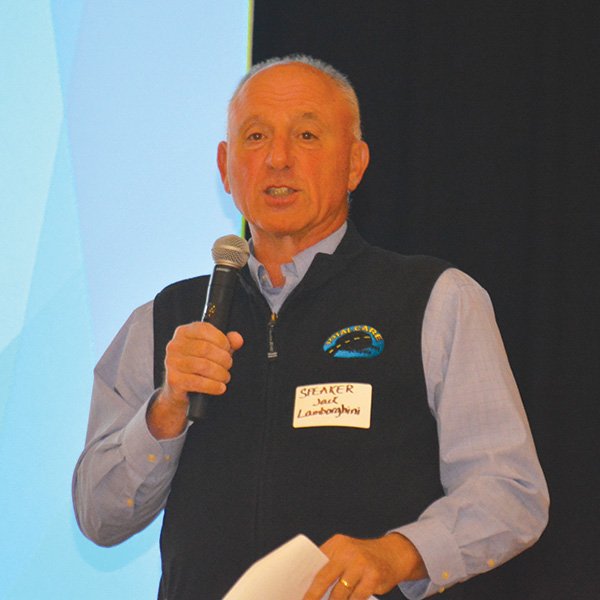 New England Automotive Report: When and how did you first get involved in the collision repair industry?
Jack Lamborghini: I always knew I wanted to be in business for myself, so when I was 22 years old, I bought a Maaco franchise and became the youngest Maaco operator in the country, although I had no prior industry knowledge. In fact, at that point, my entire aptitude with automobiles was turning a key in the ignition to start it and possibly changing a tire, but after a conversation with a body shop owner who told me how much he was making fixing cars, I was intrigued…though I quickly realized that his perspective wasn’t quite congruent with reality!
After operating the Maaco shop for seven years, I sold the business to Jerry Gnazzo who owned three other locations. For the next six months, I enjoyed a very brief retirement at the age of 29 before going to work for Jerry for four years as he grew his empire to seven Maaco franchises in 1984. Around that time, an automotive consulting firm contacted me to start a division focused on collision repair, and during the nine years I worked there, I got involved with 20 groups which was one of the best things I ever did in my career because it was a great learning experience. That led to becoming a facilitator of 20 groups with the Coyote Vision Group which provided me with a lot of perspective and insight into what others throughout the country were doing in the industry.
I returned to shop life with Woburn Auto Body for 14 years, but the long commute and constant negotiations with insurers wore me out, so I left the industry altogether from 2002 until 2006 when Bruce King recruited me as the general manager for King Collision’s two facilities. That’s where I met Brian Bernard, my future business partner. When Bruce expanded to a third location in 2009, Brian and I were given equity positions in the third store, and a year later, we bought out Bruce’s share and rebranded that shop as Total Care Accident Repair.
NEAR: How long did you own your shop?
JL: Brian and I christened the shop as Total Care Accident Repair in 2010, and I retired in 2023; however, I’m still doing some minor consulting work to keep my hand in the game a little bit because I have a tremendous appreciation and love for the industry.
During our time at King Collision, Brian and I worked together closely, implementing lean processes and becoming good friends, which led to our conversation about forming a partnership. We were very aligned with how we wanted to run the business, and he is an extraordinary guy to work with; I was fortunate to have the best business partner anyone could ask for. Although our shop was initially on multiple referral lists, we soon realized how restrictive those contracts were and decided to separate ourselves from those ‘partnerships’ in 2018. That went hand-in-hand with AASP/MA’s aggressive pursuit to correct the labor reimbursement rate in Massachusetts.
NEAR: How did you get involved with the association (MABA at the time)?
JL: I started attending MABA meetings when Jerry Gnazzo became the association president in 1983, and I maintained my involvement from that point forward because I recognized the value of belonging to an association, while understanding that you get what you put into it. Still, even shops that don’t actively participate should realize how critically important it is to support the association because that’s the organization looking out for our best interests and advocating on our behalf. My involvement with the association was reinvigorated when Lucky Papageorg became executive director because I’ve always admired Lucky and his willingness to aggressively pursue important matters. I’m really passionate about the whole labor rate issue which is the main reason I’ve remained involved even after my retirement.
NEAR: When did you decide to retire, and why?
JL: I retired in January 2023 because it was time. I had turned 70 the previous September and just felt it was time to step back; however, in many ways, I wish I was younger so I could stay on and see us through the fight for fair compensation. But at 70 years old, I just didn’t have the same capacity that a younger man might have, so it became clear to me that it was time to turn the reins over to Brian.
I’m a big sports fan, and one of the hardest things that professional athletes have to deal with is coming to grips with the fact that it’s time to retire. We’ve all watched with sadness as some of the best athletes tried to play beyond the time that their skills were viable, and it was painful to watch. With that image in my head, I decided to retire and spend more time with my family and a lot of time playing golf.
NEAR: While you’re no longer working in the shop, you still haven’t stepped away from the collision game fully. You continue to advocate for fair labor rate reimbursement. In fact, you stepped away from the golf course to provide testimony at the Auto Body Labor Rate Advisory Board (ABLRAB) public hearing in June. What do you think will come of these efforts?
JL: I guess we’ll see. They set up a labor rate commission in 2008 and again in 2022, and nothing came of either of them. The bill that established the ABLRAB isn’t exactly what we originally proposed, and I worry that whatever number they come up with won’t be what the labor rate actually should be, but if we can move the needle forward, it’ll be a step in the right direction as we continue this fight.
The industry changed a great deal in the last five or six years before I retired, and I’m really proud that I was an integral part of raising a ruckus about the labor rate issue. I’m also very encouraged by Sean Preston’s (Coverall Law) efforts to represent us. He is building his entire practice around the collision repair industry, and it’s amazing to see someone with so much passion for helping shops. More shops need to be aware of what he’s doing and take advantage of everything he has to offer.
NEAR: Obviously, labor rate reimbursement has been an issue for a long time. How did you handle it at Total Care?
JL: At Total Care, we were at the forefront of pushing the envelope with insurers and insisting on collecting what we needed to properly repair our customers’ vehicles. That often meant being willing to balance-bill customers when an insurer refused to pay for necessary repairs. A lot of repairers don’t have the confidence to explain, ‘This is what I need to charge; I’m going to repair your car the right way to ensure it’s safe to drive, and this is what I need to be compensated to do that.’ When the insurer is unwilling to pay, do you tuck your tail between your legs and accept it? Or do you refuse to accept it and balance-bill the customer?
Many shops are reluctant to charge customers because they fear the customers’ reaction, and I understand – I have great empathy for customers and fully respect that they’re in a difficult situation, but you’d be surprised by how many customers understand our plight if we educate them. At Total Care, we’ve always taken excellent care of our customers and explained what we needed to do and why. And since we started balance-billing for insurer shortages, guess how many complaints we’ve received? Zero! Not a single customer complained about paying above and beyond what their carrier compensated because we took the time to educate them, so they understood in advance that they would have an out-of-pocket cost before agreeing to have us repair their car. That’s a credit to how well the team educated the customer and the high quality of the finished repair.
NEAR: What advice would you offer shops still contending with inadequate labor rate reimbursement?
JL: Collision repair shops need to focus on doing things correctly, keeping integrity, safety and customer care at the top of the list…and you simply cannot do that for $43 an hour. That often means balance-billing the customer, and there’s no need to be afraid of that. Customers will pay for value if they are educated, and they can seek reimbursement from their carriers; shops can help them by providing documentation and support when vehicle owners seek that reimbursement.
NEAR: What do you miss the most?
JL: I miss the comradery of working in a team environment on a daily basis. As a sports fan, building a team was one of the most appealing things about owning a business. Over the years, I helped build a lot of great teams. Of course, there are always ups and downs; sometimes, you have a 20-year dynasty, while other times, you flounder and have to rebuild. But overall, we did extremely well because we had a group of people who were dedicated to repairing cars correctly and providing the best possible customer care.
I also miss interacting with customers and the sense of pride I felt when truly helping somebody. As an industry, the work we do is really important, and we need to remind ourselves – and our teams – of that every day.
NEAR: What do you miss the least?
JL: I certainly don’t miss trying to negotiate claims with people who have no clue what they’re doing! I don’t miss trying to explain why a repair is necessary and the shop needs to get paid to some kid who was a clerk at Best Buy six months ago and now works as an insurance ‘appraiser.’ And although I’ve always loved talking to shops to explain why they should join AASP/MA and why it’s in their best interests to charge a fair labor rate, I don’t miss trying to evoke change and evolution from people who are completely close-minded to the possibilities.
NEAR: What is the one thing you think you got out of this industry that you would not have gotten if you didn’t pick this career?
JL: I would not have had the same sense of accomplishment that I’ve gotten out of being able to build teams and help people. When I step back and take a look at everything I did over the course of my career, I feel pretty good about everything I was able to do and all the people I helped.
NEAR: Anything you want to say to your old body shop colleagues?
JL: Continue to operate with integrity on every level that you can – with your customers, team members and insurers – and never waver from that. Don’t be afraid to make the hard decisions. As a shop owner, this is your business, and you need to act in the best interests of your organization, your customer and yourself.
Want more? Check out the October 2025 issue of New England Automotive Report!