
The Total Loss Machine Part Three of Three: How Consumers and Shops Can Fight Back
by Sean Preston, Coverall Law
In Part One, we examined why total losses are occurring at record levels and how the economics of repair, salvage and insurance have changed over the past several decades.
 In Part Two, we walked through the Massachusetts total loss process step by step. We examined actual cash value, salvage bids, total loss reports and the hidden numbers that often determine whether a vehicle is repaired or sent to auction.
Now we arrive at the most important question: What can consumers and repairers do about it?
The answer begins with understanding a simple truth: a total loss decision is not always the end of the conversation. Sometimes it is the moment when the most important questions should finally be asked.
When a vehicle is declared a total loss, the financial consequences do not disappear – they are simply transferred to someone else.
Insurance companies often present a total loss as an efficient resolution. The claim is closed. The vehicle is removed from the road. The owner receives a settlement. The process moves forward.
But that description overlooks a critical question.
Who ultimately bears the cost?
For many consumers, a total loss is not the end of a problem. It is the beginning of a new one.
A paid-off vehicle may be gone overnight. The owner who carefully maintained that vehicle for years suddenly faces today’s replacement market, where used vehicle prices remain elevated and financing costs are far higher than they were just a few years ago. Even when an insurer pays what it believes is the vehicle’s actual cash value, many consumers discover that replacing their vehicle costs significantly more than expected.
A settlement check does not create another vehicle.
It merely creates a budget.
And in many cases, that budget falls short.
Some consumers are forced into vehicle loans they never wanted. Others find themselves making payments again after years of driving debt-free. Many face higher insurance premiums on the replacement vehicle. If financing is required, rising interest rates add another burden. What begins as a property damage claim becomes a long-term financial obligation.
The repair shop faces a different kind of loss.
When a vehicle totals, the repair disappears.
Months of planning, estimating, supplement preparation, documentation, parts sourcing and communication can suddenly become worthless. Shops regularly report situations where they identified a likely total loss early in the process, only to have the insurer continue down the repair path before eventually changing course. When that happens, disputes often arise over dismantling costs, storage fees, administrative time and work already performed.
Many shops feel as though they are expected to absorb the cost of the insurer’s delay.
One of the most common complaints I hear involves storage. A vehicle sits for weeks or months while the insurer evaluates repairs, reviews supplements or waits on parts. Then the insurer declares a total loss and argues that storage should only begin on the date the insurer itself made that decision. The shop is left wondering why it should bear the financial burden of a timeline it did not control.
The frustration runs deeper than any single claim.
During the development of the Forever Forms, I asked one shop owner what it was like negotiating with insurers before receiving legal support.
His answer was immediate.
“What negotiation?”
That response has stayed with me because it captures what many repairers experience. They do not feel like participants in a negotiation. They feel like participants in a process where the outcome has already been decided.
Recently, I spent time visiting repair shops on Cape Cod. Several owners told me the same thing. They no longer know whether they will be profitable from month to month. Not because they lack customers. Not because they lack skill. Not because they are unwilling to invest in equipment, training or certifications.
They simply do not know whether they will be paid fairly for the work they perform.
That uncertainty affects the entire industry.
Independent repairers are being squeezed from every direction. Vehicle technology requires constant investment. OEM certification programs demand expensive equipment and training. Labor shortages push wages higher. Meanwhile, insurers continue pressuring shops on labor rates, repair procedures, documentation requirements and payment approvals.
Every year, the barriers to remain independent become higher.
Every year, more shops leave the market.
Every year, more work shifts away from local repairers toward larger organizations better positioned to absorb the pressure.
The result is not merely harm to individual businesses. It is harm to an entire industry that has traditionally served as the backbone of local vehicle repair.
The total loss economy creates specific winners:
Insurers close files.
Salvage auctions gain inventory.
Global buyers gain opportunities.
But when the dust settles, the people left holding the bag are often the same people who were supposed to be protected in the first place: the vehicle owner and the local repair shop.
And that should concern everyone.
The economic consequences of total losses are real.
Consumers lose vehicles.
Repair shops lose work.
Communities lose local businesses.
Local economies suffer.
But understanding who bears the cost is only part of the equation.
The next question is whether those affected have any meaningful tools available to challenge the result.
Fortunately, they do.
A total loss decision is not the end of the conversation – it is often the beginning of the questions that should have been asked from the start.
One of the biggest misconceptions in insurance is that a total loss decision is final. Many consumers believe that once an insurer says a vehicle is totaled, there is nothing left to discuss.
That is simply not true.
In Massachusetts, there are several parts of a total loss claim that can be challenged. In fact, some of the most important numbers in the process deserve far more scrutiny than they typically receive.
The first area to examine is the repair cost itself.
Consumers are often surprised to learn that insurers and repair shops frequently disagree about what a vehicle needs. A repair estimate is not a law of nature. It is an opinion. Shops may identify procedures, parts, calibrations or repairs that the insurer initially refuses to recognize. Later, those same items may appear on supplements or even become part of a total loss calculation.
When a dispute exists over the amount of a property damage loss, Massachusetts policies typically contain an appraisal clause. Through appraisal, the policyholder can have an independent appraiser evaluate the loss and help determine the proper amount. While appraisal is often discussed in connection with actual cash value disputes, it can also be a powerful tool whenever the amount of loss itself is genuinely disputed.
The second area to challenge is the vehicle’s actual cash value or ACV.
This is one of the most common areas where consumers leave money on the table.
Insurers often rely on valuation reports that compare the damaged vehicle to other vehicles that have recently sold or are currently listed for sale. But not all comparable vehicles are truly comparable. Mileage matters. Condition matters. Options matter. Prior improvements matter.
Consumers should carefully review the comparable vehicles used by the insurer. Are they truly similar? Are the condition adjustments fair? Has the insurer properly accounted for recent repairs, upgrades, or maintenance? Has unrelated prior damage been overstated?
In my experience, when consumers push back on questionable ACV determinations and present supporting evidence, insurers often become far more willing to negotiate.
The third area – perhaps the most overlooked – is salvage value.
As discussed in the previous section, a single salvage number can determine whether a vehicle is repaired or totaled. Yet most consumers never ask to see the salvage bids.
They should.
Ask whether two bids were obtained.
Ask whether the bids came from geographically convenient salvage buyers.
Ask whether the bids were averaged as Massachusetts regulations require.
Ask whether the bids were disclosed.
A total loss calculation is only as reliable as the numbers used to create it.
The fourth area to examine is regulatory compliance.
Massachusetts has detailed rules governing vehicle appraisals and total loss claims. Those rules exist for a reason. Appraisers are required to perform inspections. Total loss reports must be completed when the circumstances require them. Salvage valuations must follow regulatory procedures. Consumers are entitled to certain information during the process. A simple but important question should always be asked:
Did the insurer actually follow the rules?
Too often, consumers assume the answer is yes without ever looking.
Finally, consumers should understand that not every dispute is merely a disagreement over numbers.
Sometimes the issue is how the claim was handled.
Massachusetts has long recognized that insurers must deal fairly with their policyholders. Chapter 176D regulates unfair claim settlement practices. Chapter 93A provides remedies when unfair or deceptive conduct causes harm. Regulations such as 211 CMR 133 establish standards governing vehicle damage claims and appraisals.
These laws do not guarantee that every consumer will win every dispute. They do not prohibit insurers from exercising judgment. They do not prevent insurers from declaring a vehicle a total loss when the facts support that decision.
But they do require insurers to act fairly.
That point is particularly important in light of decisions such as Krinsky. Some commentators have attempted to read cases like Krinsky as giving insurers unlimited authority to total vehicles whenever they choose. That is not what the case stands for.
The better lesson is much narrower.
An insurer may have contractual discretion.
But contractual discretion is not immune from scrutiny when exercised unfairly.
That distinction matters.
The question is not whether the insurer had the power to make a decision.
The question is whether the insurer followed the policy, followed the regulations, used fair numbers and handled the claim honestly.
Those are questions every consumer has the right to ask.
And sometimes, asking the right question is enough to change the outcome.
The most important question in a total loss claim is not whether the vehicle was totaled – it is who benefited when it was.
Let’s return to where we started.
A vehicle enters a collision repair shop after an accident. An insurer writes a quick estimate. The vehicle is disassembled. Supplements begin. Weeks turn into months. Additional damage is discovered. Necessary repairs are slowly approved. The repair cost grows closer and closer to reality.
Then, suddenly, the vehicle is declared a total loss.
The shop loses the repair.
The customer loses the vehicle.
The insurer closes the file.
For many people, the story ends there.
But it shouldn’t.
Throughout this article, we have examined the forces shaping today’s total loss decisions. We have seen how rising repair costs, advanced vehicle technology and supply chain challenges have changed the economics of repair. Those factors are real and cannot be ignored.
But we have also seen another side of the story.
We have seen how salvage has evolved from a local afterthought into a global marketplace dominated by companies like Copart and IAA. We have seen how rising salvage values can push vehicles over the total loss threshold. We have seen how consumers rarely challenge salvage bids, even though those bids can determine the outcome of the entire claim. And we have seen how repair shops increasingly find themselves competing against a system that profits when vehicles leave the repair stream altogether.
None of this means every total loss is improper.
Many vehicles should be totaled.
Many vehicles cannot be repaired economically or safely.
The issue is not whether total losses should exist.
The issue is whether the public understands how they happen.
For decades, total losses were viewed as the unfortunate consequence of severe damage. Today, they have become a central feature of a claims system where multiple industries benefit when vehicles are removed from the repair process. Insurers reduce exposure. Salvage auctions gain inventory. Global buyers gain opportunities.
Meanwhile, consumers lose paid-off vehicles. Repair shops lose work. Local communities lose businesses that are already struggling to survive in an increasingly difficult environment.
That is why transparency matters.
Consumers deserve to see the numbers.
Consumers deserve to understand the process.
Consumers deserve to know that they can challenge repair costs, actual cash value determinations, salvage bids and unfair claim handling.
And repairers deserve a system that values proper repairs as much as it values efficient claim closures.
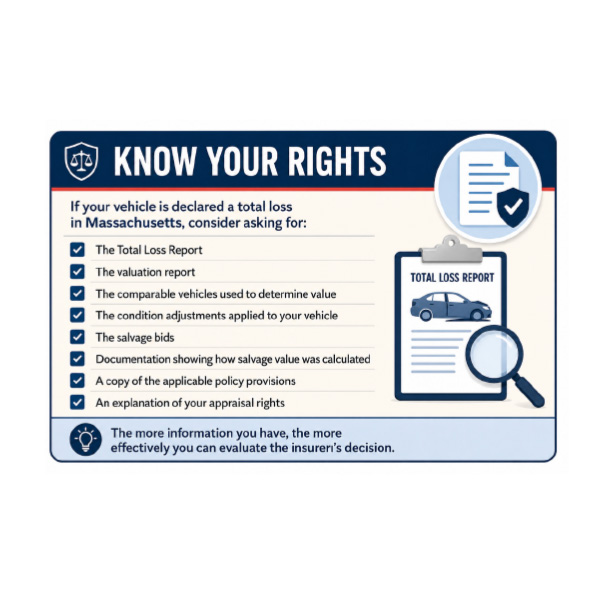
The next time an insurer declares a vehicle a total loss, do not stop at the conclusion.
Ask for the worksheet.
Ask for the valuation.
Ask for the salvage bids.
Ask how the numbers were calculated.
Because before another vehicle is sent to auction, before another repair shop loses a job and before another consumer loses a vehicle they may never be able to replace, every number deserves to be examined.
Especially the ones nobody talks about.
Especially the ones nobody challenges.
Especially salvage value.
Because once you understand the numbers, you begin to understand the machine.
Final Thoughts: Transparency Is the Beginning
This series began with a simple observation.
More vehicles are being declared total losses than ever before.
What started as a question about rising total loss frequency led us into a much larger discussion about incentives, salvage auctions, insurance economics, consumer rights and the future of the collision repair industry.
Along the way, we discovered something important.
Many total loss decisions are not simply about vehicle damage.
They are about numbers.
Actual cash value.
Repair costs.
Salvage bids.
Market assumptions.
And like all numbers, they deserve scrutiny.
Consumers should not be afraid to ask questions.
Repairers should not be afraid to document their work.
Attorneys should not be afraid to challenge unfair practices.
And regulators should not be afraid to examine whether the rules designed to protect the public are being followed.
Transparency does not guarantee fairness.
But fairness is almost impossible without transparency.
The goal of this series has never been to argue that every total loss is improper. Many are justified. Many are necessary.
The goal has been to encourage a more informed conversation about how those decisions are made, who benefits from them and what happens when the process fails the people it was supposed to protect.
The next time someone says a vehicle is a total loss, don’t just ask what happened to the car.
Ask what happened to the numbers.
Because the future of a vehicle – and sometimes the future of a repair shop – may depend on the answer.
Want more? Check out the September 2026 issue of New England Automotive Report!