
The Total Loss Machine Part Two of Three: How the Total Loss Machine Works
by Sean Preston, Coverall Law
In Part One, we examined why total losses are occurring at record levels and how the growth of the modern salvage market may be influencing total loss decisions. (See grecopublishing.com/near0726legalperspective). We explored the rise of companies like Copart and IAA, the economic incentives surrounding total loss claims and the question every consumer should ask: Who benefits when a vehicle totals?
 Part Two turns to a different question: What is supposed to happen?
Massachusetts has detailed laws and regulations governing vehicle damage claims. Those rules establish how vehicles should be appraised, how actual cash value should be determined, how salvage value should be calculated and what information consumers are entitled to receive.
Yet many vehicle owners never see those numbers.
Instead, they receive a phone call.
“Your vehicle has been declared a total loss.”
The purpose of this article is to pull back the curtain and examine the process that is supposed to occur before those words are ever spoken.
A total loss decision should not be a mystery; Massachusetts law gives the insurer a process to follow and gives the consumer numbers to question.
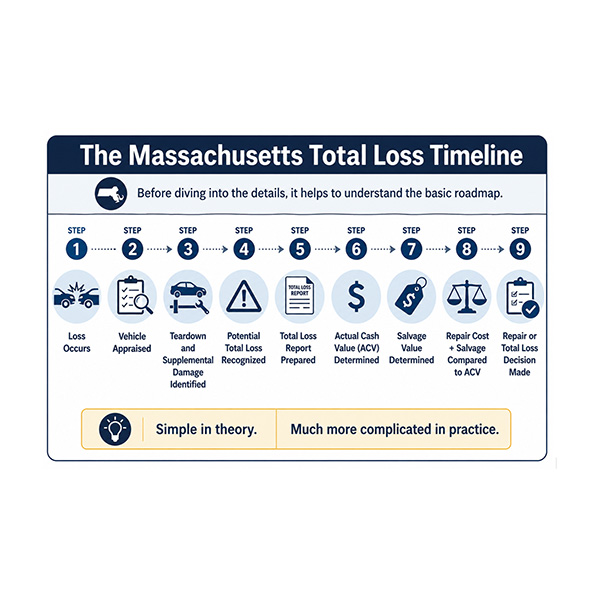
In Massachusetts, a total loss should follow a clear path. The process does not begin and end with an insurer saying, “Your car is totaled.” There are rules. There are steps. There are numbers that must be used. And those numbers matter.
The first step is simple. A loss occurs. The vehicle is damaged. The consumer files a claim. The vehicle may be taken to a repair shop, a tow yard, a drive-in appraisal site or another location where it can be inspected.
The next step is the appraisal. This is where problems often begin. In Massachusetts, an appraisal is not supposed to be a guess based only on what can be seen from across the parking lot. A licensed appraiser is supposed to inspect the damaged vehicle and rely mainly on that personal inspection. The appraiser must also photograph the damaged areas and identify the damage caused by the accident. Massachusetts appraisal rules require the appraiser to specify all damage related to the loss and also identify unrelated damage.
That matters because many claims begin with what shops call a “visual appraisal.” The insurer looks at the outside of the vehicle, writes a low first estimate and waits for the shop to find the rest. But hidden damage is common. Once the vehicle is taken apart, the true cost of repair often becomes clear. That is when supplements begin.
At some point, the numbers may show that the vehicle could become a total loss. Massachusetts law speaks directly to that moment. Under 211 CMR 133.05, when the appraised cost of repair plus the probable salvage value may reasonably be expected to exceed the actual cash value of the vehicle, the insurer must determine the vehicle’s actual cash value. The regulation also requires a licensed staff or independent appraiser to complete a total loss report on a form filed with the Division of Insurance.
That is the point where the claim should become more transparent, not less.
The insurer must determine the vehicle’s actual cash value, often called ACV. Under the Massachusetts standard auto policy, when repair cost plus probable salvage value may reasonably be expected to exceed the actual cash value, the insurer must determine ACV by considering several factors. Those include the retail book value of a like kind and quality vehicle, the price paid for the vehicle plus prior improvements less proper depreciation, any decrease in value from prior unrelated damage, and the actual cost to buy an available vehicle of like kind and quality.
In plain English, the insurer should be looking at what the vehicle was really worth before the crash. Not just a computer number. Not just the lowest comparable vehicle it can find. The condition of the vehicle matters. Prior improvements matter. Prior damage may matter. Comparable replacement vehicles matter.
Then comes the number almost nobody challenges: salvage value.
Massachusetts law is specific here. If the claimant keeps title to the vehicle, the appraiser must obtain bids from two geographically convenient licensed salvage companies. The average of those two bids is used as the salvage value. The appraiser must also provide the claimant with the names and addresses of the salvage buyers, the amount of each bid and the expiration date of the offers, if any.
That rule is important because salvage value can decide the whole claim.
For example, I recently handled a case where the insurer obtained one Massachusetts salvage bid and one California salvage bid. The Massachusetts yard did not want the vehicle and bid zero dollars. The California yard bid was close to $6,000. Instead of averaging the two numbers, the insurer relied on the California bid. That changed the math. And when the math changes, the outcome can change.
This is why consumers should ask for the salvage bids. They should ask who made the bids. They should ask where the buyers are located. They should ask whether the bids were averaged. They should ask whether the salvage companies were actually “geographically convenient,” as Massachusetts law requires.
After the repair cost, ACV, and salvage value are determined, the insurer applies the basic total loss formula:
Repair Cost + Probable Salvage Value = Total Loss Comparison.
If that number may reasonably be expected to exceed the vehicle’s actual cash value, the insurer may move toward a total loss decision. The Massachusetts standard policy also says the insurer may, at its option, repair the auto, repair or replace parts or declare the vehicle a total loss. But that option still exists inside a regulated claim process.
That is the key point.
The insurer may have discretion, but discretion is not the same as a blank check. A total loss decision should be based on real numbers, proper appraisals, proper ACV analysis and proper salvage bids. The process is supposed to be transparent.
Too often, consumers never see the numbers.
They are told the car is totaled. They are given an offer. They are pressured to move on.
But in Massachusetts, the numbers behind that decision matter. And if the numbers are wrong, incomplete, or unfair, the consumer should challenge them.
Understanding the numbers is important.
Understanding the incentives behind those numbers may be even more important.
Because once consumers understand how total loss decisions are calculated, the next question becomes unavoidable:
Can the incentives within the system influence the outcome?
A single salvage number can be the difference between repairing a vehicle and sending it to auction – and most consumers never think to question it.
When a vehicle is declared a total loss, most people focus on two numbers: the repair cost and the vehicle’s actual cash value. That makes sense. Those are the numbers that seem obvious. Consumers want to know how much the repairs cost and what the insurer thinks the vehicle was worth before the accident.
But there is a third number in the equation that often receives little attention.
Salvage value.
In many cases, salvage value is the hidden number that ultimately determines whether a vehicle gets repaired or totaled.
Consider a simple example.
Assume a vehicle has an actual cash value of $16,000. The repair estimate is $12,000. If the salvage value is $2,000, the insurer’s calculation equals $14,000. The vehicle may remain repairable.
Now change only one number.
The repair estimate stays at $12,000. The actual cash value stays at $16,000. But the salvage value increases to $5,000.
Now the total becomes $17,000.
The vehicle that was repairable a moment ago may suddenly become a total loss.
Nothing changed about the damage. Nothing changed about the repair. Nothing changed about the vehicle itself. The only thing that changed was the salvage number.
That is why salvage value deserves far more attention than it receives.
Massachusetts law recognizes the importance of this number. The regulations require that, when applicable, two geographically convenient licensed salvage companies provide bids and that those bids be averaged to determine salvage value. The claimant is also entitled to information regarding the bids themselves, including who submitted them and the amounts offered.
Yet many consumers never see those bids.
Many do not know they exist.
Many do not know they have the right to ask for them.
And almost nobody thinks to challenge them.
That needs to change.
When an insurer presents a total loss offer, consumers should ask several simple questions.
Were two salvage bids obtained?
Were those bids obtained from geographically convenient licensed salvage companies?
Were the bids averaged as required?
Were the bids disclosed?
Do the bids accurately reflect the condition of the vehicle?
These are not technical questions. They are fair questions. And the answers can have a direct impact on whether a vehicle is repaired or totaled.
I recently handled a Massachusetts claim that demonstrates the problem. One salvage bid came from a Massachusetts salvage yard. That yard did not want the vehicle and offered zero dollars. The second bid came from California and was several thousand dollars higher. Rather than averaging the two bids, the insurer relied on the higher number. The difference materially affected the total loss analysis.
That experience raises a broader concern. As salvage auctions become increasingly national and international, the pressure on salvage values continues to grow. Higher salvage values make total losses easier to justify. And the easier total losses become to justify, the more important it becomes for consumers to understand the numbers being used.
The good news is that consumers are not powerless.
If an insurer declares a vehicle a total loss, ask for the valuation. Ask for the comparable vehicles. Ask for the condition adjustments. And most importantly, ask for the salvage bids.
The insurance company may view salvage value as just another line item in a calculation.
For the vehicle owner, it may be the single most important number in the entire claim.
The most important question may not be whether a vehicle can be totaled – it may be whether the incentives in the system quietly push claims in that direction.
By now, a reasonable reader might be asking a difficult question.
If insurers have the right to declare vehicles total losses, and if rising repair costs are making more total losses inevitable, then what is the problem?
The problem is not that total losses exist.
The problem is whether the incentives surrounding total losses can influence how claims develop.
To understand why, it helps to look at how many repair claims unfold in the real world.
When a vehicle is being repaired, insurers often take a very careful approach to costs. Shops routinely report disputes over labor operations. OEM repair procedures are questioned. Calibrations are challenged. Aftermarket parts are proposed instead of OEM parts. Used parts are substituted whenever possible. Supplements are reviewed one line at a time. Every dollar seems to matter.
This experience is so common that many repairers simply accept it as part of doing business.
One shop owner I spoke with during the development of the Forever Forms described the process perfectly. When asked what it was like negotiating with insurers before receiving legal support, he replied: “What negotiation?”
For many repairers, that answer will sound familiar.
The claim begins with a low estimate. The shop performs a teardown. Hidden damage is found. A supplement is submitted. Then another. Then another. Weeks pass. Sometimes months. The insurer slowly approves operations that the shop believed were necessary from the beginning.
But something interesting can happen when the possibility of a total loss appears.
Suddenly, repair costs are no longer being challenged quite so aggressively.
Operations that were once questioned may now be accepted.
Additional damage is recognized.
Repair procedures are included.
Costs that previously generated debate become part of the calculation.
The estimate grows.
Eventually, the repair cost plus the salvage value approaches the vehicle’s actual cash value.
Then the vehicle totals.
To be clear, this does not mean the estimate was manipulated. It does not mean the vehicle should never have been totaled. Many vehicles genuinely reach a point where a total loss is appropriate.
But it does raise an important question.
Why do some costs appear to be treated differently depending on whether the insurer is evaluating a repair claim or evaluating a total loss?
If an OEM procedure is unnecessary when paying for a repair, why does it become acceptable when supporting a total loss calculation?
If a labor operation is excessive when a shop requests payment, why does it become reasonable when it helps justify a total loss decision?
If aftermarket parts are appropriate during the repair process, why are they sometimes ignored when the economics of a total loss are being calculated?
These are fair questions.
And they become even more important when viewed alongside the broader economic incentives discussed earlier. Insurers benefit from closing files. Salvage auctions benefit from obtaining inventory. Global buyers benefit from increased auction opportunities. The repair shop loses the work. The consumer loses the vehicle.
Again, none of this proves wrongdoing. It does not mean every total loss is improper. It does not mean every insurer acts the same way.
But incentives matter.
When a system consistently rewards one outcome over another, it is reasonable to ask whether those incentives influence decision-making. That is true in business. It is true in government. And it is true in insurance claims.
The purpose of asking these questions is not to accuse.
The purpose is to understand.
Because once consumers understand how the system works, they can begin asking better questions. And better questions often lead to better outcomes.
Understanding the Numbers Is the First Step
Massachusetts law provides a framework for total loss claims. Appraisals must be performed. Actual cash value must be determined. Salvage values must be calculated. Total loss reports must be prepared. Consumers are entitled to information that helps them understand how the insurer reached its decision.
In theory, that transparency should allow consumers to evaluate whether a total loss determination is fair.
In practice, many consumers never see the underlying calculations. They do not know how the actual cash value was determined. They never see the salvage bids. They never question whether the regulations were followed. And they rarely realize that some of the most important numbers in the claim may be negotiable.
That is where the next part of this series begins.
Because understanding the process is only half the battle.
The more important question is what happens when the process is wrong.
What happens when the valuation is inaccurate?
What happens when the salvage bids are questionable?
What happens when the insurer fails to follow Massachusetts regulations?
And what happens when the consumer simply refuses to accept the answer?
In Part Three, we will examine the people left holding the bag when a vehicle totals, the legal tools available to challenge total loss decisions, and the rights consumers and repairers have when the numbers do not add up.
Because a total loss decision is not always the end of the story.
Sometimes it is where the real fight begins.
Want more? Check out the August 2026 issue of New England Automotive Report!