
AASP/MA Communicates Ways to “Thrive in 25”
by Alana Quartuccio
Communication is a powerful tool. Building relationships and having the right conversations can lead to effective change.
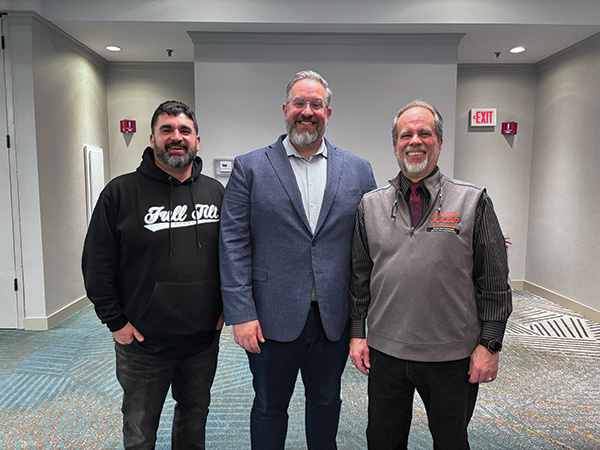 This message was felt strongly during AASP/MA’s General Membership Meeting in April at the Doubletree Hilton Hotel in Westborough. Members of the Alliance gathered to socialize and connect, absorb the latest industry info and take part in conversations that are key toward combating everyday challenges.
This was the first membership meeting since AASP/MA’s recent victory in their ongoing battle to fight labor rate suppression. Lobbyist Guy Glodis commended the Alliance for a job well done, as he gave an update on the formation of the Auto Body Labor Rate Advisory Board (ABLRAB) which began meeting virtually in April (see recap on page 16) and was expected to host its first in-person meeting in June to begin their study and review in order to make recommendations to the Division of Insurance (DOI) for a fair and equitable labor rate.
“It’s the first victory we’ve had in 20 years. It was a difficult fight; there are a lot of people on the other side constantly trying to stop us by putting out landmines,” relayed Glodis. Getting their voices heard by local legislators was a big part in landing this victory, therefore continuing communication with their local legislators is encouraged, especially as AASP/MA works to draw further support for their latest legislative push to move the Auto Damage Appraisers Licensing Board (ADALB) from the DOI to the Division of Occupational Licensure.
AASP/MA Executive Director Lucky Papageorg reminded members that they are business owners in the districts these legislators represent; therefore, “your name means 10 times more to them,” and they will welcome the communication.
One of the most talked about breakthroughs in recent times is the Society of Collision Repair Specialists’ (SCRS) blend study, which shed light on something collision repairers everywhere already knew – that blending takes much longer than full refinish. SCRS Executive Director Aaron Schulenburg briefed the audience about what initially led to the study and what actions have since been taken by the information providers (IPs) who have moved away from the long outdated “discounted 50 percent” measurement in favor of on-the-spot evaluations.
The study itself involved participation from the five major paint manufacturers. SCRS brought in DEKRA – the world’s largest testing, inspection and certification company – to audit the process. A comparative analysis was done based on 100 percent of full refinish using solid white, metallic silver and tri-coat which resulted in finding that it takes on average 131.59 percent more time to blend. “This is the data we presented to the industry. It’s good data to use in conversation,” Schulenburg pointed out, emphasizing that it is fuel for the body shop to use effectively in order to get fairly reimbursed.
SCRS’ study is really the only one available to the collision repair industry. Although the major IPs have indicated they have done their own studies in the past, “the IPs haven’t released their studies, but they haven’t rejected ours.”
He alluded to the many variables that have changed. Customer expectations have expanded over the years. Colors have advanced considerably in today’s world, and vehicle owners can spend over six figures on a vehicle. “All these variables play a role in what you have to accomplish today versus back then,” he noted. Effectively using the data isn’t simply stating “the study says,” but rather having the understanding and the documentation to be able to engage in better conversations, according to Schulenburg.
“The reason blending takes much more time is the preparation involved,” he stated, pointing to soap and water wash, an absolutely necessary step, especially with metallic paint but which is not involved with new and undamaged parts.
Repair planners have to know how to communicate so they can have conversations about the complexity of blending. If one is able to explain the care and prep that is involved in order to avoid visible panels, “it’s quite a different conversation than saying ‘the study says.’”
Training and communicating are key in helping shops get accurate pay for blending. It’s a practice a shop should adopt and make their own. “Make these conversations part of your process. Get people to buy into it as part of your facility. They will understand and reference it.”
“Lean on your refinishing supply companies companies,” Schulenburg suggested. “They have tons of documentation and information and were involved in the study. It’s a matter of employing all of your resources to build a more informed case.”
Schulenburg also spoke of the action SCRS, the Automotive Service Association (ASA) and the Alliance for Automotive Innovation (Auto Innovators) have taken with proposing landmark federal legislation – the SAFE Repair Act – which puts emphasis on safe, proper repairs and consumer protection.
He stressed there were shared concerns that the REPAIR Act legislation – championed by aftermarket parts and insurance groups as “Right to Repair” – had “nothing to do with consumer protection,” and therefore, they could not lend their support. Instead, they decided to change the conversation toward consumer safety by launching their own bill that “focuses solely on safety and preserving the consumers’ right to repair.”
This initiative and the other resources SCRS puts into play are all done in order “to try to have the right conversations on the right issues, develop programs that will have positive effects and be the eyes and ears of the industry.”
The meeting provided time for an open forum discussion on basic shop practices, launching an interactive conversation covering everything and anything from collecting customer pay to experiences with filing complaints to the ADALB. Tales about four-day work week trials and the associated wins and losses were shared as well as fears surrounding advancing technology like artificial intelligence (AI).
As the event came to an end, Papageorg infused the audience with motivation to take what they learned and use it.
“Put your plan into action, so you too can thrive in 25.”
Want more? Check out the June 2025 issue of New England Automotive Report!