
SCRS’ OEM Summit Sheds Light on Critical Performance of Safety Inspections
by Alana Quartuccio
 Mike Anderson (Collision Advice) wasted no time getting right down to the point. “Safety inspections are the number one thing keeping me up at night. And they are the single biggest friction point between insurance companies and collision repairers.”
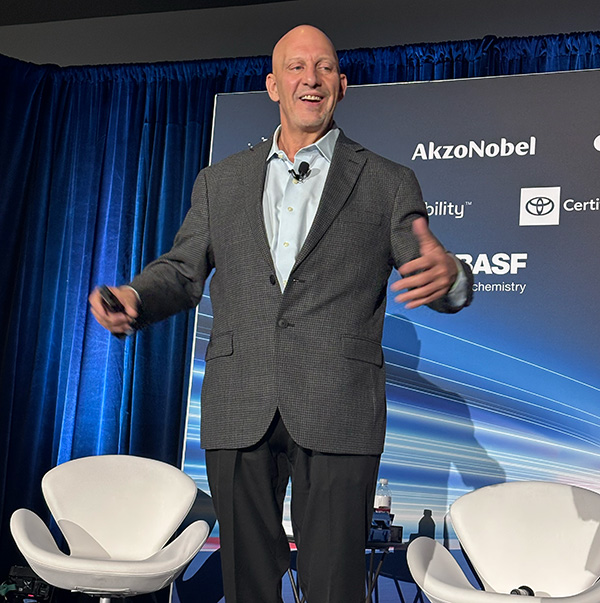
This year, the Society of Collision Repair Specialists’ (SCRS) designed its OEM Technology Summit to address the big concerns surrounding this crucial step that experts believe 98 percent of the body shops across the country are not performing.
Anderson moderated three panel discussions centered on OEM-required safety inspections for steering columns, SRS and airbags and seat belts, illuminating the fact that manufacturers state these inspections are crucial in a “safe and proper repair.” But the problem is that most shops are not doing them.
Proof lies in the minimal amount of mechanical labor hours shops are reporting nationwide. “When I see the average mechanical hours is less than two hours, I can tell you this industry is not performing safe and proper repairs,” Anderson relayed.
He welcomed Gerry Rosenbarker and Tyler Foote, both of Mohawk Collision (Schenectady, NY), and Andrew Batenhorst (Pacific BMW; Glendale, CA) to weigh in on the steps involved with inspecting steering columns as most OEMS state this step must be done following a collision. For example, Subaru has a nine-page document for the 2024 Outback specifying “all the things you’re supposed to inspect when the vehicle has been in a collision. We actually did a study in conjunction with a Subaru dealership, at a collision center out in Washington state, and we found that 26 percent of the steering columns we inspected were collapsed. Now let that sink in – 26 percent. Now, some people will question why they have to pay for that because they are focusing on the 74 percent that are not collapsed, but what is the value of a life?”
He pointed to the fact that “there is a lot of room for inaccuracy when measuring with tram gauges,” suggesting computerized measuring systems are superior. Anderson encouraged a loud “Amen” from audience members when he asked, “How many of you think that computerized measuring systems, if we have the steering column specs, would be much more accurate than tram gauges?”
Third-party payers may argue that a steering column inspection only has to be done in a front-end collision, but Anderson righted that misbelief. “We probably see as many, if not more, collapsed steering columns from rear-end collisions than we do front-end collisions.”
Visual cues are key in helping to educate third-party payers and customers. Batenhorst showed off a prop of the steering gear from a 2020 BMW X7 which he displays outside his office.
“There are two different electric motors that are belt driven inside the casing,” he explained. “They have precise machine teeth on the gears. These steering gears are not designed to take a shock load laterally without chipping the teeth off. When the teeth get chipped, you wind up getting a notchy feeling in the steering gear, and the motors can’t operate correctly. The problem is that none of that is visible from the outside, so I created this so the adjusters and customers can see what’s really going on inside.”
Showing an adjustor the procedures can also send the message home. For example, General Motors has a procedure for a safety inspection that is “three-inches thick,” according to Anderson. “It makes quite an impression on an adjustor if you show them something that looks like an encyclopedia,” Rosenbarker suggested.
Involving the customer in conversations about what is in the best interest of the vehicle also plays a huge role as it encourages them to make the necessary outreach to their insurance carrier. Ultimately, people want to feel safe. “Most customers purchase their vehicle based on safety ratings. They want to make sure it’s checked, and there is literally no way of inspecting it, without inspecting it,” he added.
Tyler Smith (Rick’s Paint and Body; Augusta, GA) joined the panel for the second session which dove into SRS and airbag inspection requirements. Upon following the safety inspection requirements for a Lexus vehicle, Smith’s shop discovered the airbags had been separated on the backside. Smith said, “They were bulging and the stitching was coming loose as well.” The mounts were also determined to be deformed. It was disturbing to note that “there were no warning lights on the dash and no diagnostic trouble codes on a pre-scan, but when his shop removed the airbags, there was actual damage,” Anderson pointed out.
“Understand that whether the insurance carrier pays for it or not, you must do it,” Anderson stressed. “It’s the right thing to do for consumer safety.”
Smith’s shop is so committed to doing the right thing that they lost their business relationship with an insurance carrier that comprised 27 percent of their business, due to the carrier’s reluctance to follow through with the facility’s commitment to safe repairs. “They told us ‘We don’t want to pay you for it, and we don’t care about it,’” Smith disclosed.
Unfortunately, collision repair facilities like Smith’s and Rosenbarker’s aren’t necessarily the norm. What may be even more frightening is that when prompted by insurance companies, there are certified shops and dealerships claiming safety inspections are not necessary.
Shedding even more light on how many shops appear to not be following procedures, Anderson noted one manufacturer that requires door replacements to have the airbag sensor also replaced. “They sold 13,000 doors this year and less than 78 airbag sensors.
“Ninety-eight, or maybe even 99.9 percent, are not performing inspections,” Anderson lamented. “We have to look in the mirror first before we look for an easy button. It starts with us. It’s a problem when carriers call a certified shop, and they tell them ‘safety inspections are not necessary.’ It’s a problem when they call the service department at a dealership, and an uneducated person says ‘you don’t have to do it.’ And it’s a problem when people do know about it, but don’t do it because a carrier won’t pay for it. That’s not right for the consumer.
“Every vehicle manufacturer says that seat belts must be inspected after a collision,” Anderson stated at the start of the third session. “And that is not just limited to seat belts used in an accident but any unused as well as child safety seat latches and tetherpoints.”
There is some good news as per the latest Who Pays for What? Survey, which shows 49 percent of shops in the country report they “always or most of the time” get an insurance carrier to pay for seat belt inspections. “That’s actually increased by 4.7 percent over the previous year. While we should be happy that shops are getting reimbursed,. based on my 300 days a year of travel, my concern is that most shops are not performing seat belt inspections properly. This is the one that keeps me awake at night the most.”
Nissan/Infiniti has a position statement that requires that all seat belts be inspected and that failure to do so can result in bodily injury or worse yet death. “That’s a pretty serious deal,” Anderson stressed the potential death sentence failing to inspect could cause. He recommends asking customers’ permission to remove the owner’s manual from their glove box and show them the cited seat belt inspection requirement, suggesting they contact their insurer and request the inspection be done.
Joining the third session panel, Bud Center (I-CAR) spoke of the feedback I-CAR seeks from shops by way of its Repairability Technical Support (RTS) portal created to learn about challenges and issues related to safety inspections. In the five years since the portal was created, only 96 shops have issued complaints. “There’s 40,000 body shops in the US. Every OEM says you need to measure steering columns or inspect steering gear, air bags and seat belts, and [I-CAR has received] only 96 [complaints] in five years?!” Anderson emphasized the troublingly low response.
“The good news is that the OEMs understand that it can be challenging and time consuming to put this information in, so they know it’s an issue,” Center explained. “We continue to have conversations with them to try to figure out how we can help with this.”
He announced I-CAR will host a virtual repair summit on December 4 “to get insurers and collision repairers together to understand the friction point from each side’s perspective. We can take that back to the OEMs to figure out how to address it and fix it.”
Anderson closed with a call to action. “Not doing safety inspections is not an option.”
Want more? Check out the December 2025 issue of Hammer & Dolly!