

Tremendous Takeaways from SCRS’ Repairer Driven Education
by Alana Quartuccio
The value of education is immeasurable. Everyone who spent time in the Society of Collision Repair Specialists’ (SCRS) Repairer Driven Education (RDE) classes at SEMA walked out with tremendous knowledge to take back to their shops – you just can’t put a price on that type of training experience!
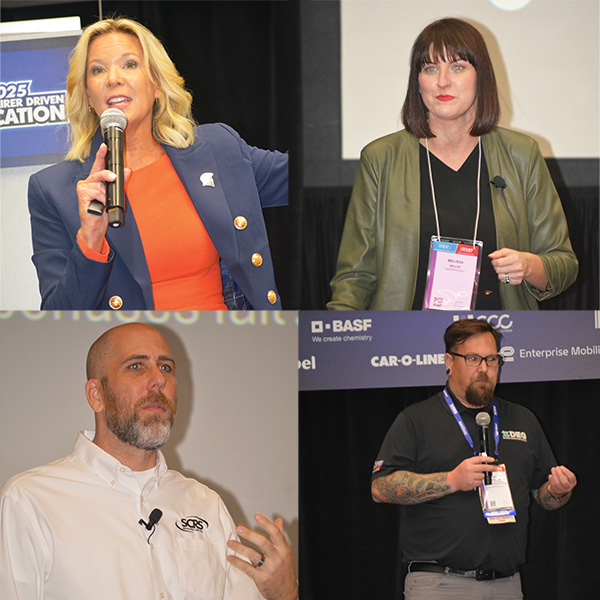 The educational slate had something for everyone as subject matter experts from all segments of the industry set out to inform collision repair professionals about everything from ADAS and business finances to repair planning and new technologies.
Leadership does not start with a management title, as Sheryl Driggers (Collision Advice) revealed with her “Winning Leadership: Influence, Impact and Driving Results in Collision Repair” discussion. “Every single person in this room can be a leader. If you have air in your lungs, you can influence someone else,” she stated, stressing that leadership comes from how one impacts the people around them.
The pathway toward good leadership starts with “creating a work environment where employees feel valued and appreciated. If they are committed to the mission of the organization and committed to each other, that is huge.”
When setting out to lead others, one must be mindful of their own emotions. Leading with negative emotions, such as fear and anger, will only lead to poor effects on the team.
Driggers suggested spending time getting to know team members and to not expect this to happen overnight. It’s a journey that takes time. “Don’t expect to go in on a Monday and know your employees well by the end of the day.”
Setting clear goals is also key. “Everyone on your team should know what it looks like to win.”
Maria Quintero and Tracy Dombrowski, also of Collision Advice, delivered pertinent financial insight to a packed house of repairers interested in getting a better understanding of how to manage their operations’ finances.
While making money is definitely a goal in business, offering money as a “bonus” does not necessarily have the positive impact that business leaders believe it will. Andrew Batenhorst (Pacific BMW) and Melissa McFarlane (Leaders Way) spoke about “The Unseen Effect of Bonus Plans in Your Shop.”
McFarlane sparked shop owners to think hard when she asked, “What if everything you knew was wrong?” People want more than having their basic needs met. Using the Pyramid of Peak Performance Conditions to illustrate the point, she showed them just how many things go into helping a person reach their full purpose.
Only 31 percent of the workforce is engaged in their work. That doesn’t just apply to the collision repair industry – it’s prevalent in all industries. Throwing money at people just doesn’t work. “Understanding the difference between a person’s needs and how they are related to money will help you understand that having bonus plans isn’t a great way for engagement and motivation.”
Batenhorst shared real experiences of offering monetary bonus incentives that only backfired. Positive outcomes will come from “tapping into intrinsic motivation.” People are not robots. He suggested finding out what keeps them engaged. “Creating conditions that will interest employees starts with getting the right people on the team.”
Danny Gredinberg of the Database Enhancement Gateway (DEG) showed collision repairers how to unlock accuracy with resources to help one’s team develop their best blueprints. Resources like the DEG can help correct labor times for certain operations; the information providers do consider the inquiries that come from the DEG. Every little win “moves the needle in the right direction.”
Educating customers upfront is crucial as he suggested repair professionals “be proactive, not reactive.”
He spoke of how the “power of .1 works” in repair planning.
A repairer may think a .1 line item must be an “easy” task when compared to a “complex” one-hour procedure.
“What if we took the one-tenth of an hour and looked at it in minutes. If instead of saying .1, I say six minutes, does it seem more complicated? Not everything has to be a .5 or one hour increment. If that is what it takes, that’s what it takes. Don’t be scared of the .3s or .8s. Now, you are validating and supporting what it takes to perform that step.”
Josh McFarlin (AirPro Diagnostics) and Adi Bathla (REVV) teamed up to address “Shaping the Future of ADAS in Collision Repair: A Community-Driven Approach.” McFarlin challenged the audience to think about what their confidence level is knowing the ins and outs of every ADAS feature their own personal vehicle has.
While pulling too fast into a parking spot recently, his vehicle’s automatic braking system stepped in. At that moment, it occurred to McFarlin that he was unaware of the exact speed that causes the system to kick in. Overall, the industry as a whole may still not have a full understanding of every single ADAS component, yet one must get past the learning curve in order to help customers get a full understanding of how these features in their vehicle work.
Communication with customers is key. It’s the repairer’s job to put the vehicle’s features back to the customer’s expectations before they had the accident. “If a customer has a feature turned off, find out why. It’s possible the customer doesn’t understand what the feature does.”
Attendees who spent time in “Automotive Advertising: The Road Map to Building a Successful Online Presence” learned about online tools to help promote their brand.
Content should be honest, suggested panelist Jasmine Shaw (Sokal) who explained why overly sensational claims otherwise known as “click bait,” a dishonest piece of media that won’t build any trust with one’s client base.
Be sure to check back with SCRS to find out when RDE courses will be available online at rde.scrs.com.
Want more? Check out the December 2025 issue of Hammer & Dolly!