

Consumer Safety Drives CIC Talks
by Alana Quartuccio
The acronym CIC may stand for the Collision Industry Conference, but it represents a whole lot more.
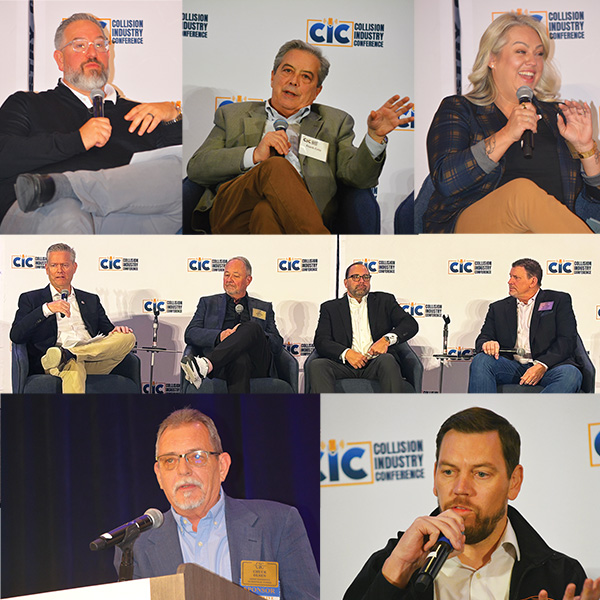 CIC also stands for its mantra – connect, influence and collaborate – yet it still goes even further than that. CIC brings all stakeholders who make up this great industry together four times a year with a shared end goal of keeping consumers safe.
CIC’s final meeting of the year took place in conjunction with SEMA in Las Vegas. From telematics to legislative goals and exploring business opportunities, every topic, every discussion, every takeaway was centered on making the industry a better place for the sake of the “empty chair” because protecting consumers is at the forefront of what this industry represents.
Various important points were made on the Las Vegas CIC stage, but most notably perhaps was Aaron Schulenburg’s (Society of Collision Repair Specialists) message that “a growing number of collision repairers from all over the country are voicing concerns about insurers lowering reimbursement rates for essential repair operations.” During the open mic portion, the executive director of the national collision repair association stressed that shops in every region and every state are “facing this pressure. We’re seeing a shift from prevailing competitive price to ‘reasonable rates’ without any definition of what ‘reasonable’ means. Zero documentation is being presented to repair facilities, yet somehow they have simply determined it’s enough, even though they’ve lowered these rates significantly from what they had recognized before.”
Schulenburg suggested all stakeholders need to come together “for the sake of restoring vehicle safety and for the sake of the motoring public who return to the roadways after leaving our businesses every day. The industry has to remain focused on fairness and reasonableness that actually supports and upholds safety, quality and sustainability in this industry. Consumers expect to be made whole, and they expect that every repair upholds the standards that we have addressed today to ensure that their vehicle, trust and safety are restored. It’s important that we talk about it, address it and figure out a path.”
In the words of Jill Tuggle (Auto Body Association of Texas), Right to Appraisal (RTA) is a “hot topic” right now. On behalf of the Governmental Committee, the Texas association’s executive director held a “fireside” chat with Justin Lewis (Accurate Auto Body and Washington Independent Collision Repair Association) to share the processes, struggles and wins both associations experienced getting mandatory RTA legislation passed in their respective states.
As was evident by a polling of the room, not everyone has a clear understanding of what this consumer right actually is, although it’s been a provision in insurance policies since the 1800s, Tuggle explained. As more consumers began to utilize the Appraisal Clause to recoup some out-of-pocket expenses, insurance companies started removing the clause from their policies. “We saw that trend, and we wanted to help solidify RTA for our customers,” said Lewis.
Great lobbying support was beneficial to both associations, and Tuggle stressed that grassroots efforts were a valuable tool as well. “Reach out to your local legislators and say you’d love to speak to them about what it looks like to be a collision repairer.” It doesn’t have to be about any current problem or legislative efforts. Taking the time to establish key relationships “lays the groundwork” for when it’s time for issues to cross their desk.
“If you do bring legislation, be very thorough. Don’t try to rush to try to get things done as it may not wind up being what’s best for consumers,” suggested Lewis.
The newly formed Business Operations and Management Committee made their CIC debut with the first part of a series that directly addresses collision repair facilities on how to strategically plan for the future. “You don’t want to wait until your business is in trouble and you’re worried about cash flow to make a plan on how to get out of that,” proposed Jeff Burton (Quality Collision Group) who moderated panelists Chris Chesney (Repairify), Jason “Buck” Zeise (LaMettry’s Collision; MN) and John Walcher (Focus Advisors) on how to diversify one’s business.
Subletting mechanical work is a big thing, but as Zeise suggests, “Let’s keep those dollars inside instead of sending them across the street.” He pointed to “modest growth” projections for the collision repair market of $37 billion (2024) to $42 billion in 2032 versus the “tremendous growth” on the mechanical side with $147 billion to $435 billion in 2032.
“People are keeping their cars longer, and people are fixing their cars. As collision repairers, we need to embrace some mechanical repairs and bring mechanical in-house to broaden the spectrum.”
The collision repair space doesn’t allow much opportunity for a shop owner to develop a relationship with a customer. As Chesney pointed out, it’s not common for a consumer to say “I got a guy” when it comes to the body shop. However, there are ways to develop a bond while the customer is in the shop. “Vehicles are complex, so there are a lot of things that you can do in the time that you have the vehicle in for a collision event to illustrate that there are things wrong with their vehicle, things that need to be serviced and maintained in a way that creates a relationship with them, so that you can perform some of those maintenance services without a huge capital investment in equipment.”
For those who do need to make a financial investment, Walcher suggests making a project plan. “When you’re looking at the ROIs, it isn’t the gross revenue that matters. That won’t get you your payback. It’s the net profit.”
The podcast-styled “The Industry Experiment” segment made its return to CIC, bringing Frank Cote, former chief deputy insurance commission and government affairs director for the Montana Commissioner of Securities and Insurance, to the stage to chat with segment host Schulenburg about what works and what doesn’t when it comes to consumer advocacy. Schulenburg posed the question, “What does consumer protection really mean to the Department of Insurance?” Cote referenced his state’s insurance code which “literally says in the statute that the Montana insurance department shall interpret these laws to the benefit of the consumer. That is very clear to me that we’re not there to represent the insurance industry or the body shops or whoever. We’re there to represent the consumer.”
The main reason consumer complaints would often be denied by the Consumer Affairs Division was because “consumers don’t understand what they are fighting for,” Cote explained. As a solution, they allowed body shops to file complaints on consumers’ behalf, so “an educated person was on the other side to respond to that complaint, and that ultimately helped resolve a lot of complaints in favor of the consumer.”
Cote confirmed that insurance departments are not very educated about issues as well, and he encouraged the collision repair industry to educate them, calling it “critically important.” In the few hours he spent at CIC, he became “fascinated by some of the things discussed on these panels. I’m sitting here wondering why aren’t insurance departments people in the room? It would be beneficial to have them be invited to this program, so they can see and understand the importance of OEM repairs and those kinds of things.”
Cote didn’t even hesitate to answer “No” when Schulenburg asked the million dollar question: “Do you think consumers get the representation that they deserve in the process?” He observed negative changes over the past 20 years which finds state workers underpaid, overworked and lacking education on the issues. He referred to one deputy commissioner who “pushed the department in a way that made it more aligned with the insurance industry that’s going to take years to overcome.”
His words of advice to repair professionals is to “work within your state associations, and make sure to get a good lobbyist. Work amongst yourselves to figure out what are the biggest challenges that you’re seeing and how you can address them. It’s important that you build relationships with the insurance department and your legislature.”
Moderated by Chuck Olsen (AirPro Diagnostics), the Emerging Technologies Committee expert panel weighed in on how to “buckle up” as software-defined vehicles, AI, telematics and more continue to infiltrate vehicles. Panelists agreed one of the big roadblocks is the lack of standardization among manufacturers when it comes to things like telematics.
“The way automakers provide the information is not consistent,” Donny Seyfer (DLS Consulting – National Automotive Service Task Force). “Sometimes it’s not even present.” Information may be attached to a technical service bulletin, but “technicians don’t want to read that far down. So that’s where it would be much more efficient to have something that tells them what to do. Some brands have that, but it’s not consistent across the board.”
“We’re all over the map,” observed Bernie Carr (CarrPoint Consulting). Ideally, “having something standardized so that the information coming off that vehicle, whether its brand A or brand Z would be the same.”
“The more data you throw at the technician, the less interested they will be in going through it,” suggested Florian Rhode (iProcess LLC) who called for a “consistent system that actually guides them through the steps based on the data. Not every technician has to be trained to understand tons of data just to do a simple replacement.”
Robert Vogt IV (Iosix) took things even further suggesting, “The whole industry should be ashamed of itself for making up targets. There’s no reason we can’t use the same targets. That was a complete miss.”
Andrew Batenhorst (Pacific BMW; CA) led the Parts and Materials Committee panel, made up of shop owners and parts suppliers, in talks about the issues surrounding OEM parts procurement strategies and conquest programs. Panelists weighed in on everything from customer expectations, the role of parts providers, alternative parts options and maintaining profit margins. Kyle Bradshaw (K & M Collision; NC) alluded to how “so many factors throughout the repair process can really derail” the process, so getting everything up front is key because “if it’s broken on the front end, you will start and stop, start and stop.”
Mike Anderson (Collision Advice) took the mic to call attention to the misrepresentation of the wholesales parts managers in this equation. “The wholesale parts managers do not have a voice in our industry, and they absolutely deserve one.”
As he observed from having done 42 wholesale parts managers workshops over the past 18 months, Anderson reported, “There are some wholesalers whose margins are shrinking so badly that they’re considering getting out of the wholesale parts business. If that happens, that is not good for any industry stakeholder. If you think we have cycle time issues today, wait until some wholesalers start getting out of this business. You’ll need to get parts from other markets, and there will be transportation costs. If our industry does not wake up and look at this, especially with the game of utilizing software to manipulate price matching for shops…It’s not good for our industry.”
Start making plans now for the first CIC of 2026 when the conference returns to Palm Springs, CA on January 22. For more information, visit ciclink.com.
Want more? Check out the December 2025 issue of Hammer & Dolly!