
SCRS Continues to Answer the Call, Give Repairers a Voice
by Alana Quartuccio
Sometimes success is measured by looking back at how far one has come.
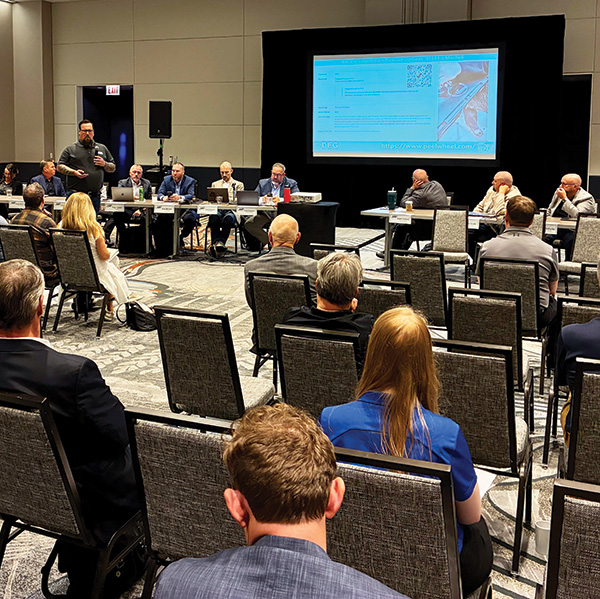 Society of Collision Repair Specialists (SCRS) Executive Director Aaron Schulenburg shared this message with industry professionals at the start of the July Open Board Meeting in Schaumburg, IL, inspiring all to think about their own journeys and what steps along the way may have had the most impact.
Sharing stories of SCRS members’ successes, Schulenburg relayed, “I think it’s important not to admire where they are today, but to look at what created it. It wasn’t luck. It wasn’t a single defining moment. It was years of decisions. Some that probably didn’t feel significant at the time and others that probably felt like impossible leaps of faith.”
“Maybe the choices we make about our standards, our independence and the investments we make in the people we support and our values become the stories of who we are in the future,” he continued.
Schulenburg noted that while SCRS works to serve the community by answering the call to give different industry segments a voice that’s larger than their businesses, expanding resources and investing in educational opportunities to provide better resources for those they serve, it’s ultimately up to the individual to make decisions that will impact their destination.
“My challenge to all of you is to not think about where you are in business today,” he said. “Think about the story you want told about your business in 20 or 30 years you will look back on with pride. Remember those moments that felt hard and the decision that changed the outcome. I hope you look back on meetings like this one today and know that’s when things started to change. That’s when you recognized what you could do differently. I hope you find one decision that you can make from our interactions with each other that will impact your business.”
Schulenburg noted some of the association’s latest developments, including the formation of the ADAS Repair Division and Governing Council in direct response to businesses who sought to have their own voice within the community of SCRS. He acknowledged that this division is in its formative stages and that it will be exciting to see how it grows. “A lot of people were talking about starting this division,” commented James Rodis, one of the Governing Council members Schulenburg noted as one of the first from the ADAS community to stress the need for their division.
“This is the right group,” Rodis said of SCRS. “There is no agenda up here other than fixing cars correctly.” He added that ADAS calibration education will be at the top of the agenda for the division.
Furthering their commitment to help improve the lives of those in the industry, SCRS announced it has partnered with Savi, a student loan navigation platform, to give members a new benefit designed to help them make sense of sweeping changes to federal student loan policy and identify potential savings.
If a member shop has employees with college-bound-aged children, this program is something they can offer to help those parents make those challenging financial decisions. The program is not contingent on the career path an employee’s student chooses.
SCRS members can get started with Savi by visiting
scrs.com/collegeplanning and logging into their SCRS member account.
To highlight the benefits of SCRS’ healthcare program for the SCRS audience, Karl Langenfeld of Decisely led a panel discussion with Kris Burton (Rosslyn Auto Body; VA), Maria Quintero (Body Builders Automotive/Collision Advice) and Michael Giarrizzo (DCR Systems). Panelists called the program “complaint free.”
Giarrizzo stressed the program is easy to manage and has lessened the administrative burden, which Quintero stressed as an absolute selling point for her. She says not only is it a great platform but it’s also bilingual, which is ideal for her Spanish-speaking employees. “It really takes a lot of the burden off me, as I was the one running around trying to get everyone enrolled. The simplicity of it is amazing. It’s a nice tool.”
Feedback from employees has been very positive. “They love it,” Burton shared. “It isn’t just about cost savings. It’s also the amount of coverage you get. More employees are taking advantage of it.”
“Employees really love the zero cost for co-pays and for prescriptions. We get a lot of compliments about that,” Giarrizzo reported.
On behalf of the SCRS Media Committee, Giarrizzo reported the association’s media campaign (via its YouTube channel, youtube.com/@SCRSCollision) had its best performance quarter in the channel’s history with 25,000 views, a 55-percent increase over the previous quarter, 706 watch-time hours and 120 new subscribers. He noted growth in existing users but the biggest increase was largely among new viewers.
According to Danny Gredinberg, Database Enhancement Gateway (DEG) administrator, 1,030 inquiries had been submitted between January and June with 51.7 percent resulting in a correction to the databases. He noted in total 745.1 labor units were added for body/mechanical hours, 166.6 total labor units added to paint and a total of $10,237 dollars were added in terms of parts to all three databases.
Gredinberg highlighted some recent wins including inquiry 41585 regarding the adhesive backing on the nameplate on the back liftgate for a Toyota 4 Runner. CCC changed the labor time from 0.3 hours to 0.4 to reflect the need to look up the OEM procedure in order to get the correct measurements to properly line up the emblem.
“It’s little things like that a lot of us may take for granted. You may walk by a technician and not notice the intricacies of what a piece of equipment takes to set it up at the right level, to make sure the car is level and not leaning to one side so the nameplate is in the right position.”
Gredinberg also shared inquiry 41183, which sought clarification regarding the removal and cleanup for residual adhesives while replacing name plates and badges. Mitchell confirmed the labor time was installation only. Clean up is a not-included operation.
Barry Dorn provided an update on the revamped SCRS’ Blueprint Optimization Tool (BOT), which the association has revamped from the ground up. “We are challenging all to take a look at it. It’s a phenomenal product and we’d love to get your feedback,” he requested.
Other meeting highlights included an Education Committee presentation from Zach Pucillo of KPA, who walked the audience through the various environmental shop hazards one must be aware of in order to avoid OSHA and EPA fines. He noted respiratory protection and hazardous communication as the top two citations collision repair businesses get fined for most. Pucillo spoke about the different forms of PPE such as loose fitting and sealed respirator masks, improper waste disposal and how to identify hazardous chemicals.
“If you do get a citation, you can request an informal conference,” he explained. “You’ll meet with the regulators to talk about the issues, and show your abatement to try to reduce your fines. In most cases, they will reduce it as long as you have shown you have done your part to comply.”
The meeting closed with strong messages about the great things that can be accomplished thanks to teamwork and speaking out. Schulenburg acknowledged the formation of new automotive associations forming in Michigan and Oregon and looks forward to seeing what the future holds. “Organizations don’t happen on their own,” he noted. “They happen because people care, show up and come forward with a plan to take the lead.”
SCRS Chairman Michael Bradshaw reminded all of the power of using one’s voice. He spoke of recent activity in North Carolina where members of the Carolina’s Collision Association (CCA) stepped up to fight proposed legislation “It was interesting to see everyone work together. Everyone used their voices to call their senators and representatives to share their own experiences about why this proposed legislation was bad, not just for them but for consumers.
“I encourage everyone to get involved because your voice matters and it can make a difference,” Bradshaw stressed. He pointed out how far CCA has come over the last 10 or 11 years since three people made the decision to form the association.
“They never would have imagined having a group that would get proposed legislation killed in a matter of five or six days because of the response from the membership who used their voice collectively. That didn’t exist 10 years prior.”
He acknowledged that it could be easy to get swept up in personal motivation, noting that some industry groups may operate for those reasons; however, those doing it for the right reasons should be commended. “There are groups and associations trying to move the needle forward for the right reasons for the betterment of consumers, the betterment of the industry, the technicians and the people within the industry, and I sincerely appreciate each and every one of you in this room who has made an impact or done something to better the industry.”
Want more? Check out the September 2026 issue of Hammer & Dolly!