

Capturing More: A Prescription for Profitability
by Chasidy Rae Sisk
Maintaining the health of your business is similar to nurturing your physical health; both require training, fueling it with the right supplies and managing stress. And when something seems out of whack, it just might be time to make a change.
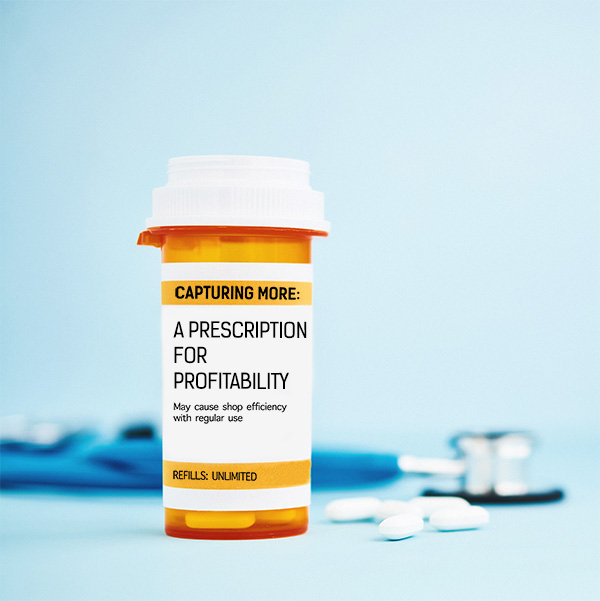 In last month’s Hammer & Dolly (available at grecopublishing.com/hd0725coverstory), several industry “doctors” prescribed repair planning as the right medicine for creating consistency and enhancing the customer experience, which results in improving profitability.
An accurate repair plan allows shops to know exactly what to anticipate throughout the repair process, reducing administrative burden and preventing workflow interruptions. It is not surprising that shops focused on capturing all parts, processes and procedures upfront report profitability increases.
“Of course, repair planning positively impacts profitability!” Barry Dorn (Dorn’s Body & Paint; Mechanicsville, VA) exclaims. “It helps us capture items we were missing before and other non-included processes that adjusters have always insisted we couldn’t charge for.” And that has additional benefits. “When you’re fully compensated for the work you’re doing, it enhances your ability to train and reinvest in tooling and equipment. If you don’t know the p-pages or what your cost of doing business is, it’s like playing a game without knowing how to score. If you don’t know the rules of the game, there’s no way you’re going to win.”
“Any time there are additional parts orders or supplements that could have been prevented, it adds an unnecessary administrative burden, and that’s a profitability killer,” Michael Bradshaw (K&M Collision; Hickory, NC) points out. “If you can capture everything on one order, you avoid all those extra steps. Additionally, 100 percent disassembly allows us to identify a total loss situation early in the process. The consistency created by repair planning has made dealing with third-party payers somewhat easier since they know what to expect when they come to our facility; they realize that things are going to be done in a specific manner.”
Kris Burton (Rosslyn Auto Body; Alexandria, VA) has had a different experience with insurers’ response to his shop’s repair plans. “They don’t like the details; they feel like you’re nickel-and-diming them even though you’re basing it on the OEM procedures. A lot of adjusters aren’t properly trained and want to apply what they’ve been told by other shops to our facility, so it’s up to us as repair professionals to do the right thing and recognize that we can’t repair every vehicle.”
Dorn agrees. “We still have frustration points with insurers, but repair planning has removed the hearsay. We have the documentation to prove why we need to perform certain operations, so their rhetoric is meaningless. When adjusters simply refuse to pay, the next step is to go to a customer pay model and educate the customer on the Appraisal Clause or their small claims options. We’ve seen a lot of success with Right to Appraisal because repair planning allows us to provide facts – not feelings, assumptions or fiction.”
Shops collect those facts through the blueprinting process which enables them to establish an accurate diagnosis that encompasses all of the vehicle’s aches and pains from the first appointment.
“Blueprinting the vehicle and creating a repair plan allows us to properly repair the vehicle,” explains Burton. His shop transitioned to repair planning to contend with advances in vehicle technology as “the requirements became too complex for a single person to remember everything. There’s much more going on now than before. Segregating roles allows our repair planner to focus on researching requirements. Identifying everything up front isn’t just right for the vehicle being repaired; it also benefits staff to recognize that they can only process so much information.”
At first, Rosslyn Auto Body encountered some challenges because “everyone estimates a little differently,” Burton acknowledges. “But when you go to a restaurant, your meal should taste the same – no matter who the chef is. Thorough repair planning has allowed us to build consistency throughout the process, creating more organization and improving the overall quality of repairs.”
Creating consistency can prevent quite a challenge since “no two accidents are the same, and no two vehicles will be damaged the same,” as Dorn notes. Since an estimate fails to capture everything wrong with a vehicle, “the vehicle must be disassembled and research must be conducted through the OEM databases, estimating software and estimate scrubbers to identify what’s truly going on and thoroughly detail everything that needs to be repaired or replaced.”
Dorn’s Body & Paint began the journey into repair planning 20 years ago in an effort to capture all vehicle damage from the beginning of the repair. “So many operations are commonly forgotten or missed, and we wanted to start capturing them,” Dorn recalls. “Inconsistent repair quality leads to decreased customer satisfaction and a high comeback rate. The clearest way to rectify those issues is by detailing every single operation needed on that vehicle and ensuring all the materials, parts and training have been acquired. When you follow the same process of collecting all that data upfront, it creates a consistent repair that leaves no excuse for incorrect repairs; you achieve the correct outcome each and every time. Our customer satisfaction ratings and comeback ratio have improved drastically.”
Repair planning “really helps to create a thorough, comprehensive and streamlined process,” according to Bradshaw. “We perform 100 percent disassembly and research the OEM repair information to identify all processes and procedures that will encompass the scope of that vehicle’s repair, including safety inspections, calibrations and so forth. That cuts back on unexpected supplements which create a ton of administrative burden and contributes to delays which decrease customer satisfaction. Repair planning helps our shop ensure we’re performing a correct repair in a more timely manner for our customers.”
The biggest change for Bradshaw’s shop resulted from having repair planners at the vehicle during disassembly, enabling them to engage in the process with the technician. “Writing the blueprint at the vehicle allows them to do a much more thorough job. Disassembly exposes the vehicle so we can identify the actual scope of repairs in its entirety on the front end, and that makes it much less likely that we’ll get 70 percent through the repair and remove a component only to learn a calibration is needed or a one-time use part needs to be ordered; we’re able to identify everything that needs to be done at the onset of the repair, which also cuts down on parts orders since we capture everything on the front end.”
Scott Ayers, Blueprint Optimization Tool (BOT) project development manager for the Society of Collision Repair Specialists (SCRS), weighs in. “A repair plan is what the repair facility creates to document a more in-depth outline of the specific operations, repair procedures and parts found once the vehicle has been disassembled, to restore it back to OEM standards. The advantage of creating accurate repair plans is setting better expectations upfront which allows you to have conversations with your customer to better establish what they can anticipate. That accuracy also translates to professionalism, where you can show you are the repair expert who is capable of diagnosing and ensuring a proper and safe repair. That attention to detail in the repair planning process can help speak to the quality of your work and build better trust and confidence with the customer that they chose the right facility to have their vehicle repaired. More accurate repair plans lead to better overall quality, efficiency and safe repairs. An accurate repair plan also better communicates and outlines the repairs that are to be done to the technicians so that everyone is on the same page about what the repair will entail.”
“Repair planning starts with blueprinting, which involves scanning the vehicle’s systems, performing structural measurement, determining suspension alignment and disassembling the vehicle to identify all damage which is all documented on a damage appraisal,” according to John Shoemaker (BASF). “The value of a repair plan is that you have each required process scheduled, so when the vehicle is ready to be repaired, all the parts, equipment and skill sets are available to move the vehicle forward through the shop very efficiently.”
“Some shops will say blueprinting and repair planning takes too long, and they would rather get the job in the shop quicker,” he continues. “Too often, they find that they missed a part or operation, forcing them to stop the repair process because either the part is required to move forward or a piece of equipment or the skill set required is being used on another repair. When a repair is stopped, it creates unwanted work in process (WIP) that causes interruptions in cash flow and triggers delays to other repairs which disturbs work processes throughout the repair facility. An inaccurate damage appraisal is most often the culprit to excess WIP as they cannot properly plan the repair so it sits and waits for either a part, a piece of equipment or a skill set.”
As repair planning becomes more prevalent, new software and tools are constantly hitting the market to assist shops with writing the most accurate blueprints possible, but the most important resource is the OEM repair procedures!
“When OEM repair procedures are reviewed, they identify the processes that are required to complete the specific repair,” Shoemaker stresses. “Properly identifying those procedures on the damage appraisal allows shops to build an outline of the repair.”
In addition to OEM procedures, K&M Collision relies on a variety of diagnostic tools in conjunction with estimating databases and other devices. Burton reports that his shop uses similar resources for creating an accurate repair plan. “We access several platforms to create a repair plan. More tools and software are available than ever before; you just need to learn how to use and apply them.”
Dorn’s Body & Paint adds materials tracking software to the list, allowing the shop to ensure that every piece of consumable material used in a repair is identified and added to the invoice.
But the biggest gamechanger to writing an accurate blueprint is SCRS’s BOT, which “provides an itemized overview of steps that ensures you capture all operations,” Shoemaker explains. All three shop owners agreed that the BOT enhances consistency as well.
“The BOT specifically helps to analyze and identify labor operations and line items that are often overlooked on a repair plan,” Ayers breaks it down. “It still places the decision-making in the hands of the repair planner using it, but it is designed to help build consistency, accuracy and efficiency in creating thorough repair plans. I would also argue that while it might help a newer repair planner make sure they haven’t missed items that the repair business is counting on them to capture, it can also help a more veteran repair planner simply improve output and efficiency.”
He acknowledges that there are a lot of other “useful tools and resources designed to help repair facilities account for the work they need to perform in the repair,” including SCRS’s Guide to Complete Repair Planning, “a free variation of some of the operations that make up the BOT, and the Database Enhancement Gateway (DEG), another free resource designed to help address errors or omissions in the estimating systems.”
Errors and omissions in a repair plan can be expensive. “Estimates that miss items can either lead to elements of the repair being overlooked, resulting in quality issues or comebacks, or overlooking billable items,” Ayers observes. “Inaccuracy consumes time and creates inefficiencies that cost shops money.”
Of course, implementing anything new comes with some impact in the form of a learning curve. “At first, work may appear to slow down,” Shoemaker warns. “But by implementing all the pieces of repair planning, shops will see that the vehicles that had a proper repair plan moves past the vehicles that were just pushed into production. That visualization of things slowing down will cause a shop to backtrack on the process and revert to their way of doing things. The best way to overcome that is to work with the repair team to develop a process that works for them that involves scanning, measuring and complete disassembly as a mandatory requirement. The impact that will be realized is they have fewer parts orders, the techs are actually busier because they are not moving a vehicle in and out of their stall but are repairing a vehicle that is ready to be repaired, and vehicles are being delivered on a regular basis.”
To overcome those challenges, he suggests “involving the people who are doing the work; explain to them what you want to accomplish, give them the criteria, so they can help build the process. Once the process is developed, it needs to be non-negotiable and must be followed each and every time. When they see a backtrack, they should stop the repair, use the team to evaluate why and either use their input to improve the process or reinforce the existing process.”
Employee buy-in is certainly a key factor for shops hoping to be successful with repair planning, but Bradshaw believes there are benefits for team members. “Once you get the process established, it reduces everyone’s stress levels. Our technicians, repair planners, parts manager, customer service representatives – everyone has more confidence in giving a delivery date and providing an accurate price quotation. We can focus on repairing vehicles because we aren’t distracted by dealing with unexpected complications that arise halfway through the process since we know what we’re getting into from the start.”
Burton agrees. “Giving people time to focus by removing the distractions and interruptions allows them to check the OEM databases, tell a story with the sheet and write an accurate repair plan.”
“It improves overall morale,” Dorn believes, though he acknowledges that “it requires a lot of discipline to achieve the desired consistency where the repair outcome is always the same, regardless of who fixed the car.”
Getting started is the first step, and as always, shops will get out what they put in.
“Consistency is the key to success,” Ayers insists, encouraging shops to “make that transition to holding your business accountable to more thorough repair plans earlier in the process, to create more efficiency, accuracy and better overall quality repairs.” He also notes that strong communication between all team members is vital for the success of repair planning, and he recommends that collision professionals attend training to enhance the education as well. “The more knowledge one has on the repair process and procedures can only help in the consistent, thorough and accurate building of repair plans.”
“We’ve created a really refined process around repair planning that allows us to write far more accurate blueprints than is common,” Bradshaw states. “As the industry evolves, we continue to refine that process and get better at it. If you’re looking for the most dramatic impact on shop profitability in the shortest amount of time, becoming serious about repair planning certainly fits the bill.”
“Change is always tough at first,” Burton admits, but he insists the effort is worthwhile. “Stick with it; don’t give up. It’s going to be better in the long run, so find the right resources and tools to support your team and keep working toward it.”
“It’s always difficult to start something that might be controversial or could add frustration and friction,” Dorn offers his input. “But with the way today’s vehicles are made, we cannot repair them the way we did decades ago…or the way an untrained third-party payer focused on cost mitigation wants you to repair them. We acquire our repair information from the manufacturers that designed and built the vehicles, and we need to follow those facts because the liability falls on us if a vehicle is not properly repaired. We have to be seriously committed to our customer’s safety, and that begins with identifying everything that needs to be repaired.”
The prescription for repair planning is in: take daily with optimism and hard work. Repeat as needed. Unlimited refills available.
Want more? Check out the August 2025 issue of Hammer & Dolly!