
Luxury Without Apology: The Dulles Coachworks Way
by Chasidy Rae Sisk
Stepping into the brand-new Bentley dealership near Dulles Coachworks (Sterling, VA), one might think they’ve accidentally wandered into the Ritz-Carlton. Between the full-service bar, a lounge reminiscent of an upscale hospitality hotel, the Formula One car parked casually to the side and 90-inch TVs everywhere, the building screams “absolute luxury!”
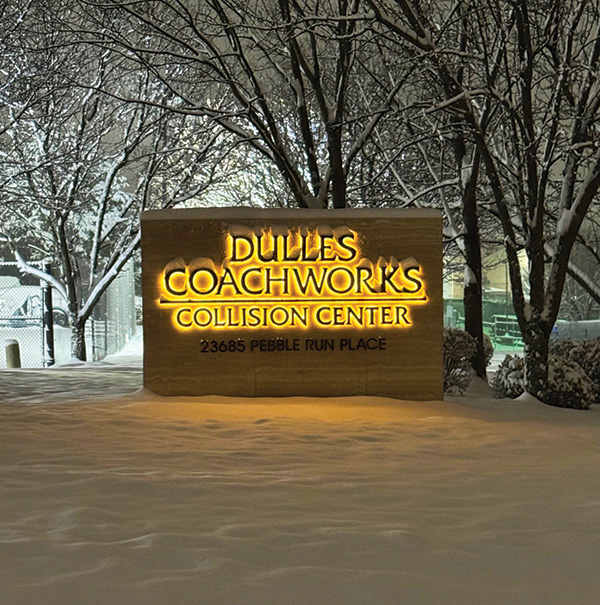 And that’s exactly the vibe Shaun Robinson, owner of Dulles Coachworks, is intent on duplicating at his collision repair facility which specializes in high-end vehicles and is currently certified by Aston Martin, Bentley, Lamborghini, Lucid, McLaren, Mercedes-Benz, Porsche, Rivian and Tesla.
“We repair luxury cars, so we’re going for more of a luxury collision repair experience,” Robinson says. “You aren’t just here because you crashed your car; you’re here because we’ve cultivated a reputation for doing things the right way and an environment that reinforces our commitment to taking care of our customers. We’re renovating the facility to reflect the caliber of vehicles we handle – glass walls for our writers’ offices, recessed lighting, and a second-floor lounge that will serve as the starting point for regional Lamborghini rallies.”
It’s a bold vision, but Robinson isn’t just a dreamer with a penchant for high-end cabinetry. He’s a realist who has built a successful, independent luxury facility by following a simple, albeit rare, philosophy: Keep your promises, do it right, and charge accordingly.
Robinson’s affinity for elite certifications is nothing new. For 13 years, he worked at a shop where he specialized in procuring high-end OEM certifications, but when COVID-19 hit and the world hit the brakes, Robinson found himself furloughed – a terrifying moment that ultimately turned out to be the catalyst for branching out on his own.
Dulles Coachworks had opened its doors in 2021, and Robinson received an offer to run the new facility, but before long, the original owners found themselves in financial straits. Rather than succumb to discouragement, Robinson viewed their loss as his gain. “I called a friend and explained my vision for the shop, and fortunately, he saw the opportunity. We became business partners; he put up the down payment, and we purchased the 3.5-acre property in February 2022.”
But Robinson had a lot of work to do to get the shop on the path he pictured. Starting with zero OEM certifications, he went on a relentless tear. Today, the shop holds nine major certifications, with a tenth (Audi) on the way. “We heavily depend on those certifications and the relationships we’ve developed with local dealerships,” he explains, boasting that the shop does “zero advertising” because their business plan doesn’t necessitate it.
An audacious strategy for sure, but the results speak for themselves. In its first year, Dulles Coachworks repaid that startup loan in full. They’ve grown from a $200,000-a-month operation to a powerhouse that generated $9.5 million last year.
Robinson largely credits the shop’s success to his business philosophy, though he acknowledges the challenge that it presents for many shops. “Insurers want to pay less and less. They refuse to pay for required procedures – even calibrations – and want to cut checks based on the third-party agreements they have in place, leaving the body shop with no room to make a profit. But we are a business, and if we don’t make a profit, we won’t be able to keep our doors open. If we allow the insurance companies to run over us, they will.”
While many shops try to walk the tightrope between insurance demands and manufacturer standards, Robinson refuses to play the game. He is unapologetically anti-DRP, with two very specific exceptions: Chubb and PURE. “I believe that a DRP and an OE certification are in direct conflict with one another. You cannot serve two masters; you either follow what the OE says and do it the right way, or you sell your soul and perform substandard repairs. If I didn’t have these OE certifications, I don’t see any other way to be successful other than being a puppet of the insurance company.”
His relationship with Chubb and PURE is built on mutual respect for delivering safe and proper repairs for the customer. “Fix the car correctly, bill them, and they pay the bill,” he says of the arrangement. “I can write a $90,000 repair on a Bentley, and the check shows up in a couple of days without so much as an inspection because they understand that insuring a luxury vehicle costs more because the repairs cost more; our pricing reflects our investment and expertise.”
For other carriers? Robinson relies on the “backbone” of his certifications. If an insurer refuses to pay for a new OEM bumper on a car where the manufacturer requires it, the conversation with the customer is transparent. “We tell them, ‘The insurer won’t pay for your new bumper, but the manufacturer requires it. Do you really want an aftermarket bumper on your Tesla?’ Typically, they do not, so they pay the difference. We balance-bill the customer when necessary, but we also educate them on the options for recovering those funds.”
But that cannot be a path that begins only when a problem arises, Robinson stresses. Dulles Coachworks focuses on extreme transparency from the moment the keys are handed over, asking which insurance company the customer is dealing with and immediately outlining the expected shortfalls. They educate customers on the Right to Appraisal (RTA), provide business cards for collision safety consultants and even help claimants navigate small claims court or insurance commissioner complaints. “I’d rather tell them the truth upfront, so they aren’t surprised three weeks later when the insurance company says no to everything,” Robinson explains.
As a member of WMABA, Robinson sees the value in networking with peers like Kris Burton, the association’s president, but he is also eager to see the association lean further into its role as a formidable advocate for systemic change. “Our industry needs a united, unwavering front,” he believes, suggesting that a direct approach is the most effective way to earn respect from insurers. “I speak bluntly and forcefully because it’s about transparency and accountability. We need to be an organization that stands firm on its word and encourages every member to do the same.”
Robinson’s recent email to an adjuster is a prime example of his no-nonsense approach. In response to the insurer’s attempt to arbitrarily cap a teardown on a Porsche Cayenne at three hours instead of the 15 hours recorded, Robinson hit back with documentation, actual labor records and a reminder of Virginia’s unfair claims settlement practices. “I asked, ‘Where did your $108 storage figure originate? Please provide the source and methodology,’” he reports. “We are a professional repair company. We bill for actual time and materials. Their refusal to reimburse the owner is arbitrary, and we aren’t moving.”
With 137 cars on the lot and $2.5 million in work-in-progress, Dulles Coachworks is a testament to what happens when a shop owner refuses to be the “insurers’ puppet” and focuses on consumer safety. Rather than yielding to adjusters’ demands or going broke to do the right thing, Robinson has chosen a new path: total luxury, total transparency and total profitability.
“We perform repairs the right way, and we charge accordingly,” Robinson concludes. “That’s what makes us successful.”
Want more? Check out the April 2026 issue of Hammer & Dolly!