
CIC Charts the Course To Clear Solutions
by Alana Quartuccio
It’s not up to one person – or even a small group – to have all the answers to the industry’s most plaguing problems.
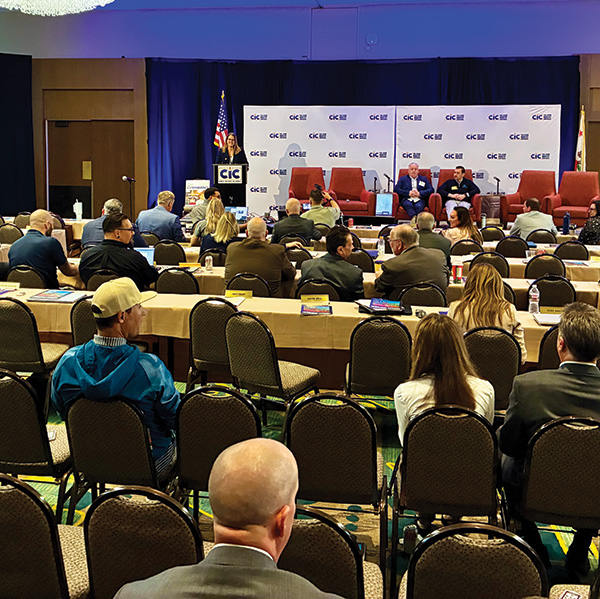 That’s the impetus behind the Collision Industry Conference (CIC): to bring people together from all facets of the industry to have the crucial conversations in order to chart the course toward finding the right solutions.
CIC Chairman Dan Risley (CCC Intelligent Solutions) made note of this during his opening remarks at the January CIC in Palm Springs, CA. “CIC isn’t here to create solutions and implement them. It’s here to raise up the issues so the industry can make good decisions and hopefully bring together some possible solutions that can evolve out of the conversations held at CIC.”
A profound example of this was clear during the open mic session when a topic of conversation that began at that very same mic 18 months earlier came full circle.
In response to Society of Collision Repair Specialists’ (SCRS) Executive Director Aaron Schulenburg’s open mic comments where he indicated concerns surrounding a potential merger between Repairify and OPUS IVS – two companies which had been known to enter into insurance company agreements – Keith Crerar, chief transformation officer for asTech, took the mic to apologize.
Calling collision repair shops the company’s “North Star,” Crerar said, “Collision repair shops are our core customers, and we don’t forget that. Truthfully, we don’t understand the cost of running a shop – the tools, the certifications and all that goes into it. We are a partner and provider to you all. We learned a hard lesson. We beg your forgiveness, and we will move forward in a different way.”
With AI continuing to evolve and infiltrate all aspects of the industry, it’s extremely important to keep open dialogue about concerns while simultaneously learning more about what is to come next. That was the mission of the Emerging Technologies Committee, which set out to research and identify some of the most cutting-edge examples of advanced technology.
AI won’t be taking the human aspect out of everything anytime soon, Scott VanHulle (I-CAR) reassured the audience, reminding all that there was once a time when it was feared that “ADAS would be the end of collision repair. Well, it didn’t happen. We are all still here.”
Fully autonomous vehicles are still “a long way away,” and there is still so much about AI today that is not fool-proof, he assured. Systems like ChatGPT and Gemini require the user to “still have to verify everything. It will hallucinate. It will make things up. You have to be really careful what you are using it for.”
Some may have a “knee jerk reaction,” thinking AI tools can begin to replace staff, but “you still really need educated people who know what they are doing. These tools can help get things done, but it won’t be able to blueprint a vehicle or do a tear down. AI is there to help but not replace [anyone].”
Laser welding is predicted to “be a huge game changer in the industry,” according to Dave Gruskos (Reliable Automotive Equipment), who believes this new form of welding will really be something widely used over the next five to 10 years.
“The Industry Experiment” brought nationally recognized litigator Rebekah Cooper (The Cooper Firm) to the CIC stage to converse with segment host Schulenburg about the litigation process in liability cases involving ADAS.
According to Cooper, whose law firm specializes in automotive product liability and ADAS, the occurrence of lawsuits involving negligent repairs is a trend we’re only going to see even more of. “It’s a new technology. The folks who have tons of experience fixing vehicles need new training to fix these advanced vehicles.”
The conversation underscored the importance of documentation – the first thing examined in the discovery process when a claim is filed. Documentation is key, not only to support the repairs that were done, but it’s also vital that a shop be able to prove the technicians involved were properly trained.
Schulenburg and Cooper’s chat hammered in on the fact that there is no question that the repair facility owns the liability.
“It puts body shops between a rock and a hard place when the right thing to do is different than what they are told to do,” Cooper addressed the role of insurance interference. “And if that is happening, document it and communicate it to the insurance company and to the customer. Put it in the repair records. The lawsuit is not going to name the company that wanted to pay less on the claim; the lawsuit is going to name the company that repaired the vehicle. I’m not saying that this is fair, but it is what is happening.”
How shops can find ways to grow from within was the focus of the Business Operations and Management Committee discussion, led by Amber Alley (Barsotti’s Body and Fender; CA) with panelists Michael Giarrizzo (DCR Systems), Kena Dacus (Dacus Auto Body and Collision Repair; KS), Tracy Dombrowski (Collision Advice) and Matt Boyd (Axalta).
Panelists reviewed various ways to use data to help make key business decisions. Boyd explained how his company offers the ability to create a market intelligence map to help shops identify the vehicles being worked on most in the area.
“Look inside your four walls and see how efficient you are,” advised Giarrizzo. Before pursuing growth by way of location, it may be smart to think about how to reinvest in the existing business. “Look inside your four walls and ask yourself if you are doing everything you can to serve the customer.”
Andy McDonald (Lucid Motors) and John Peixoto (Honda America) joined OEM Industry Relations Committee Co-Chair Liz Stein (Certified Collision Group) to examine the expectations involved with certification programs.
Stein provided an overview on behalf of Nissan/Infiniti’s updated connected car app, which now provides the vehicle owner with easy access to the crash information they input so they can send it to the certified repair shop of their choice. McDonald shared that Lucid plans to more than double their current certified shop network of 95 shops to 200 by the close of 2026. Peixoto provided the requirements of Honda’s EV certification program, which is separate from its standard certification that stands as a prerequisite for earning the electrical vehicle certification. He also reviewed Honda’s position statement on non-repair zones in bumper covers.
Advanced technology not only requires advanced skill set, but also advanced safety. The Parts and Materials Committee brought Dave Gruskos back to the stage to bring to light the dangers of dust and fume contaminants that technicians deal with regularly. “The dangerous carcinogens that are in shops are something that has to be dealt with. It should have been dealt with a long time ago, but it’s just coming into its own.”
“We have to keep our workers healthy and keep them working for a very long time,” he stressed about the cancer-causing carcinogens and silicates technicians come in contact with.
“It’s your job to read the label on something you are using,” he advised, adding his shock surrounding how many fail to do this.
He also pointed to the industry’s lack of wearing the proper personal protection. “Less than one percent of the industry wears a fresh air welding hood.”
Gruskos turned the mic over to Matt Pitta (Lucid Motors), who described the many ways the luxury electric vehicle manufacturer uses 3D printing in its tool development process.
It can take roughly three to six months to develop a tool with this technology; without 3D printing, it’d likely take about a year, according to Pitta.
What 3D printing technology should not be used for is attempting to create replacement parts. “Every six months or so, an article will pop up about insurers and MSOs discussing the possibility of creating headlight tabs, bumper brackets and clips, and we always shake our heads because the parts will never work the way they’re intended. Everything is designed to work in a specific way and to eventually fail in a specific way. You will not be able to create the part on the car with the same material it was made of; therefore, it won’t perform the way it should.”
Pitta says the OEM is open to suggestions from their certified shop technicians toward tool development, inviting them to upload submissions, photos and measurement ideas via a smart sheet. “If we think the tool has value and will help shops do the job faster, we’ll develop it, and if it makes sense, we’ll release it as a tool. Allowing shops to do their own type of development and submit it is a real benefit to an OEM program. It gives them a sense of contributing, helps make the job easier and puts us over the top as far as repair quality and ease of repairs.”
Estimating and Repair Planning Committee Co-Chair Danny Gredinberg (Database Enhancement Gateway) delivered a detailed report of recent included and not-included operation changes from the main three information providers’ P-Pages.
No updates were made to Mitchell; however, some submissions via the DEG were said to be “taken into consideration.” He also pointed to some changes to Solera that came about via DEG inquiries.
Focusing on CCC via MOTOR, he highlighted how to go about identifying updates via visual indicators. “The estimating worktime premise is something that should be kept near and dear and should be always referenced during the repair planning process,” he offered. He pointed to operations such as “the use of a scan tool for aiming procedures is now considered an included operation” while adjusting tire pressure, creating and assembling targets and filling the gas tank are not included.
He reminded the CIC audience to “always reference the latest version of the P-Pages to make sure you are working with the latest information. The most up-to-date versions are available, and you can always reference the DEG. Always reference the OEM procedures as well.”
Repair Process and Procedures Committee Co-Chairs Kye Yeung (European Motor Car Works; CA) and Barry Dorn (Dorn’s Body and Paint; VA) led a panel discussion to examine the alarming concerns surrounding welding certification.
Many factors may contribute to poor welding results, from lack of training to even just poor eyesight, but what is absolutely clear is that “these cars are missiles going down the road. If these welds aren’t done right, you can seriously put someone’s life in danger,” panelist Jason Patterson (Southern California Collision Equipment) alluded.
Ben Cid (Mercedes-Benz) shared the requirements of the OEM’s certification program – two weeks of mostly hands-on training requiring technicians to master six welds. Upon completion, they are required to return to the training facility for two more days to further prove their skill. If a shop is found to not be following procedures, Cid said the shop will lose their welding certification. “We can’t see every car that goes down the road, but we make sure to give them the tools to [do it right].”
Despite the thorough Mercedes program example, there are many questionable requirements for welding certification all around the industry. “Maybe some of these certification programs need to be reevaluated,” Yeung suggested. In some cases, a shop can purchase the right equipment and obtain a certificate to hang on the wall, but the skill set behind it may be in question, and the customer is no wiser to what qualifies as proper certification.
Just because one has experience doesn’t necessarily mean they have the knowledge, Dorn pointed out. “I think the assumption is that because a person has been welding for 10, 20 or 30 years that they are experienced, but experience does not equal knowledge. When we aren’t welding as much as we used to historically, we fall out of that. Couple this with the perfect storm that a lot of managers and owners today don’t have hands-on experience, are unaware and of the assumption that everyone knows what they are doing, but may not be the case.”
Don’t miss out on the next CIC set for Wednesday, April 22 in Charlotte, NC preceding the Southeast Collision Conference. For more information, visit ciclink.com.
Want more? Check out the March 2026 issue of Hammer & Dolly!