
Spotsylvania Career & Technical Center
by Chasidy Rae Sisk
Collision repair instructors educating the next generation of shop employees face a number of challenges – from budgetary constraints to industry engagement and everything in between – but for Curtis Harrelson, instructor at Spotsylvania Career and Technical Center (SCTC) in Spotsylvania, VA, lack of time is the biggest obstacle.
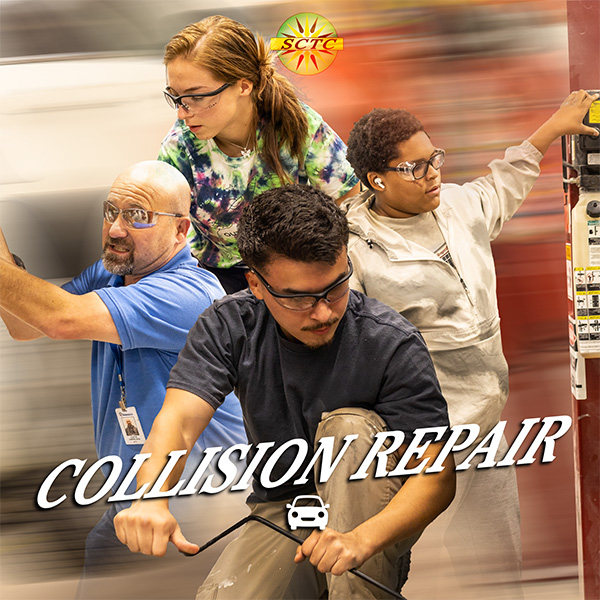 The two-year collision repair program is broken into level one, which focuses on non-structural analysis and damage repair, and level two, focused on refinishing. Class time rotates every other day for the two levels, with students receiving 2.5 hours of training on their days in the shop. “Over the course of the two years that my students are enrolled in the program, they spend less than two months in the shop if you translate that time into eight-hour workdays,” points out Harrelson, who has been teaching collision repair for over two decades, first at Osbourn High School (Manassas) and at SCTC for the past seven years.
Those time constraints are compounded by the overall lack of knowledge that most students have when they enter Harrelson’s program. “One of the most common complaints I’ve heard from shops hiring graduates from any technical center or school is ‘they should know more,’ but imagine hiring someone who doesn’t know the difference between a ratchet and pliers, someone with no idea what a universal joint is. Would you expect them to complete a full structural repair on their own after less than two months? Students enroll in my class to learn the basics, and I have to teach them from the very beginning.”
Five high schools from around Spotsylvania County transport students to SCTC, and this year, Harrelson has 55 students enrolled between the two levels. Level one, designed for 10th or 11th grade students, starts with teaching about tools, auto body parts and general vehicle construction. After ensuring they’ve obtained a basic understanding of the concepts of collision repair, Harrelson educates students on the proper safety precautions they must take before beginning hands-on instruction on damage analysis and repair, including welding and plastic repair.
Once a student has successfully completed that course, juniors and seniors can advance to level two where they will advance their knowledge of structural repair and start learning the refinishing aspect of the body shop, covering everything from prep and masking to undercoats, color coats and clears.
Harrelson relies heavily on his strong advisory committee to guide his curriculum, and he’s always happy to add more members who want to be part of the program! “Our advisory board meets annually to discuss the most relevant aspects of modern collision repair and help me figure out how to incorporate that into our day-to-day operations in the program. They’ve been vital in identifying what tasks are phasing out and what is becoming most important, whether that’s plastic repair, aluminum or ADAS calibrations.” He also leans on his personal relationships with members of WMABA’s Board for guidance, and he’s fond of utilizing articles in Hammer & Dolly to educate students on the industry outlook, body shop operations and soft skills.
Comprised largely of shop managers from Crash Champions and Caliber Collision, along with a few independent shops, SCTC’s advisory committee also contributes support when Harrelson is completing ASE recertification, and he’s particularly grateful to committee members for their involvement with the regional and state SkillsUSA competitions. “The majority of our board participates in SkillsUSA, helping us set up, prepare students and judge the competition.”
It’s especially beneficial when the advisory board visits the shop and engages with students in the classroom. “Several of our members come in on a monthly or bi-monthly basis to watch the kids work and offer feedback on the tasks we’re performing in class,” Harrelson shares. “I really appreciate them taking time away from the shop to show up because it has an obvious impact on the morale of my students, especially those who are planning to enter the industry after graduation. I’ve noticed that they become more focused and dedicated to enhancing their skills after these interactions.”
The opportunity to build those relationships presents a benefit to the shops as well; once students graduate, they’re more likely to apply for positions with people they’ve already met. “Many students are afraid to walk into a shop and ask if any job opportunities are available,” Harrelson acknowledges. “Being able to seek out a familiar friendly face makes it a little easier. I also help with job placement by building relationships with local shops and dealerships to ensure I know who is hiring and can recommend where students submit an application. I even have former graduates come to me a few years down the road when they’re looking for a new job, and I’ll help place them.”
Still, time plays an inhibitive role in students entering the workforce. “Even if I manage to teach them everything in the auto body world while they’re in this building, I just don’t have the opportunity to teach them an eight-hour workday,” Harrelson laments, noting that many struggle with moving from school to a full day of labor. “They need to develop the stamina to spend eight straight hours in the shop, and I think those who have the opportunity to move from school to a part-time gig before joining the workforce full time tend to be more successful.”
He wishes that more independent shops would offer apprenticeships to help students with this transition. “The big MSOs have developed their own apprenticeship programs, but they have age constraints and will only accept people who are 18 or older. Independents and dealerships don’t have those limitations, but they don’t always know how to find their local schools.” (Shops interested in identifying the closest schools with collision repair programs can reach out to WMABA for assistance or utilize the School Locator search features on ASE’s and the Collision Repair Education Foundation’s websites.)
Seeing his students’ success is the most fulfilling part of Harrelson’s job! “When I visit a shop and see a student (or even two students) developing their craft, that’s very rewarding and reinforces that I’m doing what’s right for the next generation of collision repair professionals.”
But he cannot do it alone. Their future employers must also be willing to invest in these students, and Harrelson suggests that developing a fair incentive program for seasoned technicians to mentor new employees could make a huge difference. “These kids don’t know everything, so someone needs to be willing to mentor them, but often, mentors complain that ‘helpers’ slow them down and cost them money. Shop owners need to incentivize those mentors while also paying these young people a fair rate to keep them engaged. It’s an investment, but it will pay dividends in the long run.
“Allowing new employees to try out different roles may also inspire them to stick around longer,” Harrelson adds. “Is an apprentice better in the body shop or paint booth? Maybe they’d excel in the parts department or as a customer service representative or estimator. Giving them exposure to every aspect of the shop allows them to learn more and be more valuable to the facility.”
Although such an investment may seem challenging for smaller businesses, Harrelson insists it’s in every shop’s best interest. “The only way to secure our industry’s future is to hire these young people and be willing to teach them. Every one of us started somewhere, and we all needed someone to help us learn. Getting them in the door and then supporting them to take the next step is key to keeping this industry rolling today and in the years to come.”
Want more? Check out the February 2026 issue of Hammer & Dolly!