
Industry Advice Ask Mike: How Is the Industry Doing with Scan Tool Training and ADAS Education?
with Mike Anderson
This month, we “Ask Mike” to share his thoughts on how well the industry is doing with addressing the demand for scan tool training and ADAS education. We at Hammer & Dolly hope you find the following exchange useful, and we encourage you to reach out to us if you have a question for Mike on this or any industry-related matter that he can answer in a future issue.
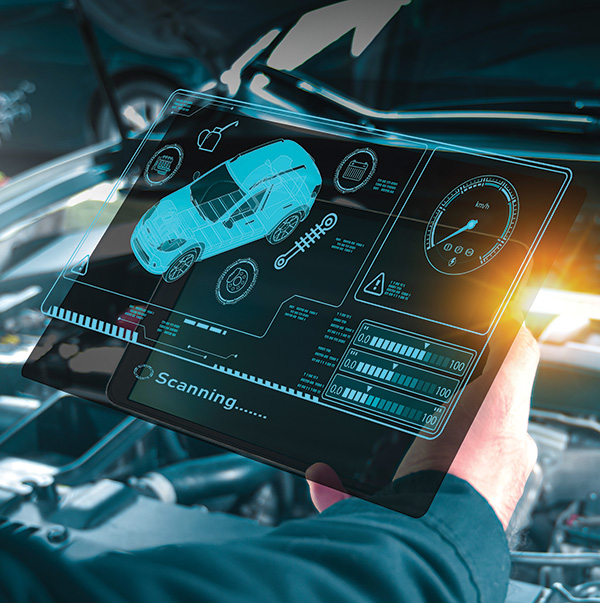 Hammer & Dolly: I recall being at a Collision Industry Conference a few years ago when you spoke adamantly in support of OEM scan tools. Obviously, scanning has been an industry topic for well over a decade now. What do you see as the current state of OEM scan tool usage in collision repair? Have things progressed positively, or do we still see gaps in education, training and adoption with those tools?
Mike Anderson: One of the things that John Yoswick [CRASH Network] and I ask in our ‘Who Pays for What?’ industry survey is what shops are using to scan vehicles. Are they using an OEM scan tool, or are they subletting out those scans? Are they using a remote scanning service? How about Autel or Snap-on?
As we’ve published those results, we’ve seen OEM scan tool utilization increase. What’s interesting is that the percentage of shops that use third parties – such as AirPro, asTech and OpusIV – has generally stayed the same. You have companies like Connected Automotive Systems (CAS), which is in Massachusetts, that sell factory scan tools and provide training and support. With insurers now restricting what they will or won’t pay for with scan reimbursement, we’re seeing more shops purchasing their own scan tools and bringing scanning in-house.
Excluding scan tools for European models, which are more expensive, a lot of OEM scan tools are quite affordable. We’re seeing somewhat of a split; some shops will buy the OEM scan tools for the majority of vehicles they repair, and they’ll use a dealer or a third party for the vehicles they only repair occasionally.
One problem area is that there’s still little to no training available to teach people how to use the factory scan tool properly. The industry still lags in that respect. We do our industry a disservice when we have our wash rack people hook up a scan tool. It’s more than just hooking up that tool; it’s understanding how to utilize it as a tool. There are certain nuances to using it properly.
For example, Honda/Acura doesn’t give you a diagnostic trouble code [DTC] if there’s an SRS problem. You have to go in and look at the live data. A lot of shops don’t know how to save scanning reports to the cloud so they’re in there as history for that OE manufacturer. There’s still a huge lack of knowledge in how to properly use a scan tool.
Additionally, a lot of people still have a flat fee for scanning. I just don’t think that’s wise. You still have to do guided fault findings, or GFFs, which determine the cause of the DTC and problem-solve it. It’s not like every code can be cleared. Sometimes, there’s a cut wire, a bad ground, a component that needs to be replaced or another issue. I think it’s a mistake to lump everything into one flat fee, because there’s more to the process than just clearing codes. A professionally-trained technician is going to know that.
H&D: If the OEM side still has gaps in training, would it be fair to say there’s an even greater dilemma in that respect on the aftermarket side?
MA: I would say the aftermarket offers a little more support in how to utilize their tools, just because their tools are somewhat standardized in how they’re operated. Some OEMs, such as Toyota/Lexus, offer training as part of their certification programs, but that’s only available to their certified shops. Nissan/Infiniti created an e-learning module for certified collision centers to take to utilize their scan tools, but that’s obviously limited to those shops as well. I was on General Motors’ website the other day, and they offer an e-learning module that anyone can take. Some OEMs offer more training and support than others.
Additionally, software issues often come into play. People will try to install two different pieces of OEM scanning software on the same laptop, and those software pieces don’t play well together. Shops need someone familiar with how a particular piece operates to ensure that it’s working properly on their laptop.
H&D: As we move forward in 2026, how would you like to see the industry step up with its ADAS training?
MA: Years ago, Collision Advice collaborated with Nissan/Infiniti to provide hands-on ADAS training specific to their vehicles, scan tools and targets. Unfortunately, that training started right as COVID began. Nobody attended the classes, and Nissan/Infiniti ultimately had to pull the plug on it financially. I’m not saying this just because we delivered the training, but it was the single-best ADAS training ever provided to the industry. If Nissan/Infiniti were to relaunch that training today, every class would be sold out.
There’s not really much OEM-specific training available to anybody and everybody. There’s a huge opportunity for the OEMs to launch more ADAS training. I still believe that most ADAS calibrations are not done properly, and that’s very concerning to me.
Want more? Check out the February 2026 issue of Hammer & Dolly!