
Time to Step Away: John Shoemaker Retires
by Chasidy Rae Sisk
From body shop helper to Air Force technician, from shop manager to business coach, trainer and mentor, John Shoemaker has had his hands in just about every aspect of the collision repair industry over the last half-century, but the time has come – as it eventually does for everyone – to step away from the field he loves.
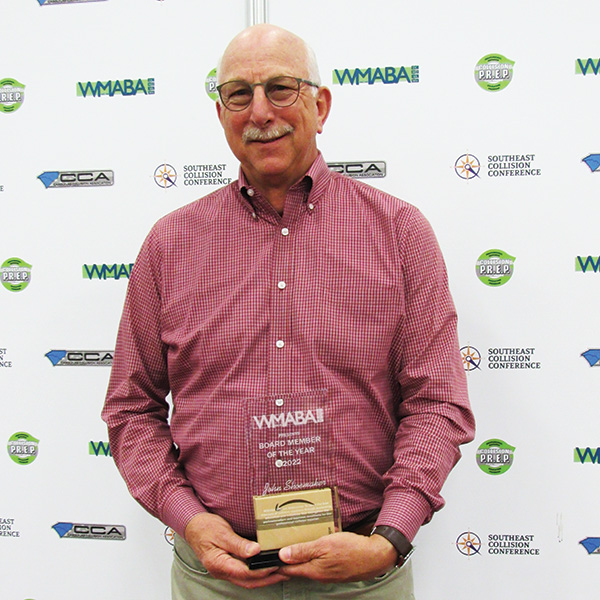 In the weeks leading up to his retirement earlier this month, he sat down with Hammer & Dolly to reflect on his career and what the future holds.
Hammer & Dolly: You began your career in the collision repair industry over 50 years ago. What sparked your passion for this industry, and how did that guide your career?
John Shoemaker: My friend’s father owned a body shop, and I would go to the shop with him after school. I liked watching the dents being repaired and seeing how the cars looked after being painted. I seemed to like it more than my friend and ended up going there a lot by myself. I would help clean up, and I learned how to fix small dents and how to prime and paint on old parts.
H&D: You started in the industry young, as a body shop helper; how did your career progress from there?
JS: I worked as a body shop helper at the age of 14. It actually took around 24 years to go from being a body shop helper to a shop manager as I joined the Air Force and really didn’t get back into the collision industry until I retired from the Air Force.
H&D: Why did you decide to enlist with the Air Force?
JS: I lived in a very small town in Oregon where there wasn’t much opportunity. My ambition was to be a firefighter, and it appeared joining the Air Force was my best option to reach that dream. Although I accomplished my goal, I was injured in an accident – not related to firefighting – and due to the recuperation timeline, I was reassigned to vehicle maintenance because of my advanced mechanical skills.
H&D: What was your career path during your military service?
JS: I spent most of my military career in vehicle maintenance as a technician, performance analyst and vehicle maintenance manager. This unknowingly groomed me for my adventures after retiring from the Air Force.
H&D: What did you do when you returned to the civilian sector, and how did your military background serve you throughout your subsequent career?
JS: Through my retraining in the military, I was given the opportunity to enter a vehicle maintenance manager program that provided training in personnel and operations management. As part of the program, I had to work in each department to understand what was required to oversee those different departments. This made me well versed in all aspects of vehicle repair and the skills that technicians needed as well as how to manage the operations.
When I returned to the civilian sector, I went to work in a dealership service department. I worked with the operations director to organize schedules and various other tasks. One day, I was asked what I knew about the body shop, so I explained my military training and how I had to work in the different departments and that the body shop was one of my favorites. The next thing I knew, I was managing the dealership body shop.
H&D: How did your career progress from managing shops to consulting, training and coaching?
JS: One of the key pieces of my Air Force training was to learn how to manage what matters. I learned very quickly about the different key performance indicators in the collision industry, and I learned to manage them very well. So much so that I received several accolades from the paint manufacturer we used for excelling in performance in sales per square foot, paint hours per repair order, paint cost per paint hour and overall sales, most of which I coach shops on today. I also became very proficient in utilizing their management system, so I was often asked to give advice to shops that were struggling.
One day while I was at lunch with the paint jobber and a couple of people from the paint company, they asked if I would be interested in consulting. That discussion went on for a couple of months, and in August 2009, I opened JSE Consulting and began working full-time with shops, most of which were customers of the jobber and paint manufacturer. In 2015, BASF reached out to me about working with them exclusively, and after some negotiations, I closed my business and became their employee as a business development manager.
H&D: Tell me a bit about your involvement with WMABA, the Collision Industry Conference (CIC) and other industry associations. How and why did you get involved?
JS: I was encouraged by a co-worker to get involved with the Hampton Roads Autobody Association which was an auto body association in Southeast Virginia at the time. I ended up being president of the organization for about six years. During that time, I met Barry Dorn and Jordan Hendler from WMABA and would reach out to them for help with getting things going with HRAA. One year at NACE [National Autobody Congress and Exposition], I met with Jeff Hendler who told me about CIC. HRAA dissolved because of membership issues, so I focused on WMABA and became a Board member.
H&D: What roles have you served?
JS: I was the president of the Hampton Roads Autobody Association. After that organization dissolved, I focused my attention on WMABA and became a Board member and the treasurer for the association.
H&D: Anything memorable from your time with WMABA that you’d like to share or reflect on?
JS: In 2022, I was selected as WMABA’s Board Member of the Year in recognition of the many parts of the organization I worked on. Within WMABA, there are many sub-committees, and it seems I have been involved in most of them at some point or another.
H&D: What do you see as your greatest professional accomplishment?
JS: Guiding young people in the collision industry. I have been an advisor to the collision program at New Horizons Regional Education Center since 1999. I have also been on the advisory councils of Tidewater Community College, Chesapeake City Schools, Forsythe Technical Center, Guilford Technical College and Northern Virginia Community College, where I’ve focused on curriculum needed by the industry and mentoring students through the programs and coaching them through job fairs.
I have also worked with SkillsUSA in Virginia, North Carolina and South Carolina. As I look around the industry, I see people I worked with in vo-tech schools who have become very successful in the collision industry. To me, that is the greatest professional accomplishment.
H&D: Why did you decide to retire now?
JS: I felt the time was right. I tried retiring a couple of times in the past, but other people convinced me the time wasn’t right – and yes, they are still trying, but I think it is time now. The problem is, I love what I do, but as you pointed out, I’ve been at this for a long time, and it is time to not get up every morning and go to work.
H&D: What are your plans for retirement?
JS: I have several people who have asked if I will still do some independent consulting and coaching, which I believe I will do. I still love helping people be successful, and I don’t think that is a switch I will be able to turn off immediately.
H&D: What will you miss the most?
JS: I will really miss walking into shops, working with the people and knowing that I left things better for that business. The slogan for my consulting business – which I still post at the bottom of my emails – was ‘working with collision centers today, to change the habits of yesterday, to develop sustainability for tomorrow.’ That has always been my goal, and I believe I deliver on that every day. Walking away from that is going to be a difficult step.
H&D: What will you miss the least?
JS: I won’t miss traveling so often or spending multiple nights away from home, but the business is great, so I’ll miss that part even as I enjoy spending more time with my loved ones.
H&D: What have you learned over the past 50-plus years that you wished you’d known sooner?
JS: There are a lot of places to get information to help you succeed. Once I became involved in organizations like CIC, SCRS, WMABA and others, my ability to be successful grew.
H&D: Do you have any advice and/or parting words for your industry colleagues?
JS: It comes from a Simon Sinek book, Find Your Why. It is very important to know your ‘why.’ Knowing your ‘why’ will drive you to incredible success as it helps you find greater fulfillment, develop more confidence and allow you to make a positive impact on those you meet.
Given his many successes and all the lives he’s positively affected over the past 50 years, it’s obvious that Shoemaker found his “why” – and we’re all grateful he did! Congratulations on your retirement!
Want more? Check out the January 2026 issue of Hammer & Dolly!