
It Can’t Happen Here
by Janet L. Keyes, CIH
Some people read the Sunday Times. Some read blogs. I read OSHA serious accident reports. They’re useful – but scary – guides to what can go wrong.
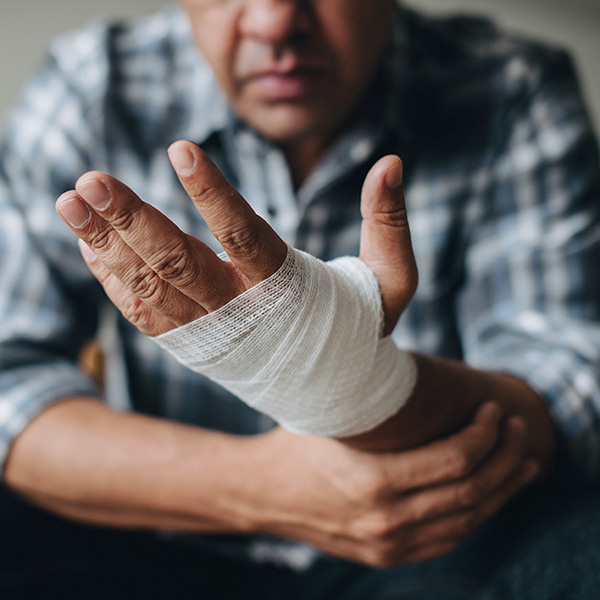 OSHA requires prompt reporting of any injuries that caused amputation of any body part, loss of an eye or overnight hospitalization. Those reports might trigger an inspection; at the least, they’re likely to trigger an inquiry from OSHA to find out what happened. And the reports get added to OSHA’s database (if you want to look them up, go to osha.gov/severe-injury-reports).
What did I find when I looked for the serious injuries reported for body and mechanical shops? The most common serious injuries for both types of shops were fractures, followed by amputations. Vehicles accounted for the most mechanical shop injuries, followed by tires and floors. For body shops, it was the floor (slips and falls), followed by vehicle and mobile equipment parts, metal chips, jacks and fuel. But that’s all abstract. What were some of the more notable incidents?
Belts and tires – especially tires, seem to cause a lot of finger amputations. An employee mounting a tire caught a finger between the rim and caliper. One person’s thumb was caught in the tire machine as it lowered to break the bead from the rim. Another lost a fingertip when he tried to determine if the tire was coming off the rim while it was spinning. A mechanic was hunting down a wheel bearing noise by spinning the tire and listening with a stethoscope. As he did so, his right hand slipped into the rim, catching his fingertip. The lesson: getting fingers between tires and rim is a good way to lose a fingertip.
Getting fingers around moving belts will do that, too. An Illinois technician lost three fingers when his hand was on the motor belt as a co-worker started the vehicle. Another had cuts and bruises, bad enough to require hospitalization and surgery, when his hand was caught in the moving serpentine belt for a car’s air conditioning unit. Belts on machines are usually diligently guarded, with the machine turned off and locked out if the guard has to be removed. That may not always be feasible during car repair. But mechanics need to remember that those moving belts can remove fingers.
We harp on the need to wear safety glasses in nearly every walkthrough we do. There’s a reason for that. When an employee removed a panel from a vehicle using a clip removal tool, the tool bounced off the vehicle door and punctured the employee’s eye. An employee pulled a metal object out of a tire; it flew out and struck him in the eye. He was hospitalized because of that. Another employee used a box cutter to remove some plastic wrap. The blade snapped, flying into his eye and cutting it.
I don’t consider box cutters to be all that dangerous. But this injury was severe enough to require reporting to OSHA.
Anyone who attends the training I do has heard me holler, repeatedly, about labeling containers and about not using food containers for chemicals. This case illustrates why: An employee used Gatorade bottles to store floor cleaning products. The employee mistakenly drank the floor cleaner, became very ill and was hospitalized. I can hear you saying, “I would never be that stupid.” But we see food containers reused for chemicals much too often. And we’ve heard from people who have made that type of mistake. Usually, it’s been taking a swig of paint thinner. That’s not good for you, but it isn’t likely to cause the type of chemical burns floor cleaners can cause. The take-home rules: never ever use food containers for anything you won’t drink. And always label containers.
Another take-home rule: do not siphon by mouth. An employee was doing that to remove water from a tank. He ingested chemicals in the siphon hose, making him sick enough to require hospitalization.
Air blow guns should never be pointed at anyone, including yourself. Why? A Caliber Collision employee found out the hard way. When he used compressed air to blow off a car, he blew the air across his hand, causing an embolism. I knew that was theoretically possible, but have never before seen a documented case of it.
Air is one thing that can be injected under the skin. Grease is another. An employee was using a pressurized pneumatic grease gun when a leak in the line injected the grease into his middle finger. Injection injuries like that don’t seem like much at first. But if all of that foreign material isn’t removed, the body tissues will die. The recommended treatment: extensive surgery.
Both body and mechanical shops work a lot with flammable liquids – gasoline, thinner, brake cleaner. Because we use those so much, we often forget about the fire danger. An employee installing a fuel pump on a car was sprayed with fuel as he tried to bleed the air out of the fuel lines. As he jumped to get away from the spraying fuel, the wrench he was using touched the positive terminal on the battery and sparked. That ignited the fuel, burning the mechanic’s hand. In a different shop, an employee used thinner to clean car parts, getting the solvent on his gloves. He went outside for a smoke. As he lit up, the thinner on his gloves ignited.
The body shop employee’s burns were completely preventable. Use less flammable solvents for cleaning – they may not evaporate as quickly, but they’re a lot safer. Don’t wear gloves that can absorb cleaning solvents. And don’t smoke. The fuel pump incident may have been harder to prevent. Maybe the technician just needed to be more careful around gasoline, which is much more flammable than thinner.
The full list of serious incidents is over 250 entries long (and doesn’t include states, such as Minnesota, that have their own OSHA programs). I’ll leave you with one more category: injuries caused by moving cars. An employee drove a pick-up truck onto an alignment rack, got out and started to set wheel chocks when the truck began rolling backwards. When he tried to jump into the truck to stop it, he fell. The truck ran over him, fracturing both legs. Another mechanic was repairing brakes underneath a vehicle when it moved, rolling over his right side. The result: a fractured femur and ankle and a dislocated hip. And in a case that sounded too familiar, because we nearly had it happen at one of our shops: an employee was guiding a co-worker as he drove a car onto a four post lift. The co-worker accidentally hit the gas pedal instead of the brake. The car jumped forward, pinning the employee against a tool box. The employee suffered a spinal fracture, cracked ribs, a lacerated spleen and a hematoma.
When that type of incident happened at our shop, the shop instituted some basic precautions. Don’t stand directly between the vehicle and a fixed object; stand to the side. Make sure technicians know how to operate the vehicle. This car had a manual transmission, which the technician had never driven.
We learn from things that went wrong. It’s much less painful to learn from others’ mistakes. What have you learned from these? Can you share that knowledge with your employees? Are there changes you can make in your shop, to protect employees from serious harm?
For more information, contact Carol Keyes at 651-487-9787 or carkey@chess-safety.com.
Want more? Check out the September 2025 issue of AASP-MN News!