
Going Up? Scaffolds, Scissors Lifts and More
by Janet L. Keyes, CIH and Carol Keyes, CSP
Do your employees need to get up in the world? Do they repair the roofs of vans or trucks? Get tires down from storage racks? Go onto the roof to reset air handlers? What are your options when extra height is needed?
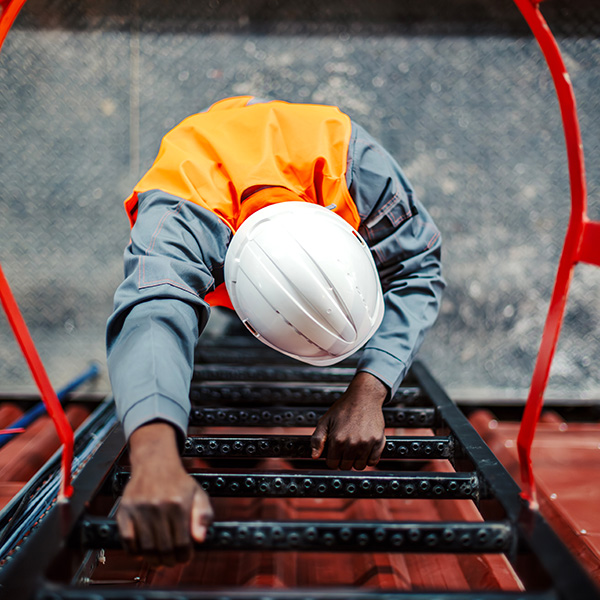 You could use a ladder. Movable scaffolds could work. You could invest in a scissors lift. Many people think their forklift could do the job. Or someone could stand in the bucket of your skid steer. Reject that last idea – it’s dangerous. Let’s look at the pros and cons of the other options.
Forklift
Forklifts are great pieces of equipment for raising materials. But they are very dangerous. Because of that, there are a lot of requirements for safe use. Anyone who uses a forklift must complete initial classroom training, be trained on the use of the specific forklift, have a driving evaluation every third year and undergo retraining if they are involved in any incident. Forklifts must be inspected daily, or before use if not used daily. If the lift has an internal combustion engine and is used indoors, you need to monitor carbon monoxide levels at least quarterly and need to measure tailpipe emissions annually.
Forklifts are not great for lifting people. It can be done with a basket designed for that and chained to the mast. But Minnesota rules require that the person in the basket must be able to control the lift. We’ve never seen an option to do that.
Don’t even think about raising someone standing on a pallet on the forklift. That’s extremely dangerous.
Ladders
Ladders are inexpensive, store easily and are easy to move. But if they aren’t set up carefully, if people try to work from the very top, or if people overreach, the ladders can tip over. They must be set up correctly, with all feet solid on the ground. Users need to keep hands free when climbing the ladder, with any tools or parts brought up with a tag line or carried on the back or belt. The ladder usually has nowhere to set down those tools or supplies. Reach is limited as the user’s belt buckle has to stay between the rails and users need to face forward.
If you opt for ladders, choose ones rated for your heaviest users plus gear. Avoid household (Type III) ladders, rated for only 200 pounds.
Rolling ladders
These are a good compromise between stepladders and mobile scaffolds. They usually include work platforms complete with guardrails, essential if they’re more than four-feet tall. They need to have wheels that lock down when the user steps on the ladder. The disadvantages: they have a relatively large footprint. As with any ladder, users need to keep hands free when climbing or descending. They only fit one user.
Mobile scaffolds (baker scaffolds)
These scaffolds on wheels can provide large and stable work platforms. They are often big enough to accommodate two workers. The working height can be adjusted easily. They are easy to move into place, offer lots of space for tools and equipment and usually let workers get closer to the job than ladders allow. They’re relatively inexpensive.
But a mobile scaffold can move during use and can tip over. The ground has to be level. The wheels must be locked in place and all safety latches secured before anyone climbs onto it. The platform has to be rated for the load (scaffold grade lumber or a metal scaffold plank. Don’t grab a piece of plywood and think that will suffice). If the platform is more than four feet above ground, guard rails are needed.
Mobile elevating work platforms (MEWP)
MEWPs include scissors lifts, vertical mast lifts and boom lifts. These can be driven into place and easily raised to the desired working height. They offer greater flexibility than ladders or mobile scaffolds. Because they are powered equipment, they are much more expensive. They require more training to use safely. Scissors lifts and vertical mast lifts only go up and down; boom lifts can go out to the side. Vertical mast lifts have a small footprint and usually fit only one person. Scissors lifts have a large working platform.
When you’re contemplating what to get for your shop, consider:
• What do I need a lift for? Is it to provide a working surface? If it’s only to lift bumpers to a storage area, a forklift would be best. If it’s to provide a working surface, the floor is level, and you only need a few feet, a mobile scaffold would probably work well.
• Where will this be needed? Is there room to maneuver? Is the floor smooth and level enough to use any of these safely?
• What capacity is needed? What’s the heaviest load? The highest height? It would be dangerous to stick a ladder onto a mobile scaffold or scissors lift because that increases the risk of falls. So whatever you use has to reach the area where it is needed.
• How much flexibility is needed? Do you need something with adjustable heights?
If you need employees to work on vehicle roofs, mobile scaffolds or rolling ladders might work well. If your primary need is facility maintenance such as changing lightbulbs, a scissors lift might be best. If all you have to do is move vehicles and lift pallets, get a forklift.
Whatever you use, make sure it’s used safely. Falls from heights are still a leading cause of workplace injuries.
For more information, contact Carol Keyes at 651-481-9787 or carkey@chess-safety.com.
Want more? Check out the August 2026 issue of AASP-MN News!