
Embracing an Adaptable Culture: AASPMN’s Leadership Conference and Annual Meeting Recap
by Alana Quartuccio
The auto service and collision repair industry is in a constant state of change.
 Shop owners simply can’t afford to remain locked away in the office and expect to keep up with the industry’s evolution. Advanced technologies like AI, talent shortage trends and continuous insurer pushback are just some of the very many things changing the landscape of the automotive industry. In order to roll with the times, one has to step out from behind their four walls and carve out a path to create adaptability for the road ahead.
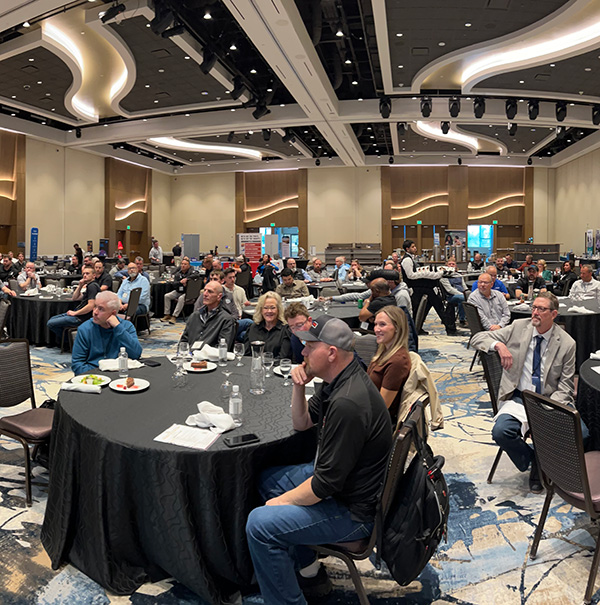
AASPMN members and supporters heard the call and made their way to AASPMN’s Leadership Conference and Annual Meeting at the Mystic Lake Center and Casino in Prior Lake on April 29-30. The 2026 event offered one-and-a-half days of engaging education and reliable resources designed to give repair professionals the fuel they need to navigate the road ahead.
AASPMN Executive Director Linden Wicklund reflected on this year’s event. “We had a lot of really great conversations on what the path forward looks like for shops.” The event featured a jam-packed agenda complete with a keynote speaker, break out sessions, networking opportunities and a vendor showcase.
“Our conference offers the same content one can get at a national show, with many nationally-recognized speakers, but at a fraction of the price, in a much smaller space so attendees have the opportunity to ask more questions,” Wicklund noted. “When you go to a big national event, you’re surrounded by hundreds of people. There’s something really nice about being in a room with dozens of people instead so you can dig into the content differently.”
Adaptability and Accountability Keynote
Melissa Furman’s (Career Potential, LLC) keynote presentation targeted the event’s “adaptability and accountability” theme, tapping into many repairers’ reluctance to change, and their difficulty in unlearning habits that were once successful, but are no longer effective. “You have to be adaptable,” Furman explained. “You have to be accountable, both as an individual and as a leader. Also, there needs to be a culture within the organization around adaptability and accountability. These are the two core pillars needed to help maximize a business’ success.”
The keynote involved a panel discussion with Tom Archambault (BLVD Auto Works; St. Anthony), Shannon Christian (Shannon’s Auto Body; Brainerd), Jesse Jacobson (Heppner’s Auto Body and Glass; St. Paul) and Ashlan Kaplan (Cannon Auto Repair: Cannon Falls).
“For some organizations, this can be no problem at all, but for others it can be a very big problem. There is no in between,” Furman relayed. “One needs the mental flexibility to embrace change.”
The panelists represented various age groups and business sizes which allowed them to explore different perspectives and how generational roles come into play.
Archambault stated it was valuable to learn what is needed to roll with the punches, go with the flow and change to be adaptable from the point of view of a small operation versus the perspective from a multi-location facility owner.
Business owners need to be adaptable to their employees, and communication is a key factor. “We’re finding that the Boomer generation is not mentoring the Gen X and Millennials the way they were mentored in their early years,” Wicklund observed. “Gen X and Millennials seem to gravitate to each other more and more to compare notes.” She also noted how this applies to association membership. “A traditional association model usually has one generation embrace the next one in order to help them grow. It’s about bridging the gaps between the different generations.”
Furman acknowledged shops’ struggles with filling vacant positions, which segued into the accountability side of the discussion, where audience members were challenged on their role in holding others accountable. Many don’t have the right idea of what accountability looks like, she explained. Many tend to avoid holding people accountable which retains low performing employees, which ultimately hurts the entire organization. Furman acknowledged that hard conversations have to be had in order to hold people accountable. She stressed that it does not mean one has to necessarily fire someone. “You may need to train them differently, or put them in a different role, or serve as their role model.”
Furman’s overall goal was to have attendees “look in the mirror and see what they can do differently.”
Dan Sjolseth Receives Lifetime Achievement Award
AASPMN’s Leadership Conference and Annual Meeting is also an opportunity to gather as an association, talk about goals and opportunities while also celebrating member achievements, sharing gratitude to those whose time with the Board has come to an end, while welcoming some new faces to the Board.
During the Leadership Meeting, longtime AASPMN member Dan Sjolseth (Superior Service Center; Eagan and Apple Valley) was given the Lifetime Achievement Award for his many years of service to the association in the wake of his recent retirement. “Dan has been such a key part of everything we’ve done. He’s always been so actively engaged,” shared Wicklund.
Sjolseth dedicated more than 30 years to AASPMN. His involvement goes back all the way to the days of the Automotive Service Association (ASA-MN), prior to the association becoming AASPMN when Judell Anderson came on as executive director. He also served many years with the AASP National Board until it disbanded at the close of 2024.
“As much as I didn’t want to go, I knew I had to leave at some point and why not do it while still in good health,” Sjolseth shared. He happily sold his business to a young colleague and noted that it’s now “his time to shine.”
“During my speech, I made reference to a fellow retired colleague, Roger Bonn, who had a shop out in the St. Cloud metro area and was known for his big booming voice. When he retired, he commented, ‘I would not be where I am today without this association.’ I echoed the same. I would not be where I am without this association. I told the membership, if you have a shop across the way or down the road, don’t view them as competition, view them as a partner in this great industry. If they need help, help them. That’s what members of the association did for me when I started out. They gave me advice, helped me make the right decisions and were very instrumental in the success of my business.”
Although he’s stepping away from association life as it’s time to pass the baton, Sjolseth plans to stay somewhat involved in industry advocacy, especially via MNCARS. His goal is to continue to encourage involvement with the schools to keep inspiring young people to pursue automotive careers.
Membership Goals
During the Annual Meeting portion of the event, Wicklund shared with attendees AASPMN’s main strategic areas, which focus on researching the industry workforce, continuing the leadership and legacy of AASPMN and growing membership. She reported on the association’s great financial health and their investment into membership and programming.
AASPMN recently hired Todd Grothe as the association’s membership outreach manager to help expand membership engagement. Grothe reaches out to member shops and schools, as well as non-member shops to encourage them to join. As Grothe says, the association wants shops to know that if they have any issues, AASPMN is there to help them work through it to become stronger and more profitable.
“The conference was a great success,” Grothe reflected, noting the great feedback he received from shop owners. “We really connected with a lot of shop owners and their staff members in the classrooms and breakout sessions. The speakers were a really big hit with the shops. We had great vendors involved and we hope to bring in even more next year.”
Much of the content at this year’s event was based on AASPMN’s research into examining who today’s shop owner really is and who are the people coming into the fold. Another key point for the association is to make sure that shop owners know the workforce is not just being cultivated and bought out by big MSOs, according to Wicklund. Many independent shop owners have been expanding their locations while many others are also looking into succession planning.
Valuable Takeaways
Roundtable discussions are always a favored highlight, as they give attendees the opportunity to have open dialogue on a wide variety of subjects.
Matt DiFrancesco (High Lift Financial) hosted a roundtable on succession planning, which allowed for open conversation where attendees could share their own personal situations and goals for transferring their businesses.
“It’s really encouraging that a lot of shops are looking to transfer internally and maintain their legacy,” he observed. “A lot of people are looking to do internal transfers to family or key employees and that’s something I can really help with.
“It was one of the best events I have been to,” DiFrancesco added. “AASPMN does a great job trying to support their members, especially by providing them with resources in the areas they need it most.”
Longtime AASPMN member and former Board member Will Latuff (Latuff Brothers Auto Body; St. Paul) took so much away from the experience that it even helped put money back in his pocket! Content from the “Information and Data Strategies to Save Time and Increase Accuracy” breakout session presented by Donny Seyfer (National Automotive Service Task Force) saved his shop $3,000.
“Just the sheer volume of information and resources that NASTF has is amazing,” Latuff recommended. “They have a lot of information shops may not be aware of and should look into.”
One of the things he picked up on relates to NASTF’s vehicle service professional ID program, which validates professional service providers and locksmiths with credentials for dual factor authorization to get past the secure gateways on vehicles via a scan tool. Latuff said with most OEM tools, there are no problems, but his shop had issues with their Hyundai/Kia tool. “It wasn’t functioning as designed via the Right to Repair version of the software, so we had to send those vehicles to a vendor.”
But thanks to information from NASTF, Latuff learned Hyundai/Kia updated their software. “We should be able to start using that software again at the Right to Repair level; it’s a lower cost than the full-fledged Hyundai/Kia tool, which runs over $8,000. We should be able to bring this work back in-house at an affordable price and save us the cost of purchasing additional hardware to do what the software should be able to do in the first place.”
Archambault noted, “We had a really engaged group this year. Lots of mingling and talking among attendees in between sessions.” He particularly favored the “super high quality of the breakout sessions,” which were facilitated by outsiders from various different companies or organizations. “There was so much good information shared on topics like AI, improving your bottom line and addressing the technician shortage… pertinent information to both the collision and auto repair attendees.”
Wicklund also championed the great networking opportunities the event provides for vendors and attendees alike. “We had breakout sessions throughout the day to allow for mingling and networking. Our vendors participate in these sessions; they don’t just sit at their tables, and I really like that they engage in the conversation. We had more mechanical shop attendees than we’ve seen in some recent years. It was nice to see some of those faces that we haven’t seen in a few years.”
Want more? Check out the June 2026 issue of AASP-MN News!