

Defining Success: AASPMN’s Leadership Conference and Annual Meeting Recap
by Alana Quartuccio
Success is defined as “the accomplishment of an aim or purpose.”
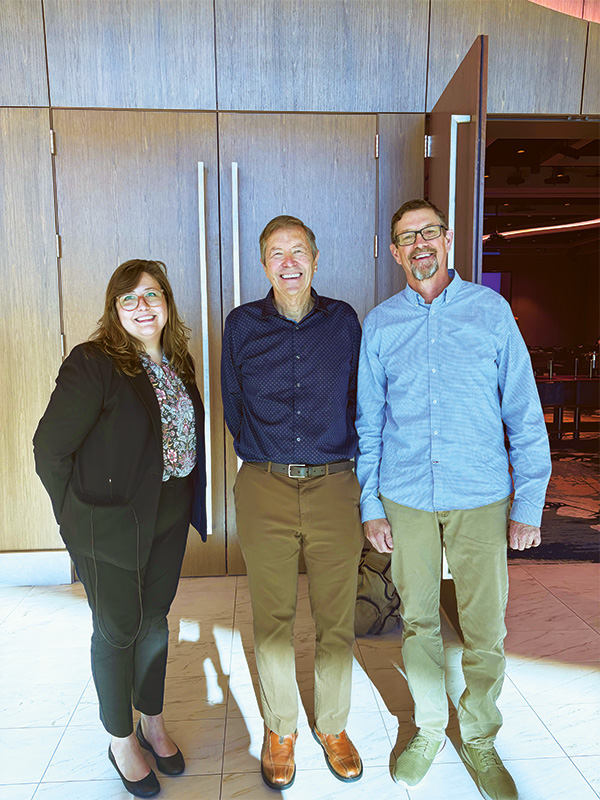 Every auto service or auto body shop business owner wants to succeed. They may all have a different picture of what success looks and therefore different paths to take, but each and every AASPMN member shop who attended the Alliance’s Leadership Conference & Annual Meeting April 28-29 at Mystic Lake Center and Casino in Prior Lake was there to map out their pathway to success.
The 2025 event, appropriately titled “Success Defined,” gave over 175 business owners, managers and industry vendors various avenues to explore to help them discover what they need to focus on most to achieve their goals. “It’s about figuring out what success looks like for each one of you individually and what that looks like over time and in the future,” AASPMN Executive Director Linden Wicklund stated during her welcome message. There’s been so much negative talk in the industry, and it can be easy to feel down about it, she added, encouraging that “we hope you will leave here uplifted and ready to go.”
Day one laid the first brick toward finding one’s path to success via three interactive workshops. Audience members packed the room to hear Will Latuff (Latuff Brothers Auto Body; St. Paul) and Josh Shaw (Shannon’s Auto Body; Brainerd) provide valuable information on how to effectively write estimates with their “Consistently Strong Estimates: Tools for Success” workshop. There are various costs most shops are likely overlooking, especially in the area of consumables, like if only half a tube of seam sealer was used for one job and the product is unlikely to be used again. “Are they responsible for the full quantity or the partial? Those are things to take into consideration,” Latuff stated. He and Shaw also stressed the importance of following OEM procedures. Shaw used an image of a Lego build of a Star Wars Millennium Falcon to drive home the point that one will follow a manual to put this model toy together, questioning why wouldn’t one do the same thing for a vehicle. “The average new car has 30,000 pieces. Why would you not follow the manual for that? Let that sink in.”
Tyler Enslin got repair professionals to think about what holds them back from their goals with “Achievement Now – Elevate Your Success.”
“We tend to sacrifice the things we want most in life for the things we want right now,” he illustrated by using an example of someone’s weight loss goal being put further out of reach because the person wants a donut “right now.”
Having a healthy balance of confidence and humility are two factors toward achieving success. “One can’t be confident and self-loathing at the same time, but having a healthy balance is essential to sustainable achievement in any area of life.”
It’s surely no secret that finding good workers has been a challenge for the automotive industry. Jolene Rotitch (BrookLynk) spoke about “Bridging the Gap: Engaging and Retaining the Next Generation of Workers,” outlining the characteristics of each of the five different workforce generations and how business owners can best manage multigenerational workforce challenges. There are many misconceptions about each generation. Rotitch pointed out that Gen Z often is seen as “lazy and entitled, but the truth is that they are seeking stability and mental health support.” The younger generations are also moving away from being career-minded like Baby Boomers and Gen X in favor of what they refer to as job growth. “They want the ability to upskill by receiving frequent and real-time feedback, so they can be coached through and learn their role quickly.”
Enslin got day two in gear with “Remaining Positive in Challenging Times.” Even during times of crisis, people possess the ability to manage what they focus on and create positive habits, he informed the audience with his opening keynote presentation.
“Two people can go through the exact same experience; one may only see struggles and the other opportunities,” Enslin illustrated his point that perspective is what matters most. Like the “garbage in, garbage out” phrase applies to the input sources to our brain, “you can’t fill your body with junk and expect positive results. The same goes for your brain.”
Enslin got the audience to think about what negative input sources they can eliminate from their lives. Perhaps it’s spending too much time on social media, which is filled with negativity, or being surrounded by people with negative thoughts and complaints fueling one’s focus toward their biggest stressors. Instead, he suggests actively taking the time to focus on positive things by spending a few minutes a day citing the things they are most grateful for.
Focusing one’s mindset is another key. “When we focus too much on things that we can’t control, we actually lose power over what we can control.” In fact, the only thing one really has control over is how they react to things, according to Enslin. He advised attendees to consider the situation or crisis they may face and ask if they have ownership or control over it and base a plan off that. “Problems tend to grab our focus and attention, so if we spend all of our time on that, it creates a negative problem mentality.
“There is nothing great about a crisis, or they’d call it a party or a vacation,” but even something as bad as the pandemic did leave some with positive outlooks, such as finding more patience or gratitude for one’s health and well being.
He referred to the business world, encouraging all that some can come out thriving during hard times. “During times of crisis, there are some business organizations that don’t make it through. Some just survive to get to the other side, and then there are some who find ways to grow and come out stronger.”
The Leadership Conference always provides opportunities for members to interact and share ideas via its roundtable discussions. Attendees broke out into groups to discuss leadership/business, as well as mechanical and collision topics including shop safety, rising insurance costs, multi-location leadership, AI customer service, mechanical and collision business combined, 20 groups and leadership conferences, building projects and major expenses, supplement time delays, results from Department of Commerce complaints, repair planning and OEM procedures and safety inspection denials.
The Annual Meeting portion of the event gave the Alliance opportunity to recognize outgoing Board members, welcome new ones and remind the membership of the importance of volunteering on behalf of the automotive industry.
Wicklund thanked outgoing president Aaron Swanson (LaMettry’s Collision) for his leadership and support over the past year, especially as she recovered from major spinal surgery.
Upon reflecting over the past year’s efforts, Swanson noted great participation in the regional meet ups and activity at the state Capitol, which led to a great legislative year. “It’s about showing up and making a difference.” He acknowledged all those who volunteer their time to the Alliance, an experience that allows one to get to know others in the industry and interact outside of a formal setting. Ultimately, “showing up matters,” Swanson stressed.
Wicklund and Swanson recognized outgoing Board members Mike McLynn (Automotive Electric; Grand Rapids) and Paul Yager (Enterprise Mobility; Eagan) for their contributions to the Board and welcomed Andrea Ossowski (Blue Rock Refinishing Solutions; Roseville), who will serve as Associate Division Director, and Greg Kasel (Downtown Tire & Auto; Hastings), who will serve as a Mechanical Seat. In addition, they acknowledged Randy Notto (Lenfer Automotive & Transmission; Lino Lakes) who will serve as President for the coming year. Notto noted Swanson for his “personable and easy ways which helped make this a great year.”
Following lunch and the vendor showcase, the conference included breakout sessions on a variety of business-minded topics, giving attendees the option to pick the course of action they wanted to explore most. Those interested in expanding their online marketing efforts attended “First Impressions, Online Reviews and Customer Marketing: Tools for Bringing Customers in and Keep them Returning,” presented by Doug Robison (Optimize Digital Marketing.)
Robison outlined the benefits of having a strong online presence – giving detailed examples of the features of the “three big players:” Facebook, Google and Yelp. The use of Yelp especially is key. Robison revealed that 47 million people used Yelp for auto repair related searches in 2023.
Perhaps the most important thing to consider is online reviews – whether they are good or bad. “We all like reviews when someone says something good,” Robison relayed; however, he delivered the key component to online reviews by asking, “How many of you actively answer your online reviews? Not many do. You are actually hurting your business if you aren’t spending time to answer your reviews.”
The average person looks at about six reviews before they make the decision to work with someone, and if a business interacts with reviews, it increases the consumer’s decision in your favor, according to Robison. “The review is there 24 hours a day for everyone to see, and you didn’t care to take the time,” he stressed, adding that “you want to remove your emotions” when dealing with negative reviews. “You don’t want to get into a screaming match; you’ll want to encourage them to call you so you can fix the issue offline.” He also recommended reviews be responded to in a timely manner, within one week of the review.
Attorney Christopher Chantry (Larkin Hoffman) informed those looking to expand their knowledge of employment law by providing an overview of the laws that may most directly affect their businesses with his “What You Need to Know: Employment Laws and the Modern Workforce” discussion.
Employers must be certain they are categorizing their employees correctly because “misclassification could have serious consequences.” Chantry educated the audience on the differences between independent contractors and employees. For example, if someone is misclassified as an employee and not an independent contractor, state agencies are likely to come looking for the unemployment insurance contributions.
He advised that although it may not be an employers’ “favorite subject,” they must comply with the Earned Sick and Safe Time (ESST) as state agencies are taking a good look into it. “It’s important because as much as this law has been talked about, it’s a common issue I see businesses encounter with an employee handbook or an employee complaining the company violated the law.” Chantry reminded business owners that cannabis has been removed from the state’s definition of drug, and therefore, their drug policy must be compliant with the updated law. In addition, he gave an overview of the Minnesota Paid Family and Medical Leave act which goes into effect January 1, 2026.
AASPMN Lobbyist Sam Richie (Larkin Hoffman) was joined by Brian Chenvert (InsuraClaim) to review what’s being done to push for legislative support in favor of safe and proper collision repair, informing them about “Making the Law Work for Your Shop.”
Currently, AASPMN is promoting legislation that would “tighten up the statute, to give you more leg to stand on” by requiring a three-day response time from insurance companies after a shop submits a supplement, adding some definitions on repairs and repair procedures and pushing for storage fee reimbursement. The bill has gotten some serious attention, and Richie hopes to see it move forward.
He commended all those who took part in the recent AASPMN Day at the Capitol. “We’ll never be able to give more donations than the insurance industry, but we have members in every corner of the state to reach out, and it’s important for the legislators serving on these committees to be reminded of who they serve. Those of you who take the time to go to the Capitol really help move the needle. They want to interact with you and have your ear, and you theirs,” shared Richie.
Getting paid properly is a continuous battle collision shops face daily. Alberto Amayo (3M) set out to help shops “Boost Your Profits with Precise-Documentation and Efficient Material Management.”
Insurance companies continue to move toward digital, so that means body shops “need to make sure that you’re documenting what’s happening at your shop and make sure that you’re doing it correctly and effectively so that you get paid for those items.” Amayo acknowledged how extremely important it is that every vehicle be repaired properly. “Your name is on that repair. So, what better way to make sure that you capture those than by having all the correct documentation in place?”
Most insurance adjustors don’t understand the repair process – their motivation outside of paying the claim is their paycheck – so educating them is extremely important, he stressed. “Reasonable and customary are really strong words in the insurance industry; don’t be afraid to ask for things” because “the more you ask, the more likely the insurance adjustor, at some point, will actually change their tune and pay for the repairs.”
While Enslin lit the spark toward positive mindset earlier in the day, Nick Arnette, the “feel-good funny guy” carried the torch the rest of the way with his closing keynote “Me, We and Glee: How to Have a Great Attitude, Work as a Team and Keep Your Sense of Humor.”
It all starts with one’s attitude. Arnette notified the audience of the shocking fact that “73 percent of self talk is negative.” Every single person deals with change and is “going through something” because the rhythm of life is filled with ups and downs. “The COVID pandemic was bad. It’s hard to believe how bad things can get, and we are still here. That was not an easy time,” he sympathized, offering encouragement that “you’ve survived 100 percent of your worst days, and you will get through whatever you may be going through now.”
People complain once a minute during typical conversations. Why? “Because it feels good to complain. It just feels good. Misery loves company. Complaining is the junk food of conversation,” Arnette says.
People do have control over their attitudes because “happiness is a choice. We have a choice over our thoughts and emotions.” When his brother lost a job he loved, the family expected him to be down in the dumps, but instead, his brother revelled in the opportunities the job gave him, spent a day writing thank you notes to everyone he worked with and chose to be grateful for the experience instead of wallowing.
Spreading positive messages is another consideration toward happier times. “Listen to understand,” Arnette suggested. “Don’t think you know what they are saying. Silent and listen contain the same letters, so just listen.”
Taking the time to compliment people is something people should spend more time doing because “People may not remember what you said, but they will always remember the way you made them feel.” It’s been found that in most cases, employees don’t even know where they stand due to lack of communication from their employers. According to Arnette, 29 percent know they are doing a good job, and 36 percent rarely or never know.
Lastly, he spoke of the importance of teamwork. “Why do we need teamwork? It makes up for our weaknesses and encourages each other.”
In addition to the education and information provided throughout the day, attendees had multiple opportunities to interact with vendors, win prizes, network and enjoy refreshments with their peers. AASPMN is grateful to all of its generous sponsors who supported the event and provided prizes that were awarded to attendees throughout the day.
Want more? Check out the June 2025 issue of AASP-MN News!