
Listen to This…If You Can
by Janet L. Keyes, CIH
How loud is your shop?
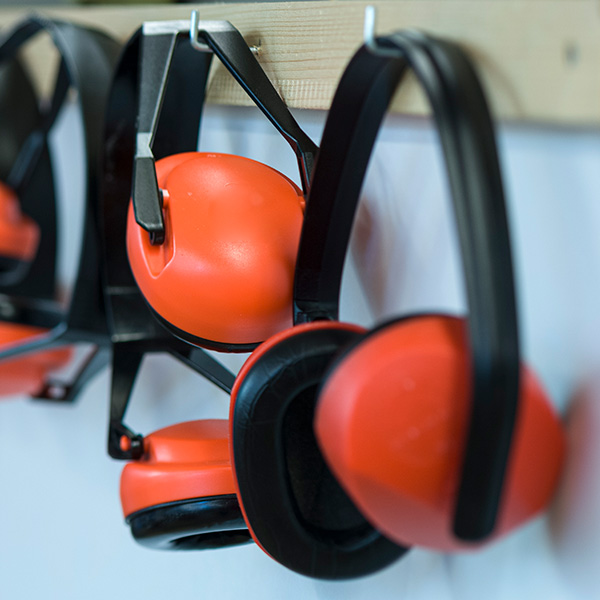 It varies, right? If someone is using a pressure washer or blowing off a car, it’s loud. If a tech is applying body filler, it might be quiet a minute later.
So, you don’t need to worry about your employees’ (or your!) exposure to noise, right?
Wrong.
Whether noise can damage hearing depends on how loud the noise is and the duration of exposure. OSHA says that if employees are exposed to more than 90 dBA averaged over eight hours, they need to use hearing protection and you need to try to reduce the noise levels. In all likelihood, your employees aren’t exposed to that much noise for eight hours a day. 90 dBA is about how loud a pneumatic sander or electric buffer would be, or the loudness of a welder. No one spends eight hours just sanding or buffing or welding.
But:
We know that routine exposure to 90 dBA will result in damaged hearing for many people.
Adding three decibels doubles the sound level (because decibels are a logarithmic measurement). If you double the sound level, the amount of time you can be exposed drops in half. Many tools used for automotive repair are much louder than 90 dBA.
We’ve measured air gun sound levels ranging from 94 to 105 dBA. Pneumatic grinders: 100-105 dBA. An impact wrench removing a lug nut: 104 dBA. A tire removing machine removing the tire bead: 100 dBA. Air chisels: 106 – 112 dBA. How long could your techs be exposed to those sound levels before being overexposed?
While OSHA says you don’t need to get serious about controlling noise until it hits 90 dBA averaged over eight hours, OSHA standards also say that you need to provide hearing protection, hearing tests and training at 85 dBA. So, let’s compare those numbers to 85 dBA.
Your technicians could use air guns and impact wrenches for no more than 30 minutes per day, to stay below the 85 dBA eight-hour average. They could have no exposure above 85 dBA for the rest of the day (no sander use, no buffer use, no other air-powered tool use, no hammering on metal…). Only 15 minutes of air chisel use would put them over the 85 dBA 8-hour limit.
To compound the problem, we’re discovering that solvents such as styrene in body filler and toluene in lacquer thinner can damage hearing.
Is hearing loss your concern? It’s covered by workers’ compensation, so it certainly could cost you. According to a 2001 report from the Minnesota Department of Labor & Industry, most workers with hearing loss claims are paid permanent partial disability benefits. That’s in addition to any medical costs.
What can you do to protect hearing?
Provide hearing protection. Don’t offer just one type. Provide a roll-up option, a push-in option and ear muffs, at least. What fits or is comfortable on one person may not fit someone else’s ear canal.
We see a lot of employees wearing earbuds or headphones. Those might work as hearing protection. If you allow those, tell employees that they must choose ones that have Noise Reduction Ratings (NRR) of at least 20 and must limit their peak volume to 82 dBA or less. Noise reduction ratings are a rating of how much the device can drop the sound level under nearly-perfect conditions. Noise cancelling earbuds and headphones do not necessarily have a NRR.
Strongly encourage the use of quieter tools and equipment. Provide incentives to switch to battery-powered tools, which are consistently quieter than air-powered tools. Encourage employees to invest in air blow guns engineered to be quieter, such as Silvent’s or Guardair’s lines. Put your compressor in its own insulated room – or, better yet, invest in a quiet compressor (check for energy company incentives, as newer compressors may be much more energy-efficient).
Provide annual hearing tests for noise-exposed employees. That is an OSHA requirement if noise levels exceed 85 dBA averaged over eight hours. The first hearing test given to an employee provides a baseline of their ability to hear at different frequencies. Subsequent tests are compared to that baseline. Because we know that noise first damages the ability to hear high frequencies, if we see a drop in hearing ability at those frequencies, we know it is likely from noise exposure. If that drop is detected before hearing loss is really bad, we might be able to prevent further deterioration of hearing.
Provide training. That can be part of Right to Know training or part of the hearing tests, or both. If employees know the effects of noise and how to prevent damage, they stand a chance of protecting themselves.
Protect your own hearing. Do that not just to serve as a good example, but so you can continue to enjoy sounds. Vikings football games have been measured at 105 dBA. Were you in the stands back when the Twins won baseball’s World Series? Levels there were around 97 dBA. A Paul McCartney concert was measured at 112 dBA. Motorcycles and snowmobiles are usually over 100 dBA. Do you go to drag races? Levels in the stands have approached the pain threshold of 120 dBA. Ever go to a firing range? That noise easily exceeds 150 dB. Even though the duration is very short, the level is high enough to damage.
If you need to shout to talk, make it quieter. If you can’t make it quieter, make hearing protection mandatory. Hearing loss from noise is permanent. It’s also 100 percent preventable.
If you have questions about hearing protection, requirements for personal protective equipment, or general safety issues, call CHESS at (651) 481-9787 or e-mail us at CHESS@chess-safety.com.
Want more? Check out the May 2026 issue of AASPMN News!