
The Elephant and the Rope
by Ken Miller, AASP/NJ President
There is an old story about how elephants are trained to accept restraint.
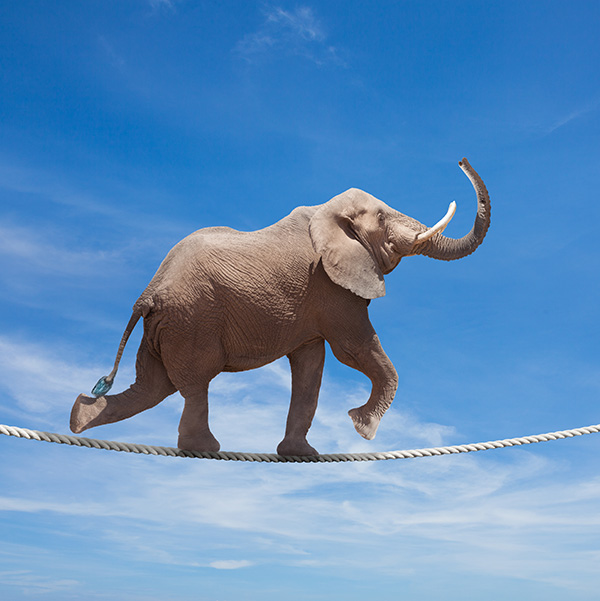 When an elephant is young, it is tied with a rope to a secure post. The elephant pulls, struggles and fights to free itself, but it isn’t strong enough to break the restraint. Eventually, it stops trying. As the elephant grows larger and stronger, the same rope can be tied to something as insignificant as a fence post, yet the elephant makes no attempt to escape. It has learned that resistance is futile, even though it now possesses more than enough strength to free itself.
The story illustrates a psychological principle known as learned helplessness, a phenomenon in which repeated experiences of having little or no control over an outcome can diminish the willingness to attempt to change it, even when circumstances have changed. While the elephant story itself is more folklore than established scientific evidence, the underlying psychological principle is well documented. I wonder whether something similar has been happening in the collision repair industry for decades.
Think about the relationship between insurers and repair facilities. Over the years, we’ve witnessed a steady progression of reimbursement reductions. Some repairers are now experiencing downward pressure on labor rates. I remember when vehicle scanning was commonly reimbursed as a flat-rate service. Over time, those allowances were reduced, then converted to hourly reimbursement, followed by reductions in the time insurers were willing to recognize for the operation. Today, we’re seeing similar pressure on ADAS calibrations. Where multiple required calibrations were once reimbursed individually, some insurers are now attempting to impose a single flat fee regardless of how many calibrations the vehicle requires. Each change introduces another limitation that shops must decide whether to challenge or accept. Shops resist, argue, negotiate and attempt to justify their positions. Sometimes they prevail, but often the resistance becomes exhausting, time-consuming and financially burdensome. Eventually, some shops stop fighting certain battles altogether. What was once a disputed reimbursement limitation gradually becomes an accepted part of doing business.
Psychology offers another principle worth considering, operant conditioning, in which behavior is influenced by its consequences. When challenging a reimbursement decision repeatedly results in delays, disputes or lost revenue, while accepting the limitation allows the repair to proceed, could those experiences gradually influence how a shop approaches future repairs? More importantly, could that influence continue long after the original dispute has ended?
I began thinking about this because of the responses I receive to the technical information I share on social media. I regularly explain manufacturer repair requirements, inspections, calibrations and other operations necessary to properly repair today’s vehicles. Among the countless comments and messages I receive, one response appears with remarkable consistency: “Insurance won’t pay for that.” What’s interesting is that I don’t often discuss insurance reimbursement at all. I discuss what the vehicle manufacturer requires, yet the response immediately shifts to what an insurer is willing to pay.
Even more interesting is who makes some of these comments. Many come from technicians who have never negotiated a claim with an insurance company. Their understanding of what insurers will or won’t reimburse has been passed along by estimators, managers and shop owners. Psychology refers to this type of behavior as social learning, where people develop expectations and behaviors by observing and learning from others. Could it be that the original financial limitations have become so deeply embedded in our businesses that we’re now teaching them to the next generation of repairers?
Consider the implications. An insurer challenges an operation, a shop eventually accepts the limitation, and that acceptance becomes part of the shop’s estimating practices. The estimator communicates those expectations to the technician, who may eventually teach another technician the same thing. Over time, the original disagreement is forgotten, but the limitation remains. Nobody needs to explain why the rope is there anymore. Everyone has simply learned not to pull against it.
We’re now seeing another potential example as the number of repairable vehicles becomes increasingly constrained. When an insurer suggests that a vehicle may be declared a total loss if the repair cost isn’t reduced, the immediate pressure is on that particular repair. But could the experience influence how the shop approaches the next vehicle, and the one after that? Could the fear of losing future work cause repairers to begin adjusting their expectations before an insurer even raises an objection?
I don’t know whether these psychological principles fully explain the behavior I’ve witnessed, and I’m not suggesting that every reimbursement disagreement results in an improperly repaired vehicle. But the consistency of the responses I receive makes me wonder how much of our industry’s decision-making has been shaped by limitations we’ve gradually learned to accept.
Perhaps the question we should be asking isn’t simply whether insurers have conditioned collision repairers to accept their reimbursement restrictions. It’s whether we’ve become so accustomed to those restrictions that we’ve begun enforcing them ourselves, teaching them to others and defending them as though they were legitimate industry standards. If that’s possible, how many of us are still tied to a rope that no longer has the strength to hold us?
Want more? Check out the November 2026 issue of New Jersey Automotive!