Scoring Big! ABAT’s 2026 Texas Auto Body Trade Show Highlights
by Alana Quartuccio
If you’ve been keeping tabs at all, you likely already know that ABAT’s Texas Auto Body Trade Show is the place to score big in education, innovation and celebration, and the 2026 show was surely a grand slam in every area!
 September 18 and 19 at the Marriott Dallas Allen Hotel and Convention Center was the place to be to optimize profitability and efficiency as this year’s show had more to offer than ever before! It was a big win for every collision repairer who attended and took advantage of the various offerings in education and hands-on training in windshield repair and urethane certification, an abundance of resources along each and every aisle, and some seriously fun competition!
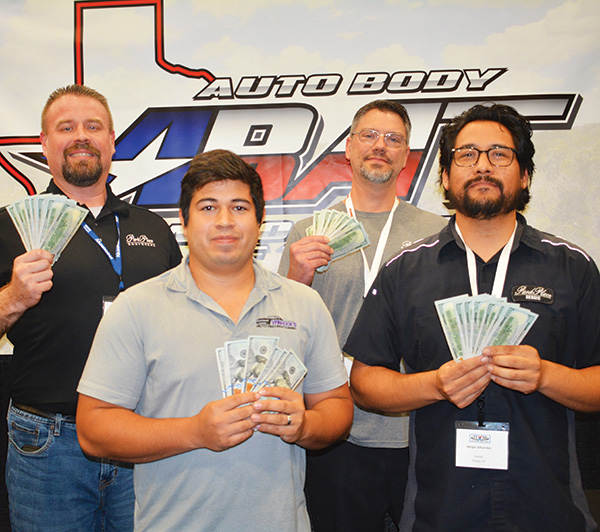
This year’s BIG SHOTS Competition sent winners home with amazing prizes thanks to the show’s generous sponsors. This popular trade show attraction allows repairers to test their skills in painting, auto body/welding, paintless dent repair and estimating. First place winners in all four categories (featured on the cover of Texas Automotive) each walked home with $1,000 in cash and major bragging rights!
Outside the box thinking is key in today’s often challenged collision repair environment. With this in mind, ABAT’s plans for this year’s event included glass repair and other alternative revenue streams shops can consider bringing in-house. In addition to an abundance of educational seminars, the 2026 Texas Auto Body Trade Show offered a hands-on windshield repair training program conducted by Jason Horne (Kaizen Glass), and urethane certification offered by Mark O’Brion (SIKA USA) and Kody Allan (Dupont).
On the trade show floor, an entire section was devoted just to glass, glass and more glass! The Glass Garage Live area was visited by attendees interested in seeing demonstrations and learning about the various glass related repairs they could consider bringing into their business.
“It’s so exciting that we were able to collaborate with Jill Tuggle and ABAT for this year’s Texas Auto Body Trade Show,” reflected Shauna Glass of Kaizen Glass (Gold Sponsor). In addition to making the Glass Garage Live a reality, Kaizen Glass teamed up with ABAT to present the well-attended Kaizen Glass Golf Tournament the day before the trade show.
“Jill was open to my ideas and together we brought the vision to life,” she added. “The Glass Garage has been super busy with a constant flow all weekend. It’s really great to see people become aware of Kaizen Glass and all the tools, training and support we can offer.” Davis also extended her gratitude to all the glass-related tool, distributor and resource companies who took part in exhibiting in the Glass Garage.
Longtime supporter Deric Krist (KriTech Solutions), who this year participated in the show as a presenter and exhibitor, saw a great deal of new and returning faces both in the classroom and on the floor. “It’s been a great show. The class had a great turnout, with standing-room-only near the end of the session. Both days, we’ve been steadily busy at the booth. We signed up a lot of customers and gained interest from some smaller investors.
“I’ve always been a big fan of Texas shops and this area,” he added. “I served this area when I was a Mitchell rep years ago. We launched KriTech at this show eight years ago. We’ve always loved what ABAT does here in Texas. I felt it was fitting to bring our new versions of ReKEY, which we initially launched here, to the show and present a class specifically for this audience.”
Matt DiFrancesco of High Lift Financial returned to the 2026 show as Industry Over a Pint sponsor and took part in the popular segment’s panel discussion about alternative revenue streams (see page 19 for recap).
“We’re trying to educate shop owners on the need to start planning five, 10 or more years in advance and not to wait until the last minute to build up their shop so they can determine what their future life could look like,” he explained. “We sponsored Industry Over a Pint because the topic of diversification is a big thing, whether it’s in your investments or with your income streams. We wanted to help be able to promote this message and inspire shop owners to think ahead so they are aware of ways they can build value in their business.”
“We’ve always been a big supporter of ABAT and the show ever since it started, so we make sure we show up every year to support the association and the body shops in the great state of Texas,” shared Kyle Hollingshead of BIG SHOTS Sponsor Car-O-Liner Southwest.
“We’re really glad to be here on behalf of Surventis,” said Will Godina of Diamond Sponsor Surventis. “We’ve been a longtime supporter of the Texas Auto Body Trade Show. Our goal here is to make sure we’re supporting the industry, supporting the customers that come to the event, and most importantly making sure that we are well-known and recognized for being a big promoter of the event. It was a great show. It’s good to see a lot of vendor partners and people coming together in the industry. It’s really important because the collision repair industry is very small when you think about it. We’re glad to be here and to collaborate with ABAT.”
KECO Body Repair Products (BIG SHOTS Sponsor) continues to show their support for ABAT’s show and the Texas market. “Our training center is in Oklahoma City and it’s just a short drive away so we love to get involved down here,” says KECO’s Emma White. “Not only do we have our booth every year, but we also get involved with the glue pull repair portion of the BIG SHOTS competition. It’s always fun to see people come out and try their hand at glue pulling whether they are a seasoned technician or just starting to get into it. The show also provides a great opportunity to see shop owners and technicians. There’s always great education as well.
“It’s no secret that it’s been a down year for the industry, but people are still coming out and are serious about investing and growing their business,” she added. “They definitely want the education, help from the association and taking advantage of all the vendors here.”
According to Jason Vilardi, vice president of business development and marketing for All Clear Diagnostics & Calibration (Silver Sponsor), the ABAT show gives the team a great opportunity to connect with the Texas market.
“We have a very large presence in Texas. We are in Houston, San Antonio, McAllen and Amarillo, so we always come to support this organization because it’s a vital market for us,” said Vilardi. “Along with Dynamic Solutions, we are so much more than an ADAS calibration company. By providing full mechanical, electrical, diagnostics and programming services right inside the shop, we help repair facilities eliminate sublet bottlenecks and keep everything in-house so nothing has to go to the dealership.
“We are a member of every auto body association in the states we work in, and we love sponsoring these events,” he continued. “Being here gives us a chance to meet our customers face-to-face, connect with new shops and thank the partners who trust us to help restore vehicles with OEM-level accuracy.”
What brings FindPigtails.com (Silver Sponsor) back to the show each year is their support for ABAT and the opportunity to see their customers face to face.
“We always want to support ABAT, as they’ve been great to us,” commented Ruston Blanchard. “It’s been a great year for us. We got to see a lot of our customers, many who are fellow exhibitors. It’s nice to be able to have an impersonal meeting. We seem to be able to get more done when it’s not over a computer.”
ABAT thanks the following sponsors for their generous support of the 2026 Texas Auto Body Trade Show: Diamond Sponsors: Surventis and Wesco Coatings; Platinum Sponsor: Partly; Gold Sponsor: Kaizen Glass Solutions; Silver Sponsors: All Clear Diagnostics and Calibration, Complete Collision Solutions, Drive Tech ADAS, Elitek Vehicle Services, FindPigtails.com and Paint Works; Education Sponsors: AAMS Training, Autel and FindPigtails.com; Happy Hour Sponsor: Enterprise Mobility; BIG SHOTS Sponsors: AkzoNobel, Anson PDR, Car-O-Liner Southwest, CCC One, Enterprise Mobility, Evercoast ITW, Keco Body and Repair Products and Sherwin-Wiliams; Industry Over a Pint Sponsor: High Lift Financial and Ladies Mixer Sponsor: Tasco Auto Color.
BIG SHOTS WINNERS:
Painter
First place: Sergio Sifuentes
Second place: Abel Sanjuan
Third place: Andy Lopez
Auto Body Tech
First place: Philip Glass
Second place: Justin Daughetry
Third place: Bill Thacker
Estimator
First place: Thomas Miller
Second place: Dawn Ethridge
Third place: Rauder Grayton
PDR Tech
First place: Nic Vahook
Second place: Carlos Garcia
Third place: Victor Gallegos
EDUCATION
Simplifying Estimating with Technology
A good repair plan takes hours to write. Maybe even as long as a day or more if an estimator is riddled with constant interruptions tending to other needs in the shop. Deric Krist of Kri-Tech Solutions set out to show the trade show audience how AI and automation can help take some of the administrative load off estimators so they can focus on their job.
“Interruptions kill production,” Krist indicated. He pointed to how complex the estimator role has gotten due to the increased research and administrative tasks that have been piled on due to the advancements in vehicle technology. ADAS calibrations for example have grown substantially over the past 10 years.. “We may be capturing more ADAS calibrations but that adds to more administrative work.”
Culling technology into the process doesn’t take away the human expertise from the estimating role, Krist suggests, “When we look at everything an estimator has to do, we have to ask ourselves does it require human expertise?” Re-keying estimates is something that can be automated. “We may think the estimator is the only one who knows the estimating systems but we have to ask ourselves how we can use automation or AI in our process to limit those administrative tasks.
“We have to identify what the human problem is first and then figure out how to assist that problem with software,” he continued. “We need to automate the task while preserving the expertise.”
Krist acknowledged that some may fear that AII intends to replace the estimator but he assured that is not the case. “It won’t happen. Not anytime soon. AI will only be able to assist. IT can’t replace anyone in the shop. But AI and automation can help the estimator so they don’t have to spend all their time on administrative tasks. We have to think about how to adopt technology to help with this.”
The Key to Getting Paid
“You can absolutely win against insurers, but you have to take control of your business.”
Coverall Law’s Sean Preston relayed that message to the Texas collision repair audience fueling them with the knowledge they need to improve the three biggest areas: process, protection and getting paid.
Preston believes that small businesses can benefit from the same best practices Fortune 500 companies implement. “There are corporate best practices we want to see you put into play,” he encouraged. For example, shops need to know their numbers. “That is a best practice this industry was lacking for a long time.”
A business can have legal high ground but they must own that legal high ground, Preston suggested. “Having legal high ground is basically building a castle around the shop. Without a castle around you, when you try to get paid, it’s as though you have a catapult and you’re looking for someone to fight. The castle is defense first.”
Taking action is another key. “If you sit on your hands, nothing gets done. Starting is easier than staying reactive.”
Preston also reminded shop owners, “Every dollar coming into the shop represents unlimited liability. You own the repair.”
He drew light to the fact that “Shops must be paid. Customers must be reimbursed. These are two different statements that you need to internalize. Those are two separate truths.”
Preston stressed the role of documentation in the process. “You need evidence that the work was done. If your customer can provide this to the carrier, there’s a burden shift. Now the carrier has to answer to why they won’t pay.”
Utilizing Refinish Resources
Mike Anderson (Collision Advice) led a panel of representatives from leading paint manufacturers including Shane Andondson (Surventis), Greg Askew (AkzoNobel), Ben Sampson (Axalta), Jamie Leppanen (Sherwin-Williams), Jason Newby (PPG) and Danny Gredinberg (Database Enhancement Gateway and Collision Advice), who highlighted the valuable resources made available by these manufacturers which most collision repairers may not be aware of let alone utilize.
Anderson outlined changes in collision repair space. “In 2025, about 20 percent of all ROs had 96 hours or more labor hours and in 2026, less than 10 percent had 96 labor hours or more. We lost 10 percent because accident frequency claims count is down so we see a reduction.” Total loss frequency and ADAS resulting in fewer severe accidents are among the causes. “If you want to grow your sales, you have to figure out how to increase your average labor hours on small and medium sized jobs,” he stressed.The majority of panelists agreed that shops should either use the multiplier method or invoice for paint and materials – not do a mix of both as it sends an unclear message to carriers. “Don’t pick and choose. It has to be one or the other,” Anderson suggested.
Discussion focused on how each paint manufacturer’s software is set up to help estimators and how to access and make use of the position statements from every refinish company represented on the stage. These resources exist to help shops get proper reimbursement.
“I suggest you visit every one of these companies’ booths at the show and tell them you need to get their position statements. It will absolutely help increase your chances of getting paid,” Anderson told the audience.
The Power of .1
Danny Gredinberg (Collision Advice and Database Enhancement Gateway) and Mike Anderson teamed up to talk about the many resources available to help shops improve their capture rate.
“Never underestimate the power of point one,” Gredinberg relayed. “Point one is better than not one,” Gredinberg stressed about getting the bill payer to understand and acknowledge the step.
He spoke of the four rules of negotiation which includes asking if every step is required. ”Every line on that sheet should be about bringing that vehicle back to its original condition before the accident.” Documentation plays a huge role as one has to build a strong evidence package to support the work.
Information can be found via the manufacturers, position statements and owner’s manuals. Gredinberg showed the repair audience the various resources that lie in the Database Enhancement Gateway, the Society of Collision Repair Specialists’ Blueprint Optimization Tool (BOT) and the quarterly “Who Pays for What?” surveys conducted by Collision Advice and CRASH Network. He showed the audience various examples from the survey such as 33 percent reporting having been reimbursed for using a dolly to move parts around the shop.
“I’d rather be told no, then not ask at all. You have nothing to lose,” Gredinberg suggested.
“When we hear ‘you’re the only one’ we have proof via the surveys that shows we are not the only ones asking for it,” he added. “They want you to fall for the trap and get emotional and pissed off, but it’s not about you. Have conversations with the customers. Educate them about the requirements to fix their car. When they deny an operation, they are enjoying the customer.”
Gaining an UnfAIr Advantage
Ryan Taylor (BodyShop Booster) demonstrated some game changing options shops can use to grow their businesses via AI tools and outside the box thinking.
Sharing real experiences from his body shop days, Taylor emphasized the importance of offering a positive customer experience which goes very far in business building. The value of a single lifetime customer has reached $149,932.50 from repeat business and referrals.
Taylor got owners to think about their shop’s “tip of the spear’ – the person a customer first comes in contact with. “Forty-three percent of customers abandon a shop upon first contact because the tip of the spear is not sharp,” he revealed.” Not having a “best soldier” to represent is likely leading to the two biggest leaks in the bucket for shops – lead capture and estimate capture.
Customers want answers quickly. “If a customer texts or calls and you don’t respond in five minutes there is an 85 percent chance they will go elsewhere.” To increase chances the customer will get to the buying step, AI tools can not only answer the phone after hours but can do the intake and text the customer a damage assessment link so the shop has contact information to follow up with.
Taylor says 47 percent of shops are inadvertently kicking customers out the door by just giving them an estimate and not taking the time to educate and engage them. Follow up is key and will result in five percent increase in capture rate.
“Are you easy to do business with? Are you convenient? Can you service customers 24 hours a day? AI can do that for you,” he showcased.
Seventy-two percent of the time a second buyer is involved in the decision making so the information that is shared with the customer has to show the value of service. AI can create a digital video package that can be sent to the customer to explain the process. “If the value of what you are offering is lacking, all the customer sees is the cost.”
Right to Appraisal: Four Shops, Four Perspectives
ABAT’s legislative victory with Senate Bill 458 which calls for mandatory Right to Appraisal (RTA) in all insurance policies was truly a huge win as it is a key defense mechanism for consumers to get their vehicles properly repaired.
Robert McDorman (Auto Claim Specialists), one of the biggest advocates for this legislation, led a panel with four shop owners – Burl Richards (ABAT), Logan Payne (Payne & Sons Paint and Body Shop; Dallas), Steven Stringer (Reno Paint and Body; Paris) and Manuel Rubio (Miracle Body and Paint; San Antonio) who shared their individual perspectives about the process.
“The spirit of the appraisal clause is to resolve loss disputes fairy and do so in a timely and cost effective manner. It takes it away from those who are non-experienced and puts it in the hands of the experts,” McDorman explained.
Educating customers is key. “You have to plant the seeds early,” Richards suggested. Letting customers know they have options when their insurance company comes back with an amount well below the cost the shop has determined will bring the vehicle back to its pre-accident condition, they can choose to invoke their RTA. “I’ve told my customers, once you invoke your RTA, I’ll cover the cost of the appraisal. I won’t pull the vehicle out of production. They pay their deductible, I pay my technicians. Basically, I finance the repair. The RTA process can take three months, six months, sometimes longer but I’m willing to accept what the appraisers decide. It can be a long game and you have to be prepared if you choose to go down this road.”
“My role is to make sure we take care of customers and our people,” shared Payne. “I want our guys to be paid well. I have guys who write great estimates and then they can’t get paid for them. Insurance companies chop them up and try to fix cars for 40-60 percent what we wrote for. “
Panelists agreed that not every customer may be on board with invoking their appraisal right. Ultimately, it’s the customer’s decision. “If you have to talk the customer into it, don’t do it. It’s up to them to decide,” Richards stated.
Real World AI Solutions
“Customers don’t go with the shop they find first, but rather the shop that answers first,” James Spears (Tractable AI) told the body shop audience.
Capture rate could not be more important in today’s collision repair climate. Spears set out to show the audience how AI tools can help businesses make the most of getting damage assessed in order to help increase sales.
Shops can utilize AI to get the basic information about the vehicle damage by sending a link to the customer’s phone. “The person takes an image of each corner of the vehicle and two close-ups of the impact. AI will look at every panel pixel by pixel and it will detect any type of image,” Spears explained. Body technicians will still need to disassemble the vehicle to write a proper estimate but the initial action via AI gets the customer engaged with the shop and helps take it to the next step.
Tractable has taken AI to higher levels with its latest innovation the company unveiled at the 2025 SEMA Show. The LumaScanner is a drive-thru device that can detect 98 to 100 percent of damage on a vehicle in seconds. It takes thousands of pictures and sorts out the best images of the damaged panel. Spears also showed how it detects hail damage by assigning a number to every dent even identifying the depth and width of each one.
“Forty-two percent of every vehicle that is driven through it has some damage that is repairable,” Spears noted. “The average ticket is around $2,200.
Revamping the Customer Experience
Quality service and safe repairs are absolutely essential to a collision repair business, but it may only go so far in keeping customers happy.
“Technicial success doesn’t hit on customer satisfaction,” Kyle Bradshaw (K&M Collision: Hickory, NC) revealed as he spoke of a negative Google review that led him to completely revamp the customer experience at his shop. Nothing about the bad review was a reflection of the repair itself, but rather the communication and expectations the shop didn’t produce well.
Using inspiration from Ritz-Carlton co-founder Horst Schulze’s book titled “Excellence Wins,” Bradshaw demonstrated what a difference offering an excellent customer experience can do for a business.
Being proactive with clear communication, setting up terms, and asking customers their preference about when and how they want to be contacted are crucial to a successful experience. “Confidence is important when communicating with customers. They are looking for empathy and direction.” Bradshaw stressed that being transparent is a crucial component as it will help lead to trust.
“Repeat business is the biggest testament to what you are doing and doing it right,” he says.
Bradshaw outlined the importance of understanding what customers expect. It falls into four areas: accuracy, communication, availability and accessibility.
“Every single customer expects every shop to have the equipment to repair their vehicle. They don’t understand the difference in rivet guns and frame machines,” he pointed out why it’s important to offer a great experience that makes one’s business stand out.
“People will pay more if they are being provided a great experience,” Bradshaw insists.
Expressing gratitude to one’s customers goes a long way.
“The customer could’ve gone anywhere, but they chose you. They trusted you to do the right thing with their vehicle. I think there is power in sincerely appreciating that they gave you the opportunity to repair your vehicle.”
Exploring Alternative Revenue Streams
It was standing room only for the popular Industry Over a Pint segment, which brought industry professionals to the table to talk about the various opportunities that lie in alternative revenue streams.
“A lot of shops are facing a slowdown,” ABAT Executive Director Jill Tuggle acknowledged while introducing the panelists. “People are starting to look outside of conventional repair to find ways to make money.” To show how it can be done, panelists included industry experts Mike Anderson (Collision Advice) and David Willett (SPARK Underwriters), shop owners who have successfully expanded their businesses Manuel Rubio (Miracle Body and Paint; San Antonio) and Brian Brunson (Auto Tech Services; Manfield) and Chris Hardy (Xpel) and Jon Jordan (Kaizen Solutions and DRE Calibrations) who shared how coatings and glass work can be brought in-house.
Matt DiFrancesco of High Lift Financial (and segment sponsor) moderated the discussion centered around the benefits of diversifying one’s business.
“Today, people have an accident once every 18 years, so we have to look at other ways we can offer services to our customers,” Anderson explained.
Jordan pointed to the multiple opportunities that lie in bringing work in house as procedures overlap. “If you do glass work or alignments, you have to do calibrations. When you start adding those things in-house, you open not one door but three doors.”
“The idea to take a little risk,” suggested Rubio. “The biggest risk is not taking any risk at all. You have to pivot, think outside the box and ask questions.”
“There’s some comfort in knowing you did the work the right way instead of relying on a sublet,” Brunson offered. “If your guy is doing it right, you sleep better at night.”
Want more? Check out the October 2026 issue of Texas Automotive!