
CIC Recap: State Farm Called Out for Systematic Tactics
by Alana Quartuccio
During the Spring Collision Industry Conference (CIC) held in Charlotte, NC, Michael Bradshaw (K&M Collision; NC) took action during the open mic portion to call out State Farm for engaging in practices like “reducing labor rates across the country” ultimately affecting shops and, more importantly, consumers nationwide.
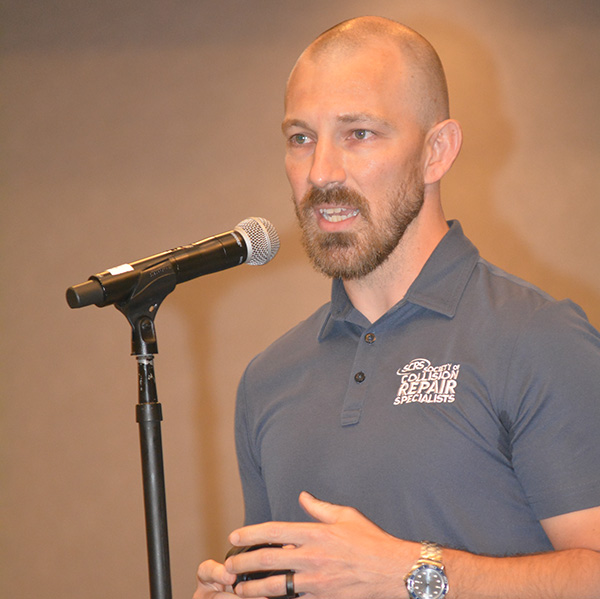 State Farm Property and Casualty Claims Director Ed Mondragon exclaimed from the audience that Bradhaw’s comments “encroached on anti-trust,” though ultimately the claim was denied as having been in violation.
Bradshaw shed light on the tactics of the carrier’s centralized review team, which “removes countless operations without discussion with the body shop, review of the proper documentation or without explanation or names of the individuals on the central review team” following the initial inspection with the carrier’s appraiser. These tactics lead to supplement after supplement, resulting in a 45-60 day process.
Bradshaw presented a challenge to the industry: “We are seeing a systematic approach to devalue the repair and omit required operations, placing consumers in vehicles that are far less safe than they were prior to the accident. If we can’t engage as a body and call out this conduct, why are we here? What are we doing to move the needle forward?” Then to Mondragon, he stated, “I have copied you on emails and I would love to have a conversation with you without having to come to the open mic to bring this to attention.”
The scope of the podcast-style “Industry Experiment” segment between Society of Collision Repair Specialists (SCRS) Executive Director Aaron Schulenburg and Opus IV CEO Brian Herron examined the role of identification or “scrubbing” tools in the ADAS diagnostic and calibration space, how OEM procedures fit in and how the industry is embracing it all.
Herron commented that “collision repairers are the center of Opus’ universe.” Explaining what the company set out to do initially, he noted, “The problem that we were originally trying to solve was to help the estimate writer identify things that maybe they were missing and bring to their attention.” When asked how consumers and insurers fit into the equation, Herron shared that consumers most likely are unaware about what goes into a repair. He explained that the company’s relationships to insurers developed on behalf of their sole focus – repairers. “Our approach was to help our repair shops with OEM scans so our conversations with carriers had to do with helping them understand why OEM scanning is necessary.”
Body filler may have evolved in modern times, but the mindset to carry out these techniques has not necessarily followed suit. On behalf of the Repair Process and Procedures Committee, Co-chairs Kye Yeung (European Motor Car Works; CA) and Barry Dorn (Dorn’s Body and Paint; VA), were joined by Ricky Miller (3M), George Smith (SoCur) and Emma White (KECO) to chisel away at some of the wrongdoings in favor of meeting standards.
Dorn suggested the industry should be past this point and more awareness is needed to get repairers on board with best practices. “One of the problems is that technicians think they need to get things done quickly so they can get it to the painter,” Yeung suggested.
Panelists considered the role of training and if discrepancies in that area have indirectly passed along bad habits. They also considered the use of new tools. White explained there is a cultural shift for those who embrace the modern non-invasive Glue Pull Repair (GPR) technique. “It’s not difficult, but it is different and training is absolutely necessary.” Panelists expressed that change is hard. “Technicans may not like the idea of changing their habits,” Miller observed.
On behalf of the Estimating & Repair Planning Committee, Scott VanHulle (I-CAR), Mark Fincher (CCC Intelligent Solutions) and Raj Pofale (Claims Genius) considered how technology is taking photo estimating to the next level. Photo estimating was never intended to replace blueprinting; it’s designed as a replacement for the intake process to get that initial estimate, VanHulle relayed.
Advanced tools are improving accuracy but panelists suggested that human interaction will remain necessary. “There will always be a gap; it won’t be 100-percent accurate,” observed Pofale. “There are thousands of parts on a car so a human will always need to come look at it.”
“It can’t guess things that it can’t see and that’s why human involvement and full disassembly is key,” Fincher added.
Don’t miss out on the next CIC set for Wednesday, July 22 in Chicago/Schaumburg, IL. For more information, visit ciclink.com.
Want more? Check out the June 2026 issue of New England Automotive Report!