
MABA Community Learns How to Make More with Less Cars
by Alana Quartuccio
Running a collision repair facility in 2026 is nothing like the way it was done decades ago. It’s incomparable.
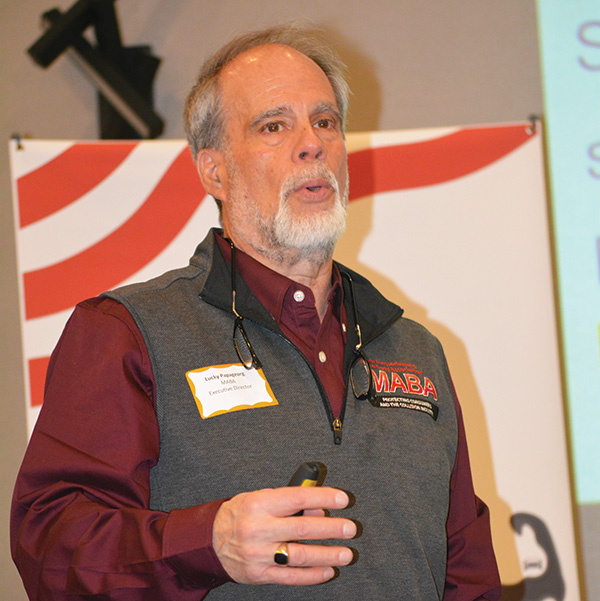 In the words of Mark Olson (Vehicle Collision Experts) during MABA’s Spring General Membership Meeting: “You can’t run a body shop the same way you did in the 1980s. If you have a sign that says you fix all domestic and foreign vehicles, you are going to go out of business.”
Commonwealth collision repairers filled the room at the Courtyard Marriott in Marlborough in April for the first newly re-branded MABA meeting to hear from Olson, whose “Less Cars Make More Money” presentation encouraged them to figure out their current path in order to project a more successful future.
“In order to know where you are going, you have to figure out where you are,” he suggested.
Olson pointed to various considerations: Do shop owners truly know their numbers, or are they falling for a disbelief that they are doing great while overlooking potential potholes? Or perhaps the problem with finding good help is that they are hiring the wrong people.
He got them to think about the future. Exit planning is a necessity. “Do you even know how much you need to retire?” he queried. One must build what Olson calls “a golden parachute” so they don’t wind up like Olson’s own father-in-law, who had to work at age 85 just to pay for his much-needed medication because he failed to plan early on.
Olson shared that he is not anti-DRP, provided this type of work makes up less than 30 percent of a business. “If your shop is more than 30 percent DRP, you are a discount body shop.” He also championed OEM certifications as long as it makes sense for one’s market. Business owners need to study their market and invest only in the car brands most seen in their area. A Subaru certification program won’t work for a body shop in El Paso, Texas, where there’s mostly Chevy, Ford and Dodge trucks, but it would make sense in Massachusetts where Subaru vehicles are seen everywhere.
“Know what is in your market and you’ll make a lot of money. There is money to be made in any brand if you can specialize in it.” Holding the certification is one thing, but it won’t go very far if the shop doesn’t market this specialization, Olson advised. Business cards should state the shop is OEM certified and whoever answers the phone at the shop should be able to promote certifications to the customer.
“If I call your shop and tell them I just wrecked my Nissan Sentra, will the person who answers tell them the shop is Nissan certified? If the answer is no, maybe some training is needed in that area.”
AI technology continues to evolve so repairers need to be mindful that it can play a dangerous role in how it affects the collision repair landscape. “When you send in your estimates with line notes citing DEG queries, no one reads it. Why? Because it’s all being done with AI. You are dealing with a computer, not a human being.”
Documentation is still key in order to back up everything that was done, however repairers need to be aware that they may be indirectly teaching AI bad practices if they agree to take an adjuster’s suggested one-line concession in a certain amount to come to an agreed price. “When you take a concession line, you leave no evidence of what actually happened [in the repair process]. They heat map it. If the estimate says four hours to fix a fender, when you really need eight hours, you are training AI to give you bad information in the future.”
According to Olson, many shops tend to weigh “how much?” versus “how to?” when it comes to fixing vehicles, something he says is not going to go over well in the long term.
“The only difference between two repairs is what the shop chooses to do for free. There is only one way to repair a vehicle.”
Also, Olson says one repairer can’t realistically know how to fix everything. He encouraged them to ”find your niche.”
The cost of turnover is huge in the workplace, so it’s important to find the right workers and put them in the roles they are best suited for. Olson encouraged all to get to know their staff and try to understand their personality types and their generational differences to improve communication in the workplace.
It all comes down to understanding the difference between the Golden Rule of treating people the way you want to be treated versus the Platinum Rule of treating people the way they want to be treated. “You have to know who they are. Know their generation and how they want to be treated. Know their personalities and how to talk to them. And then people will trust you.”
Olson got the audience to think about enlisting new strategies to go about negotiation strategies by taking the telling out of the picture in exchange for asking an insurer straight out if they will pay for things.
“You may wind up fixing less cars, but you will make more money with the cars you fix.”
Want more? Check out the June 2026 issue of New England Automotive Report!