
WMABA School Profile: Northern Virginia Community College
by Chasidy Rae Sisk
Maturity is an important trait to possess when working in a collision repair facility.
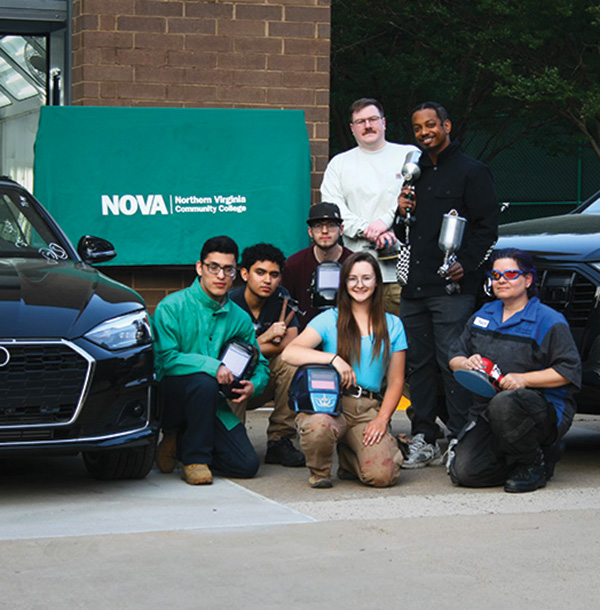 Safely repairing a customer’s vehicle according to OEM requirements, communicating effectively and compassionately, accepting accountability and demonstrating a high level of ethics and dependability all factor into an employee’s success…and the success of the business.
Through the thoughtful structuring of its collision repair program, Northern Virginia Community College (NOVA) attracts a more diverse student population while offering a schedule suited to individuals with greater maturity and life experience. While some students have transferred to NOVA after graduating from one of the three vocational high schools in northern Virginia, the school’s primary demographic is comprised of students who did not previously have the opportunity to study collision repair.
“Although we do get some students out of high school, we have students of all ages, some looking for a career change as well as a few students who are exploring the option of joining the collision repair industry for their first career,” shares NOVA Collision Repair, Refinishing and Welding Instructor Warren Barbee.
“It’s not uncommon to see students over 25 and even in their 30s or 40s enroll in our collision program,” adds NOVA’s Automotive and Collision Program Head Laura Garcia. “Often, they’ve explored different career paths and are ready to change, so there’s a level of commitment involved because they’re highly motivated to create a better life.”
Because NOVA attracts a more mature student base, classes are scheduled in the evenings and on weekends to accommodate students’ work schedules. Full-time students graduate from the program in one year, while part-time students typically finish the program within two years, earning their Collision Repair Career Studies Certificate.
“Our schedule and course list is designed to ensure that students receive the required amount of hours to gain a level of proficiency expected of technician apprentices,” Garcia explains. “The majority of our students are employed, though not necessarily in collision repair, so part of our mission is to convince them to transition into the field, but it can be challenging for them financially, especially for those who are supporting a family.”
Utilizing the I-CAR Academy curriculum, NOVA’s collision repair offerings cover estimating, refinishing, basic metal operations, welding and structural repairs. According to Garcia, “Offering the full suite of collision training to students allows them to explore the different specialty areas and find their place in the shop.” However, despite the many ways in which the school offers flexibility, the program stands rigid in one aspect: safety.
“Introduction to Collision Repair” is the program’s safety course. “We review safety protocols and practice safety in this lab-based course which is designed to teach students of ALL ages to be ‘shop-wise,’” Barbee stresses the importance of building that foundational knowledge first. “Students in this class gain familiarity with vehicle materials and the tools we use, learning a bit about shop competency before we move into anything technical or complex. Many of our students have absolutely zero previous experience and no hands-on skills. To ensure their safety, it’s imperative that we start with the basics, which is why this class is a prerequisite/corequisite to all other collision classes.”
In addition to ensuring students receive training in foundation skill sets, NOVA’s instructors strive to enhance the quality and quantity of collision repair technicians in the field through its collaboration with local employers. “We speak often about the employment opportunities available in collision repair in all classes,” Barbee says. “We want to establish realistic expectations of what they’ll experience in the field, and our partnerships with local employers plays a key role in doing that effectively.”
“We actively recruit shop partners to participate in the development of our students while they’re in school through job shadowing, internships and job placement opportunities,” Garcia stresses the importance of these relationships. “Having industry partners who care makes a huge difference. When someone from the industry comes in, speaks with students and offers them employment, they know they’re on the right track. Students need this continual assurance to know they’re on their way to something greater than when they started as many are looking for certainty in an uncertain world. Industry members who know how to lead entry-level technicians recognize that the bigger picture is huge.”
Students enrolled in NOVA’s Collision Damage Estimating course are required to complete a mini-internship. “We always hope those internships will lead to an offer of employment, and they often do,” Barbee says, acknowledging that employers who actively engage with the program are likely to receive the first pick of his graduates. “If any students ask for employment help, we provide guidance on which of our Premier Employer partner shops are in their commuting area. We’re always looking for more shops to partner with us to enhance our program that will fuel a pipeline of new talent.”
Garcia suggests, “One of the best motivators for students and the best job placement opportunities come from our micro internships where students spend a few days of the semester in one of our partnering employer shops. Industry professionals can also help by teaching one of our classes! Students are most influenced by our part-time instructors who are active in the field they want to be in. There’s a deep level of trust and influence built when students know they’re being mentored by someone who has the experience doing the job they’re looking to do. Many experienced technicians today can relate as they also once had someone training them to be successful, and now, we provide an opportunity for those experienced technicians to convey their technical lineage to dozens of students each year who will go on to work at many shops here in the area.”
Another essential way industry professionals can ensure they’re doing what’s necessary to support the future workforce is to volunteer on NOVA’s advisory board. “There’s a continual need for new members on our advisory board to stay up to date and ensure our local industry is being heard,” Barbee reports. “We have some of the best minds on our current advisory board who have a high level of dedication and passion for our industry who serve with us regularly. Although our meetings are focused on improving the program to create students with a strong skill set, there’s a huge benefit for these employers to connect with each other, collaborate and inspire. We cannot thank our advisory members enough as our program is only successful because of them.”
“NOVA has a high regard for advisory boards,” Garcia praises those who contribute their time and energy to supporting the program in this way. “Any time an advisory board makes a recommendation to the college, the college follows through whenever possible.”
In fact, NOVA’s collision program would no longer exist without the influence of local industry professionals! Only a few years ago, the school planned to close the program. Fortunately, Garcia saw the potential for the collision repair program to grow and be successful. “I didn’t think closing it was a logical decision; we know there’s a need for more collision technicians, but we had to prove to the college that there was a need.”
That’s when WMABA stepped in to assist. WMABA’s leaders connected Garcia with local employers who helped convince NOVA’s administrators that this program was vital. “WMABA, WrenchWay and the local industry saved collision repair at NOVA. Instructors can compile research and present data, but without local employers who are willing to support the program, there is no program.”
Garcia applauds WMABA for its “unwavering support to all the schools in the area.They’ve been with us helping to score scholarships, grants, components and even vehicle donations! They understand how important technician training is, and with NOVA’s collision repair program being the only post-secondary school in Northern Virginia, they recognize how important this program is now and how valuable it can become for their members, the collision repair industry and our region.”
That ongoing support has allowed the program to sustain itself, but growth has been limited due to space and lack of part-time adjunct instructors. “Thankfully, the college is ready to renovate our space this summer to expand our program, but we are in need of additional part-time instructors to strengthen our enrollment,” Barbee says.
Of course, instructors understand that repairers are “busy running their shops, but a little bit goes a long way,” Barbee encourages. “We’ve been grateful to receive connections to other shops, suppliers who are willing to donate parts and materials and assistance from our board in completing surveys to help us apply for grants. The time commitment is attending one advisory meeting every semester, but since we are in the phase of ramping up for our grand re-opening after the renovations are complete, we are meeting more regularly to ensure our programming and curriculum is as cutting edge as our facilities.”
Shops should see it as an investment in their future, Garcia urges. “We’ve all seen what happens when investment in a critical area of a business ceases. Education and training is a cornerstone of any industry and must be done to stay afloat. The wonderful thing about partnering with a community college is that we can tailor our training to fit the industry at an extremely low cost. Furthermore, with a strong advisory board, all things are possible including building registered apprenticeships, embedding certifications and just about anything else you can imagine. The key is to work together to design a training system that makes it worth the investment, and we can do that. And we continue to work with you after you hire one of our graduates…once you have one of our students, we work alongside you to grow the student into the technician you need. That is what we’re here for at the end of the day.”
Want more? Check out the May 2026 issue of Hammer & Dolly!