
A Leader’s Leader: Jeff McDowell Retires After Five Decades
by Alana Quartuccio
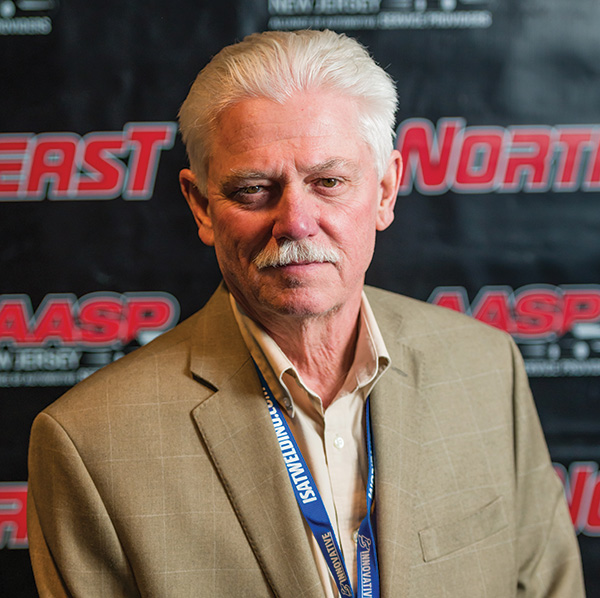
If you’ve had your hands in some form of collision repair over the past five decades, chances are you have encountered the one and only Jeff McDowell somewhere along the way. From laying the bricks to establish (and lead) AASP/NJ and nurturing the growth of the NORTHEAST® Automotive Services Show to running a successful collision repair shop in Leslie’s Auto Body (Fords) – not to mention simply being a dedicated leader and friend – there isn’t much McDowell hasn’t had a role in. Now, after five decades in the auto body industry in the Garden State, McDowell has decided to close up shop. He may have left his business behind, but McDowell isn’t showing any signs of actually stepping away entirely from the industry he has devoted his life to. The former AASP/NJ president graciously sat down with New Jersey Automotive to reflect on the past and share what is to come next.
 New Jersey Automotive: How is retired life treating you so far?
Jeff McDowell: It’s only been a few weeks so far. I’m staying busy. It’s not all that it’s cracked up to be, though, when you’ve been working all your life.
NJA: When did your love for or interest in cars first begin?
JM: I first started working in a body shop in 1967…
NJA: What led you there?
JM: I was poor, and I needed money (laughs).
NJA: Tell us what your introduction into the body shop world was like.
JM: I started at 11 years old, working as a helper, cleaning up and putting tools away. From there, I stepped up to learn how to mix paints, and I helped with odd jobs around the shop. We did a lot of work with tractor trailers back then. It was my job to paint the wheels. I stuck with it as I needed money. Eventually, I learned the craft of collision repair. By the time I was 16 years old, I was a full-fledged painter doing complete paint jobs, and we did a lot of paint jobs back in the ’60s. The guy I was working for became hospitalized and closed up his shop, so I went to work for another shop, and they taught me how to do bodywork and frame. In the old days, we used to call the guy who could do everything a combination man. Nowadays, everyone has a specialty, like body man, painter or metal man. Back then, the top guy did everything. That’s the way I came up, and that is the way I learned.
NJA: When did you decide to open your own shop? How did that play out?
JM: When I was 18, I went off to the Navy and served for three years. When I got discharged, I went right back to the body shop. I was discharged on a Friday, and I was back in the body shop that following Monday morning. I didn’t take any time off. I continued to work in the body shop a couple more years and then left to work for a dealership body shop. I was born and raised in Staten Island, but at that point, I had moved to New Jersey. I was working for a dealership in Manasquan, and that’s when I met my wife. Once we were married, we lived in Edison. I had a fairly long and monotonous drive going to Manasquan every day that was making me fall asleep in the car. So, I decided to look for work in the Woodbridge area to be closer to home, and I got hired by Leslie’s Auto Body. At the time, I didn’t have any interest in opening a shop. The opportunity presented itself a couple years later when my boss made the decision to sell the shop and move to Colorado to open a motel. So, I bought the shop with a partner at the time, and 42 years later, the rest is history.
NJA: You’ve obviously been very active with AASP/NJ all these years. What first got you involved with the association, and what was the first association you started with?
JM: It was 1983 when I first joined the auto body association. At that time, it was the Central Jersey Auto Body Association. I was always interested in learning and went to classes. But 1983 was the year that the state of New Jersey decided to get the infinite wisdom that they’d like to get several hundred dollars out of us every two years for a license, so every body shop had to get a license. Of course, that pissed me off. I joined other people who were also annoyed that there was now an auto body license we had to pay for, and that is when I started going to the auto body association for more information. In the beginning, we tried to fight the license, but there was no fighting it. When it started, there were no real requirements for getting a body shop license. So we went back to the state after several years to point out the fact that, by licensing us, it’s a guarantee to the consumer that we have credentials and ability to do this type of work so there should be some regulations that go with the license for a person to get a license for their shop. Over the next couple years, we sat down with the state and actually wrote the regulations for what is needed to become a licensed body shop – you have to have continued education, a minimum amount of equipment and equipment specifications. We put all that into the regulations. Once we did, there were unlicensed shops that the fraud department had to go after to close down or enforce that they get a license. That was the beginning of it with the Central Auto Body Association. Of course, there were actually four associations at that time.
NJA: How many positions did you hold over the years?
JM: There is not a position in the associations that I have not held. I served as fundraising chairman. Many of the events AASP/NJ conducts now are things I created, like the annual golf outing. We used to hold an annual dinner dance and a night at the races. I also was the time study chairman. Before we had what is now the Database Enhancement Gateway (DEG), we had books from MOTOR or Mitchell, and I would do a time study on a particular operation and get them to change the manual if the times were wrong. I served as a board member on all the associations I’ve been involved with since 1983.
NJA: Eventually, the four associations came together as one which eventually became AASP/NJ. How were you involved in that?
JM: Four associations at the time – the Central Jersey Auto Body Association (CJABA), the South Jersey Auto Body Association (SJABA), the Automotive Service Association of New Jersey (ASA/NJ) and Greater Northwest Auto Body Association (GNABA) – would meet to discuss the idea of becoming one big group to have more power by being all under one roof. This is the short version of the story, by the way, as I can probably write a book about this. We tried to come to terms with all of our resources and expertise in different areas. Everyone had something to bring to the table. ASA/NJ had the NORTHEAST show, CJABA had good political contacts, and GNABA had a fair amount of collision and mechanical shops in their membership. ASA/NJ decided not to merge with the other groups and stayed separate. Eventually, the other three groups came together under the same banner. A year or two after becoming the Garden State Automotive Federation, we found out there was another group that had registered the same name, so we had to change the name. At this point, many states began to move away from ASA, and the Alliance of Automotive Service Providers (AASP) was founded. At that time, we had completed the merger with ASA/NJ and needed a new name, so we became an affiliate chapter of AASP, and that is how we became AASP/NJ.
NJA: What are some of your favorite memories of all the years you’ve spent with the association?
JM: The camaraderie between the shops was a lot different back then than it is now. In your local area, you probably knew all the shops around you, and everybody was friends. Now, everyone has their head down, going full speed ahead and trying to make some money. We had more in-person events back then. The fondest memories I have are of all the other guys I was friends with who are no longer here. There was always someone you could reach out to and call to say, ‘Hey, I’ve got this problem. Can you help me out?’ We tried really hard to get things accomplished for the industry. Some we did, some we didn’t.
NJA: How long did you serve as president of AASP/NJ?
JM: Eight years, and I was treasurer for 16 years before that.
NJA: You’ve been such a huge part of the growth of AASP/NJ’s NORTHEAST® Automotive Services Show. During those early days, did you think it’d become as big as it is now?
JM: Nobody did. I always went to the show, even though I was part of a different association when ASA/NJ ran it. I knew a lot of the guys who ran the show then, as they always came to our dinner dance events. Over the years, I probably only missed going to the show one or two times. Some of my favorite things about NORTHEAST is the opportunity to see all the guys. The Leadership Meeting is an opportunity to interact with guys from other state associations like Rhode Island and Pennsylvania. Ron Reichen comes from the West Coast. Those are the moments from the show that I always feel most strong about. I’m happy to be involved with it all.
NJA: You’ve been involved with AASP/NJ for decades. What are your thoughts on the association after all these years?
JM: It’s harder to get shop owners moving in the same direction today as it was in the past. That’s a real challenge. And membership might be down, but that’s the way it is for all organizations like the VFW or the Elks. It’s become harder to get people to participate. Their lives are so busy, and they have so much on their plate. I know we’ll continue to be successful, and I hope that we’ll be able to make some headway with some of the insurance issues the shops are dealing with. We’d like to be able to just flip a switch and make things better for all the shops in New Jersey, but it’s just not that simple.
NJA: What are some of the biggest changes you’ve seen in the industry through your career?
JM: Technology. It’s always been technology. I remember a ‘big change’ that was industry altering was when they first came out with the mig welder. Now, look at the technology we are dealing with – ADAS, Lidar and all these things that are in the vehicles now. Another big change is when we went from handwriting estimates out of a book to computer-based estimating. Changes are always happening whether its equipment or procedures. You have to stay up on that. That’s one thing the association has always been good at providing for members, making them aware and having the information and education available.
NJA: In addition to cars, you also have a love for civil war weapons. How did you get into that hobby?
JM: I was always a camper. I happened to be camping in South Jersey when a buddy of mine who lived in Virginia told me about his Civil War shooting competition and asked me to come to check it out. So I did, and now 41 years later, I am still doing it.
NJA: Will retirement life give you more time for this hobby and others?
JM: It should! People get confused about what it is I actually do with the North-South Skirmish Association. It’s not a re-enactment. We compete by shooting Civil War weapons. Each team represents an original unit that served during the Civil War. Our uniforms are basically a living history, but we don’t run around the woods pretending to shoot each other; we shoot for a high score. And we shoot every weapon that was used in the Civil War, like cannons and rifles.
NJA: What will you miss most about daily shop life?
JM: First of all, I loved to work. It was my craft. Body repair is my craft, and I was somehow given an innate ability to learn how to do it…and do it well. I’ll miss that. Newer vehicles aren’t as much fun. It’s all more technical now. Fixing and painting a piece of metal is like doing something artistic. Reading data sheets on the computer and making repair plans must be done, but it’s not my craft. My craft is doing and fixing.
NJA: What will you miss the least?
JM: The insurance companies.
NJA: As an industry veteran, what advice would you give to anyone looking to launch a career in auto body?
JM: Starting a business today can be very challenging. But there are plenty of jobs out there. You can make a good living doing it. I’ll give you a quote from the first guy who taught me to do body work. I was 16 years old at the time, and he said, ‘Kid, you’re going to spend more time here than you will with your family. Now, I guarantee you, if you learn this trade and learn it well, you’ll never be without a day’s work in your life.’ He was right. I have never been without a day’s work in my life.
NJA: What is one thing a life in collision repair gave you that you’d not have if you chose a different career path?
JM: As a tradesman, I don’t know if I could have risen to the level of being able to be of service if I was in a different field. I am passionate about collision repair, and I’m passionate about the guys in the industry, and that is what drove me to participate as much as I did in having the association grow. That’s what gave me the opportunity to contribute to others.
Want more? Check out the January 2026 issue of New Jersey Automotive!