
AASP/MA Members Gain Value in Total Loss Talks
by Alana Quartuccio
The phrase “you don’t know what you don’t know” is especially true in the complex collision repair industry.
 Whether it’s keeping up with the latest technology and training, looking up OEM repair procedures or learning about processes and resources to help battle the day-to-day challenges, auto body professionals need all the knowledge they can possibly get.
Collision repairers from all over the Commonwealth gathered for AASP/MA’s October General Membership meeting at the Doubletree Hilton (Westborough) to soak up as much information as possible about how to retain control when it comes to total loss claims – an unsettling and growing nationwide trend.
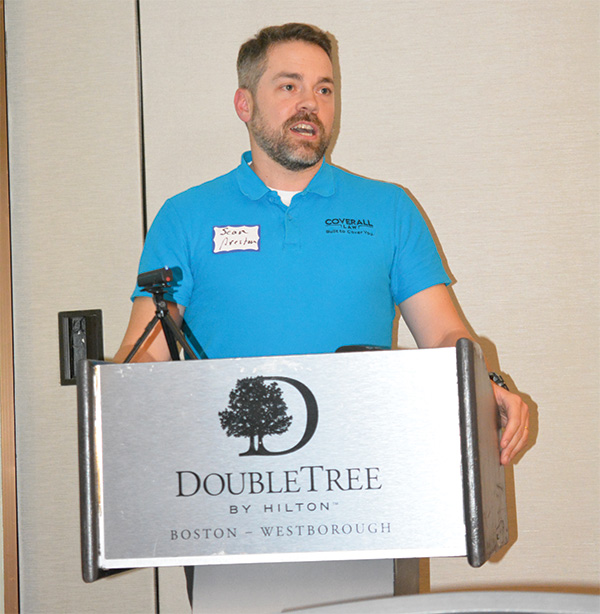
The Alliance welcomed attorneys Erica Eversman (Vehicle Information Services) and Sean Preston (Coverall Law) who opened doors to a whole new world of information on how to manage total loss claims.
Eversman made it clear that she is a consumer advocate. She serves as the consumer liaison with the National Association of Insurance Commissioners (NAIC), a position she’s held since 2019 that makes her “extremely fortunate because I’ve learned a lot of things in addition to being able to provide information. The position allows me to advocate on behalf of consumers and explain to the insurance commissioners what is working and what is not working for consumers, particularly in the auto insurance related area.”
She pointed out, “When I first started working with NAIC, the regulatory staff knew absolutely nothing about your issues, consumer issues and your particular area of pain,” driving home the importance of educating legislators about the industry. As opposed to the small group of 32 consumer advocates representing auto insurance with NAIC, the insurance industry has “a minimum of a thousand people at every meeting” making presentations. She stressed the need for the collision industry to do the same because “all they know is insurance went up this year. Everybody is screaming about premiums. The insurers use that hysteria to manipulate the regulators.”
Regulators need to be made aware of what’s going on, and one way to do that is by drawing their attention to “a number of class action lawsuits currently in play across the US about allegations that insurance companies are in concert with the database providers – CCC, Audatex/Solera or Mitchell – to have deliberately and systematically figured out a way to program the systems to undervalue total loss claims.”
When cases like this are successful, “it can really impact regulators” to step in and take some type of action.
And it’s important for shops and consumers to be aware of these legal actions because “you are the ones who are obviously losing business because of these total losses, and the consumer loses because the insurer won’t pay them the sufficient and appropriate amount to allow them to replace their vehicle.”
Shops can help consumers by encouraging complaints be sent to the Department of Insurance and to perform research into the true value of their vehicle by way of sources like Kelly Blue Book.
“If you don’t know how this specific industry works, you don’t know [insurance companies] are pulling the wool over your eyes,” she stressed about the lack of industry knowledge regulators have.
Discussion also included diminished value as regardless of how well the vehicle was returned to its pre-accident condition, any alteration to the vehicle could decrease its value.
“How can we control the situation to provide the best monetary benefit for ourselves?
Educating your consumers is critical, as well as educating your regulators and educating your legislators. Become a cohesive force that says ‘this is wrong; Massachusetts consumers are being taken advantage of.’ Insurers are supposed to be the experts, so they should be figuring out what the premium is to ensure the correct vehicle value.”
Preston illustrated a deep dive into what is happening with total losses, how they are calculated and what areas to focus on most when advocating for customers.
In Massachusetts, total loss is determined by an equation that looks at “the appraised cost of repair plus estimated salvage. And if that’s in excess of the actual cash value (ACV), the insurer may deem it a total loss.” ACV minus salvage gives “the max repair cost before the insurer may total. If the cost of repair plus the salvage is more than the ACV, it could result in a total loss. A lot of this is at the insurer’s discretion, and they have a lot of wiggle room, so it is and will continue to be a problem.”
Preston examined what steps are and are not considered parts of the repair. For example, ADAS calibrations may not be unless an actual sensor was damaged, needs to be replaced and is indeed part of the repair cost. “In parts seven, eight and nine of a standard Massachusetts insurance policy, it says ‘we will also pay reasonable and necessary expenses for towing, recovery and storage.’ So, that’s not part of the cost of repair. That’s not part of the loss. That’s extra. If they have a rental policy, that’s extra. The three terms that we look at are the cost of repair, the salvage value and the ACV. We work with the hand we are dealt. These are the three areas that we can attack if we’re advocating for our customer’s benefit.”
Consumer protection can also lie in the form of the Right to Appraisal (RTA), which exists in most insurance policies and provides vehicle owners with an alternative dispute resolution without the expense of hiring an attorney to fight for an $800 loss discrepancy, according to Preston. With RTA, each side picks an appraiser and then chooses a “competent and disinterested umpire” if they cannot agree on the repair costs. If the parties can’t agree on an umpire, they will seek a judge to select one. “They are supposed to appraise the loss at a time and place convenient to them, both separately stating two things – the ACV at the time of loss and the amount of loss. The amount of loss is not the cost of repair. The amount of loss encompasses the cost of repair and then some. If they fail to agree, they submit their differences to the umpire.”
Circling back to the point about the need to educate the consumer, Preston told repairers, “You always want to involve the customer. Everything we do at Coverall Law with the Forever Forms, we’re trying to legally put you and the customer on the same side of the table with the insurer on the other side.”
He cited an example where his firm was able to seek RTA without even involving a customer. “We had an insurer that has continued to abandon total loss vehicles enough times that we wound up with seven or eight of the same cases. The cool thing is that there’s just so much built into our forms that we were able to bring it seven or eight different ways. The vehicle was a total loss, the customer already paid and gone, but the vehicle remained at the shop. We were able to invoke RTA as we had assignment of rights for every single repair.”
Preston stressed that he doesn’t want to see shops “spending $30,000 to $50,000 in litigation. I want to spend much less than that if we can on something that’s going to benefit everybody.” He also pointed out, “Not only do regulators not understand the industry, judges do not either, so you have to keep things as simple as possible.”
Eversman and Preston were joined by Steven Goldstein (Coverall Law) for an interactive question-and-answer session that covered various topics raised by audience members.
AASP/MA members in good standing can purchase a recording of the meeting via the Members Only section of aaspma.org.
Want more? Check out the December 2025 issue of New England Automotive Report!